

B-hPD-L1 plus/hCDH6 MC38

NA • 322534

B-hPD-L1 plus/hCDH6 MC38

Product nameB-hPD-L1 plus/hCDH6 MC38
Catalog number322534
Strain nameNA
Strain backgroundC57BL/6
NCBI gene ID60533,12561 (Human)
Chromosome19, 15
AliasesB7h1; Pdl1; Pdcd1l1; Pdcd1lg1; A530045L16Rik; Rcad; R-CAD; R-Cadh
TissueColon
DiseaseColon carcinoma

このページで

  • Description
  • Phenotypic analysis
  • Tumorigenicity

ポスター

すべて表示

    出版物

      Description
      • Origin: The MC38 cell line is derived from C57BL6 murine colon adenocarcinoma cells. The cell line is a commonly used murine model for colorectal carcinoma.
      • Background Information: PD-1 (programmed death receptor-1) is an immune checkpoint protein on the surface of T cells. When it binds to its ligands (PD-L1/PD-L2) in the tumor microenvironment, it suppresses T cell activity, leading to immune evasion. CDH6 (Cadherin-6), also known as K‑Cadherin (renal cadherin), is a type II classical cadherin within the cadherin superfamily. It plays a key role in cell‑cell adhesion, tissue development, and tumor progression. It is a highly expressed and well‑characterized target in a variety of refractory solid tumors, especially ovarian and renal cancers. CDH6‑targeted therapies hold promise for offering new treatment options for cancer patients with limited effective therapies.
      • Gene targeting strategy: The exogenous promoter, human PD-L1 and luciferase coding sequences were inserted to replace part of murine exon 3. The insertion disrupts the endogenous murine Pdl1 gene, resulting in a non-functional transcript. The exogenous promoter and chimeric human CDH6 coding sequence were inserted to mouse genome randomly.
      • Tumorigenicity: Confirmed in wild-type C57BL/6 mice.
      • Application: The B-hPD-L1 plus/hCDH6 MC38 tumor models can be used for preclinical evaluation of monoclonal antibody drugs and bispecific antibody drugs targeting human CDH6 and PD-1/PD-L1, as well as for combination therapy with CDH6-targeting ADC.
      • Notes:

      Inoculated cell lines can be suspended with DMEM stock solution.

      Before implementing the project, it is recommended to perform tumor growth experiments. The recommended cell inoculation amount is between 5E5~1E6.

      In the experiment, it is necessary to ensure that the number of animals inoculated subcutaneously is at least 1.6 times the actual grouping number.

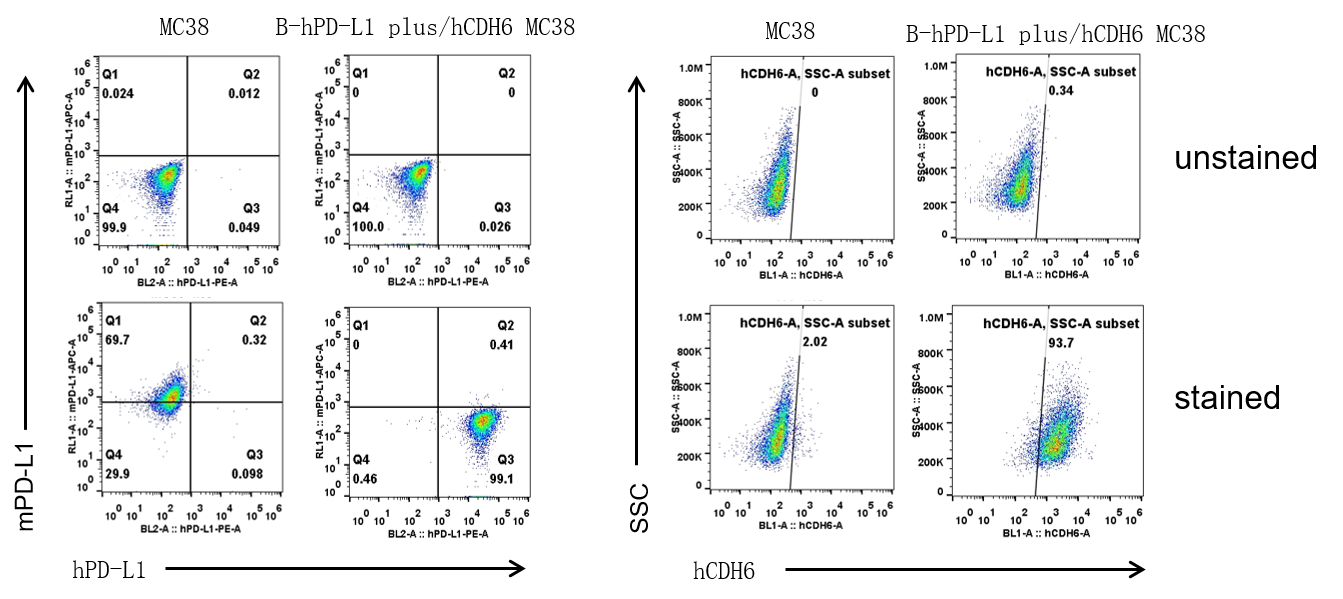
      PD-L1 and CDH6 Protein Expression Analysis
      • Human PD-L1 and CDH6 were detected on the surface of B-hPD-L1 plus/hCDH6 MC38 but not wild-type MC38 cells.
      • Mouse PD-L1 was detected on the surface of MC38 cells but not B-hPD-L1 plus/hCDH6 MC38.

      PD-L1 and CDH6 expression analysis in B-hPD-L1 plus/hCDH6 MC38 by flow cytometry. Single cell suspensions from wild-type MC38 and B-hPD-L1 plus/hCDH6 MC38 clone 1-D07 cultures were stained with anti-mouse PD-L1 antibody (Biolegend, 124312), anti-human PD-L1 antibody (Biolegend, 329706), and anti-human CDH6 antibody (R&D, FAB2715G) .


      Tumor Growth curve & Body Weight Changes

      Subcutaneous tumor growth of B-hPD-L1 plus/hCDH6 MC38 cells. B-hPD-L1 plus/hCDH6 MC38 (5×10⁵) and wild-type MC38 cells (5×10⁵) were subcutaneously implanted into C57BL/6 (female, 14-week-old, n=6). Tumor volume and body weight were measured twice a week. (A) Average tumor volume. (B) Body weight. Volume was expressed in mm3 using the formula: V=0.5 × long diameter × short diameter2. Results indicate that B-hPD-L1 plus/hCDH6 MC38 cells were able to establish tumors in vivo and can be used for efficacy studies. Values are expressed as mean ± SEM.

      Subcutaneous tumor growth of B-hPD-L1 plus/hCDH6 MC38 cells. B-hPD-L1 plus/hCDH6 MC38 (5×10⁵) and wild-type MC38 cells (5×10⁵) were subcutaneously implanted into C57BL/6 (female, 14-week-old, n=6). Tumor volume and body weight were measured twice a week. (A) Average tumor volume. (B) Body weight. Volume was expressed in mm3 using the formula: V=0.5 × long diameter × short diameter2. Results indicate that B-hPD-L1 plus/hCDH6 MC38 cells were able to establish tumors in vivo and can be used for efficacy studies. Values are expressed as mean ± SEM.
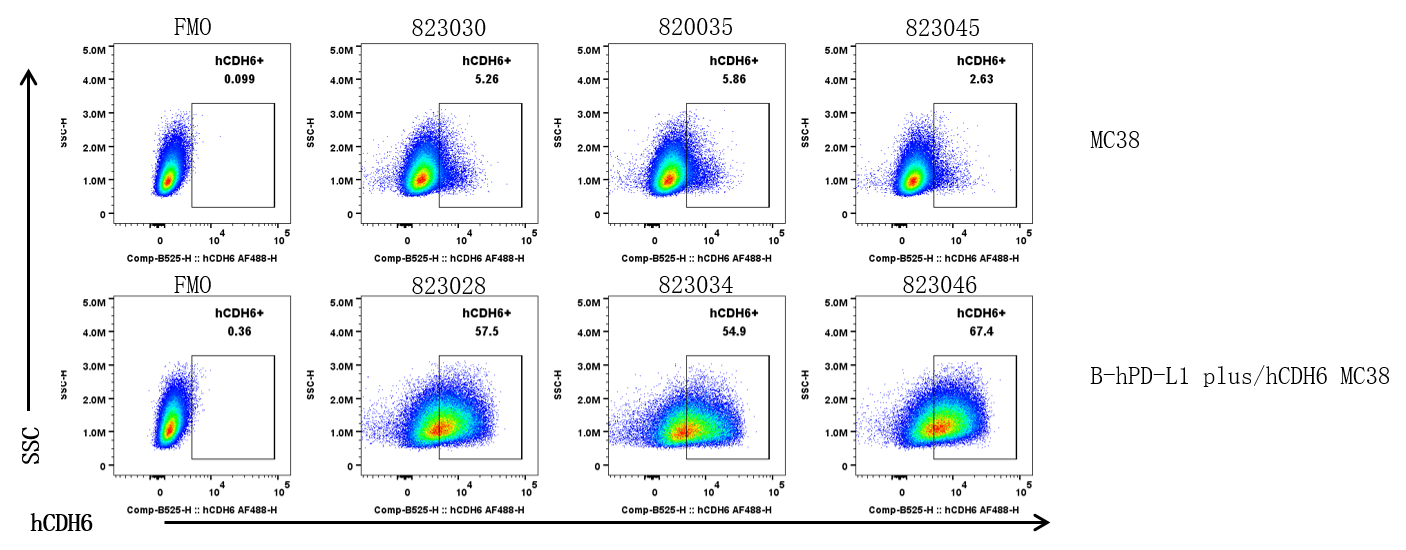
      CDH6 Protein Expression Analysis of Tumor Tissue
      • Human CDH6 was detected on the surface of B-hPD-L1 plus/hCDH6 MC38 tumors but not wild-type MC38 cells.

      CDH6 expression was evaluated​​ on B-hPD-L1 plus/hCDH6 MC38​​ by flow cytometry. ​​These cells​​ were subcutaneously transplanted into C57BL/6 mice (n=6). At the end of the experiment, tumor cells were harvested and ​​analyzed for both mouse and human CDH6 expression​​ by flow cytometry. ​​