Frequently Asked Questions (FAQs) About Bispecific Antibody Platform
1. What is a bispecific antibody, and what unique mechanisms of action does it offer beyond conventional monoclonal antibodies?
A bispecific antibody (BsAb) recognizes two different antigens or epitopes within a single molecule. This dual specificity enables novel therapeutic mechanisms beyond conventional monospecific antibodies, including: dual pathway blockade, receptor co-localization or clustering, and immune-cell redirection such as
T-cell engagers (TCEs).
2. What antibody formats and modalities does Biocytogen’s bispecific antibody platform support?
Biocytogen’s platform supports fully human bispecific, biparatopic, and multispecific antibody formats. Flexible architectures can incorporate common light chain antibodies, VHHs, scFvs and cytokines to meet diverse therapeutic design needs. In addition to unconjugated BsAbs and BpAbs, Biocytogen has also established a platform that enables selected bispecific antibody backbones to be further developed into
bispecific antibody-drug conjugates (BsADCs).
3. What are the advantages of developing biparatopic antibodies (BpAbs)?
BpAbs bind two distinct, non-overlapping epitopes on the same antigen to overcome the limitations of conventional monoclonal antibodies. Key advantages include:
- Enhanced target engagement: Achieves greater receptor occupancy and more complete ligand blockade compared with single-epitope antibodies.
- Differentiated functional activity: Modulation of receptor clustering, internalization, or signaling to enhance therapeutic activity.
For example, Biocytogen’s
BCG028, a biparatopic OX40 antagonist, leverages dual-epitope binding to reduce OX40-mediated T-cell costimulatory signaling, delivering superior in vivo efficacy in preclinical models.
4. How does Biocytogen address chain mispairing in bispecific antibody generation?
Biocytogen combines complementary engineering strategies to simplify fully human bispecific and multispecific antibody assembly:
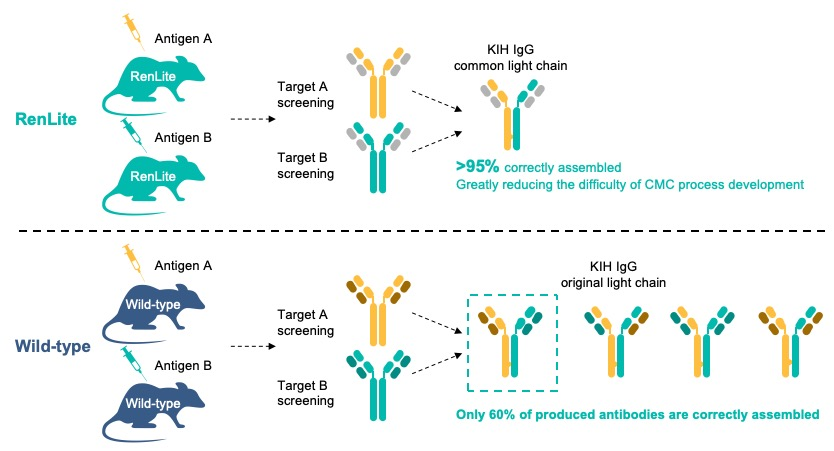
- RenLite®-derived common light-chain antibodies: Use a shared light chain to avoid mispairing between different heavy and light chains.
- Fully human VHH antibody integration: Provide compact, modular single-domain building blocks that require no light chain, reducing pairing complexity.
- Knobs-into-Holes (KIH) engineering: Applied to promote correct pairing between two different heavy chains.
Together, these approaches address distinct chain-pairing challenges, simplifying antibody assembly and supporting favorable developability.
5. How does Biocytogen discover and evaluate fully human bispecific antibody candidates?
Biocytogen uses RenLite® or RenLite® target-gene KO mice to generate fully human common light-chain antibodies. Beacon-based single-cell screening with AI-powered selection supports accelerated candidate identification. Candidates are then evaluated in in vivo studies, including target-humanized mouse models, to assess efficacy and safety with high translational potential.
6. What off-the-shelf antibody libraries does Biocytogen offer for bispecific antibody development?