
このページで

BCG051 combines a RenLite®-derived bivalent anti-GDF15 antibody with RenNano®-derived anti-VEGFA VHHs fused to the C-terminus of the Fc domain, integrating both targeting components into an engineered bispecific format.
The RenLite® common light chain design simplifies chain pairing within the bivalent GDF15-binding component, while the light chain-free RenNano® VHHs provide a compact and flexible format for incorporating VEGFA specificity. Together, these complementary platform-derived components facilitate efficient assembly and support the manufacturability and further development of BCG051.
BCG051 is being evaluated across solid tumors, with development potential in:

The comprehensive preclinical package for BCG051 demonstrates high-affinity and functional dual-target engagement, robust antitumor efficacy with cachexia alleviation across CDX and PDX models, favorable biophysical and physicochemical properties, and excellent PK in target-humanized mice. Together, these data support the strategic advancement of BCG051 as a differentiated GDF15 × VEGFA bispecific antibody for tumor control and cancer-associated cachexia.
(Representative data shown; full data package available upon request)
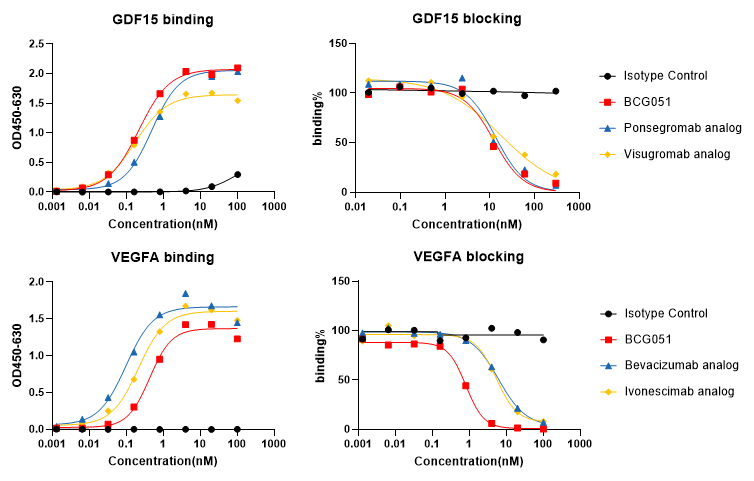
Figure 1. GDF15 and VEGFA binding and functional blockade by BCG051. BCG051 showed potent, concentration-dependent binding to both GDF15 and VEGFA, along with effective blockade of their respective signaling. BCG051 also maintained target-binding activity in the presence of the second antigen, supporting simultaneous dual-target engagement without apparent binding interference.
(Detailed SPR affinity profiles for human and cynomolgus GDF15 and VEGFA, benchmark comparisons, and target specificity across GDF and VEGF family homologs are available in the full data package upon request.)
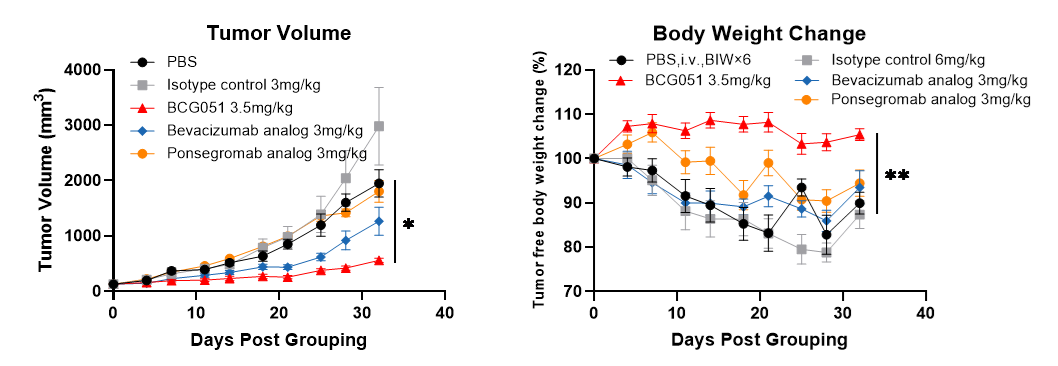
Figure 2. Antitumor efficacy and cachexia alleviation in the MKN45 gastric cancer CDX model in B-NDG MHC I/II DKO mice plus. BCG051 showed robust tumor growth inhibition while maintaining stable body weight compared with bevacizumab and ponsegromab benchmark analogs. In addition, BCG051 reduced tumor weight, preserved skeletal muscle (lean mass) and adipose tissue (fat mass), and stabilized food intake throughout treatment, supporting its combined antitumor and anti-cachexia activity.
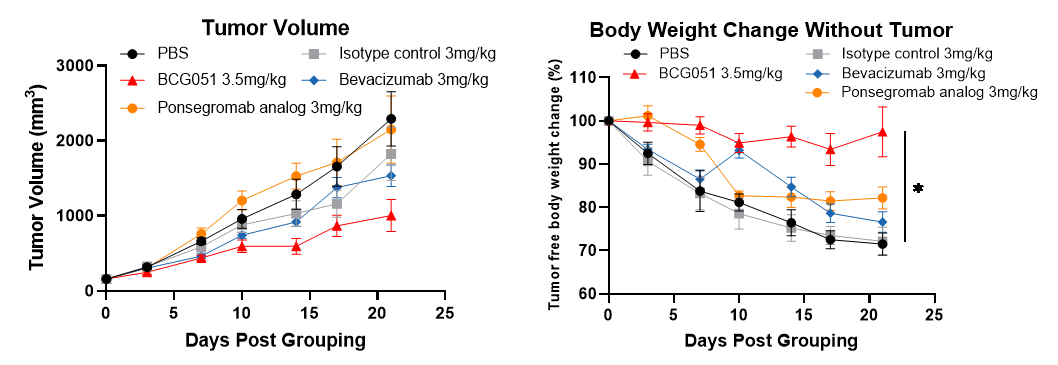
Figure 3. Antitumor efficacy and body weight preservation in an advanced patient-derived xenograft (PDX) cachexia model. BCG051 achieved superior tumor growth control compared with both bevacizumab and ponsegromab benchmark analogs in tumor-bearing mice. In addition, BCG051 mitigated disease-associated weight loss, reduced tumor weight, and stabilized food intake, demonstrating broader therapeutic benefit than single-agent targeting.
(Comprehensive developability data, including favorable biophysical properties, physicochemical stability under thermal, buffer, and acidic stress conditions, and pharmacokinetic profiles across 1–10 mg/kg in humanized mice, are available in the full data package upon request.)

Biocytogen welcomes partnership discussions to further evaluate this GDF15 × VEGFA bispecific antibody asset.

BCG051 is a potential first-in-class, fully human bispecific antibody co-targeting GDF15 and VEGFA. It differentiates by coupling enhanced vascular blockade with potent anti-cachexia activity, supported by robust in vivo efficacy across CDX and PDX models, favorable PK, and strong developability.
Co-targeting GDF15 and VEGFA addresses two distinct but complementary drivers of disease progression: GDF15 is associated with anorexia and cancer cachexia, whereas VEGFA drives tumor angiogenesis and progression. Importantly, the pathways are interconnected—GDF15 has been shown to promote VEGFA secretion by tumor cells—providing a compelling rationale for simultaneous dual-pathway inhibition.
RenLite® and RenNano® provide complementary antibody formats simplify chain pairing within the BCG051 bispecific architecture. The RenLite®-derived bivalent GDF15-binding component incorporates a common light chain, while the RenNano®-derived VEGFA-binding VHHs introduce a second specificity without additional light-chain pairing requirements. Together, these features support practical bispecific assembly, manufacturability, and further development.
BCG051 has development potential across multiple solid tumors, including colorectal cancer (CRC), non-small cell lung cancer (NSCLC), ovarian cancer, and cervical cancer. In CRC and NSCLC, its profile supports combination strategies that may also help address weight loss and cachexia, while in ovarian and cervical cancers, VEGFA blockade offers an established rationale for targeting tumor angiogenesis. Furthermore, BCG051 has potential for combination with PD-(L)1 inhibitors, ADCs, and chemotherapy, supporting flexible treatment strategies across indications.
This preclinical asset is available for licensing and co-development. The full data package includes GDF15 and VEGFA binding and functional blocking, SPR affinity and specificity data, biophysical and physicochemical stability, antitumor and anti-cachexia efficacy across CDX and PDX models, and PK profiles in target-humanized mice. Contact Biocytogen to request the complete data package or discuss potential partnership opportunities.