このページで

Built on the RenLite® platform, YH006 utilizes common light chain technology to eliminate heavy/light chain mispairing, ensure seamless assembly, simplify manufacturing, and provide a developable backbone for the bispecific CTLA-4 × OX40 antibody drug development.
YH006 is being developed as a potential "golden combination partner" for PD-1 antagonists in patients with ICI-resistant colorectal cancer (CRC) and non-small cell lung cancer (NSCLC), supported by its selective intratumoral Treg-depleting mechanism and enhanced preclinical activity in combination therapy.

The preclinical data package supporting YH006, generated from Biocytogen’s internal studies, demonstrates dual-target-dependent binding selectivity, preferential depletion of tumor-infiltrating CTLA-4/OX40 double-positive Tregs, differentiated antitumor efficacy at low doses, and enhanced activity in combination with PD-1 blockade. YH006 also showed favorable expression, purification, and formulation characteristics, supporting continued development as a CTLA-4 × OX40 bispecific antibody for solid tumors.

Figure 1. Dual-target-dependent binding profile of YH006. YH006 showed weak binding to cells expressing CTLA-4 or OX40 alone, whereas substantially stronger binding was observed when both targets were co-expressed. This profile supports preferential engagement of CTLA-4/OX40 double-positive cells and greater selectivity than monoclonal antibodies.
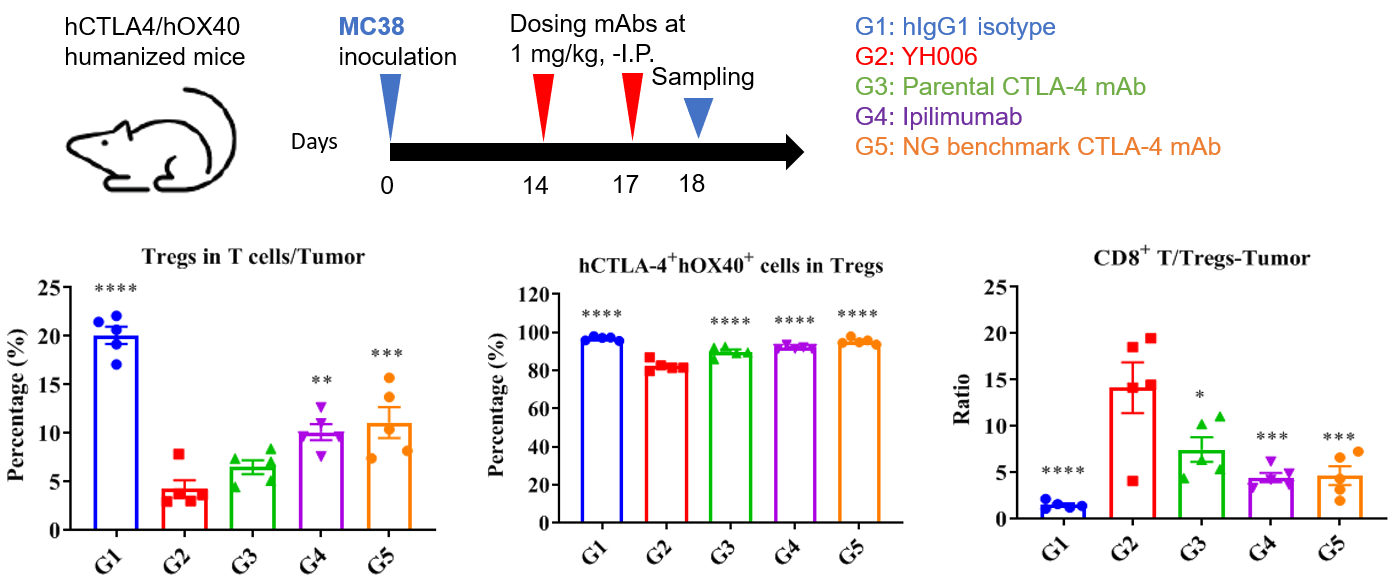
Figure 2. Tumor-infiltrating lymphocyte analysis following YH006 treatment. In CTLA-4/hOX40 humanized mice bearing MC38 tumors, YH006 administered intraperitoneally at 1 mg/kg reduced intratumoral Treg frequency, with a pronounced effect on CTLA-4/OX40 double-positive Tregs. YH006 also increased the intratumoral CD8+/Treg ratio compared with the parental CTLA-4 antibody, ipilimumab, and CTLA-4 antibody benchmark, supporting selective remodeling of the tumor immune microenvironment toward greater antitumor immune activity.
(Note: Data was shown as Mean±SEM, and analyzed using One-way ANOVA followed by Dunnett's test compared with YH006. (*p<0.05, **p<0.01, ***p<0.001, ****p<0.0001). NG: Next generation.)
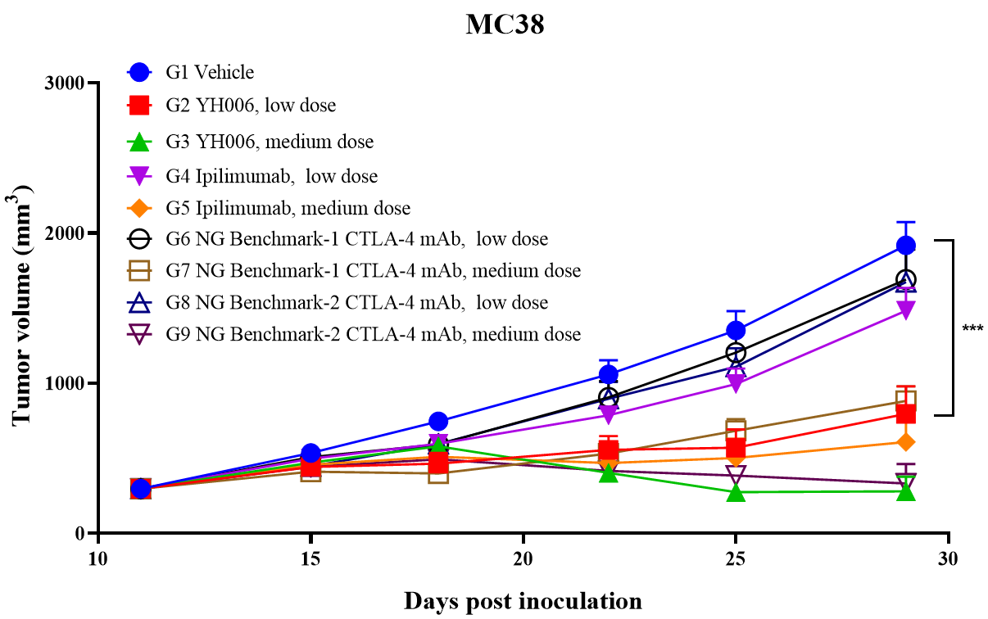
Figure 3A. Superior antitumor efficacy of YH006 in an MC38 tumor model. In CTLA-4/OX40 humanized mice (n=6) bearing MC38 tumors, a low dose of YH006 demonstrated stronger antitumor activity than first- and next-generation CTLA-4 antibody benchmarks, supporting the functional advantage of simultaneous CTLA-4 and OX40 engagement.
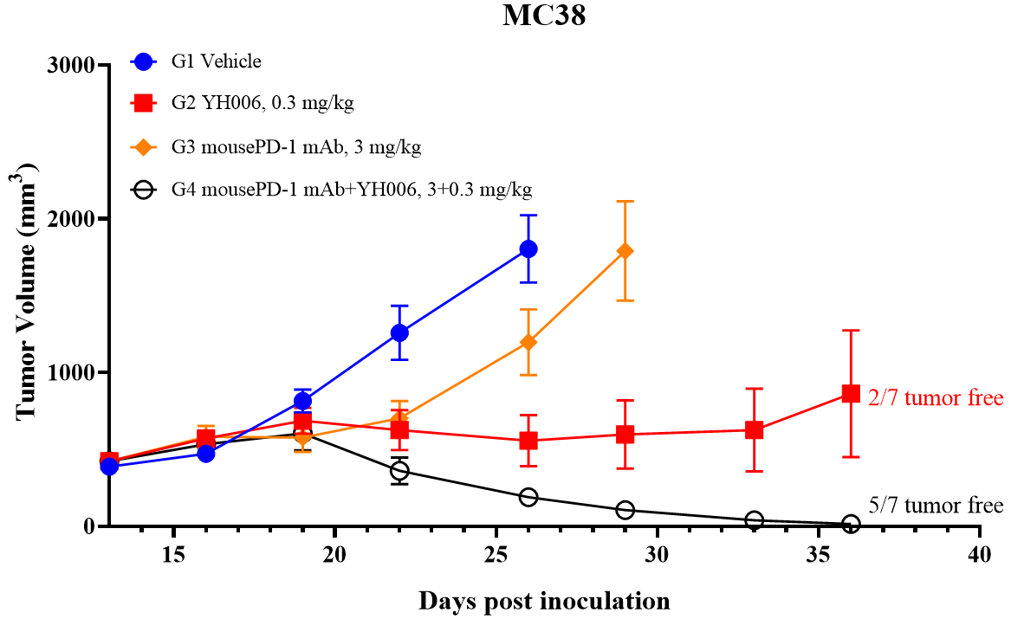
(mousePD-1 mAb: RMP1-14 clone with hIgG1-LALA isotype)
Figure 3B. Combination efficacy of YH006 with PD-1 blockade in an MC38 tumor model. In CTLA-4/OX40 humanized mice (n=7) bearing MC38 tumors, YH006 enhanced the antitumor activity of PD-1 blockade, supporting its potential as a combination partner for tumors with limited response to checkpoint inhibitor monotherapy.
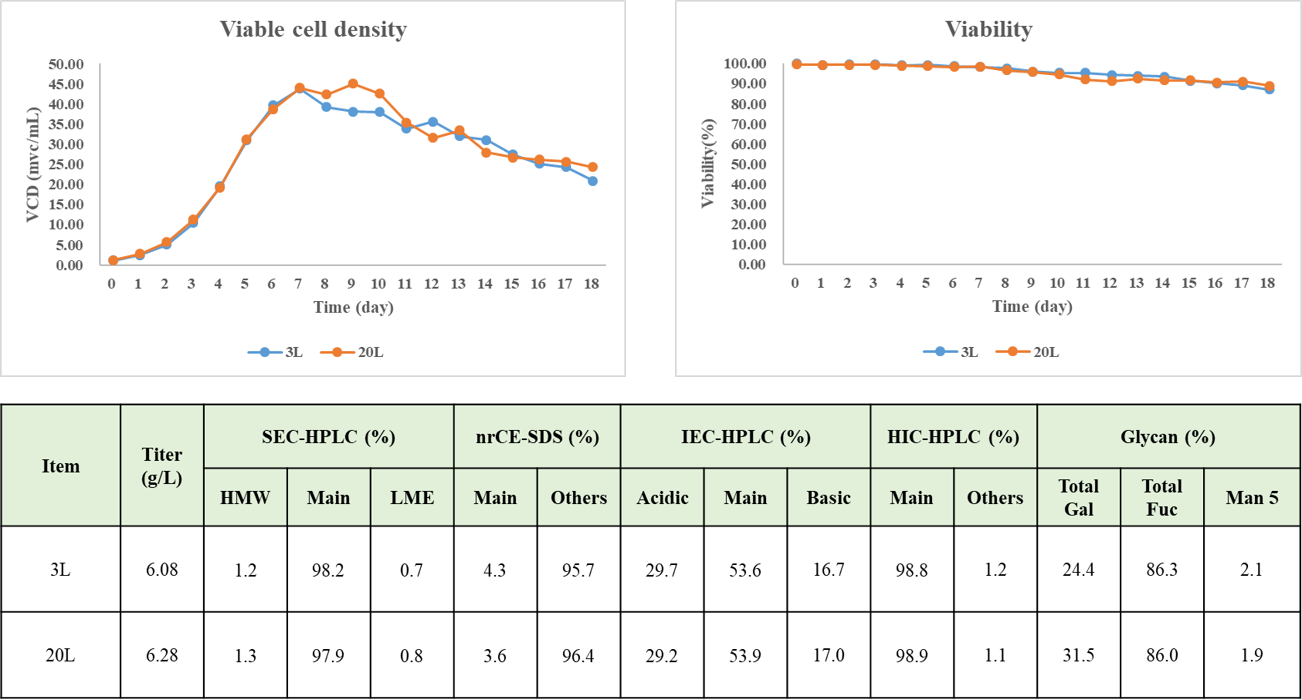
Figure 4. Manufacturability and formulation assessment of YH006. YH006 achieved a titer exceeding 6 g/L in bench-scale bioreactors, with an overall purification yield above 80%. A 40 mg/mL drug product remained stable under the evaluated conditions, including 40℃ stress testing, supporting robust production, formulation feasibility, and continued process development.

Biocytogen welcomes partnership discussions to further evaluate this CTLA-4 × OX40 bispecific antibody asset.

Conventional CTLA-4 antibodies bind broadly to peripheral Tregs, contributing to dose-limiting immune-related adverse events (irAEs). YH006 is designed to bind with high avidity only when CTLA-4 and OX40 are co-expressed. This dual-target-dependent selectivity is designed to concentrate Treg depletion within the tumor microenvironment. In preclinical models, YH006 more effectively depleted intratumoral Tregs and increased the CD8+/Treg ratio compared with ipilimumab and next-generation CTLA-4 benchmark antibodies.
CTLA-4 and OX40 are co-expressed at elevated levels on activated tumor-infiltrating Tregs but rarely co-expressed at high levels on peripheral T cells. By requiring engagement of both targets for strong binding, YH006 uses this biological difference to distinguish intratumoral Tregs from peripheral T-cell populations. The dual-target design also enhances binding avidity, supporting more potent Fc-mediated depletion of the cells that suppress antitumor immunity within the tumor.
RenLite® provides a fully human common light chain architecture that helps reduce heavy- and light-chain pairing complexity and supports consistent bispecific antibody assembly. YH006 achieved titers above 6 g/L and an overall purification yield above 80% in the evaluated process. A stable 40 mg/mL drug product was also developed, supporting continued manufacturing and formulation development.
YH006 is being prioritized for ICI-resistant colorectal cancer (CRC) and non-small cell lung cancer (NSCLC), where FDA-approved CTLA-4 plus PD-1 combination regimens have established clinical precedent in defined patient populations. Its selective intratumoral Treg-depleting mechanism and enhanced preclinical activity with PD-1 blockade support its positioning as a potential “golden combination partner” for PD-1 antagonists.