C57BL/6-Il13tm1(IL13)Bcgen Tslptm1(TSLP)Bcgen Crlf2tm2(CRLF2)Bcgen/Bcgen • 113947

Gene targeting strategy for B-hIL13/hTSLP/hTSLPR plus mice.
The exons 1-4 of mouse Il13 gene that encode the full length coding sequence were replaced by human IL13 exons 1-4 in B-hIL13/hTSLP/hTSLPR plus mice.
The exons 1-5 of mouse Tslp gene that encode the whole molecule (ATG to STOP codon) were replaced by human counterparts in B-hIL13/hTSLP/hTSLPR plus mice. The promoter, 5’UTR and 3’UTR region of the mouse gene are retained. The human TSLP expression is driven by endogenous mouse Tslp promoter, while mouse Tslp gene transcription and translation will be disrupted.
A chimeric CDS that encodes human TSLPR extracellular domain, transmembrane and mouse TSLPR cytoplasmic domain, followed by mouse 3’UTR-STOP is inserted right after mouse Tslpr signal peptide sequence to replace part of the exon 2 of mouse Tslpr gene. The chimeric TSLPR protein expression will be driven by endogenous mouse Tslpr promoter, while mouse Tslpr gene transcription and translation will be disrupted.
B-hIL13/hTSLP/hTSLPR plus mice was developed by cross-mating the B-hTSLP/hTSLPR mice plus and the B-hIL13 mice together.

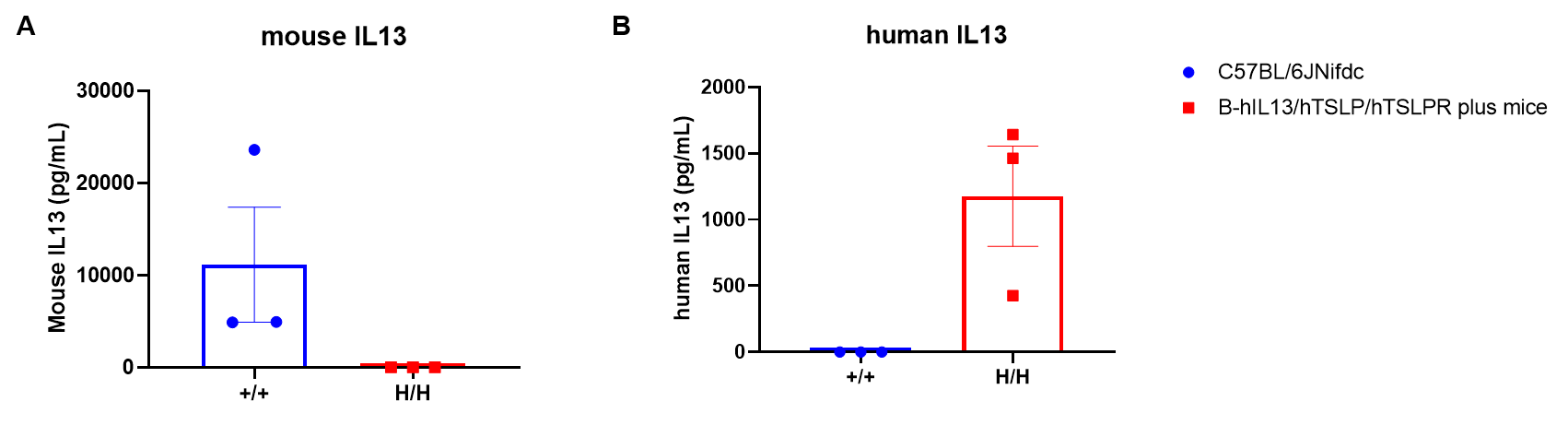
Strain specific IL13 expression analysis in wild-type C57BL/6JNifdc mice and homozygous B-hIL13/hTSLP/hTSLPR plus mice by ELISA. Splenocytes were isolated from wild-type C57BL/6JNifdc mice (+/+) and homozygous B-hIL13/hTSLP/hTSLPR plus mice (H/H;H/H;H/H;H/H) (female, n=3, 6-week-old) and stimulated with 2 μg/mL anti-mCD3e antibody, 5 μg/mL anti-mCD28 antibody, 10 ng/mL mIL4 and 10 μg/mL anti-IFN-γ antibody in vitro for 72 hrs. 5 hours before collecting the cell supernatants, add cell activation cocktail to stimulate the cells. And then cell supernatants were collected and analyzed by ELISA with species-specific IL13 ELISA kit (mouse IL13 ELISA kit: Abcam, ab219634; human IL13 ELISA kit: Abcam, ab288591). Mouse IL13 was detectable in wild-type mice. Human IL13 was exclusively detectable in homozygous B-hIL13/hTSLP/hTSLPR plus mice but not in wild-type C57BL/6JNifdc mice. Values are expressed as mean ± SEM.
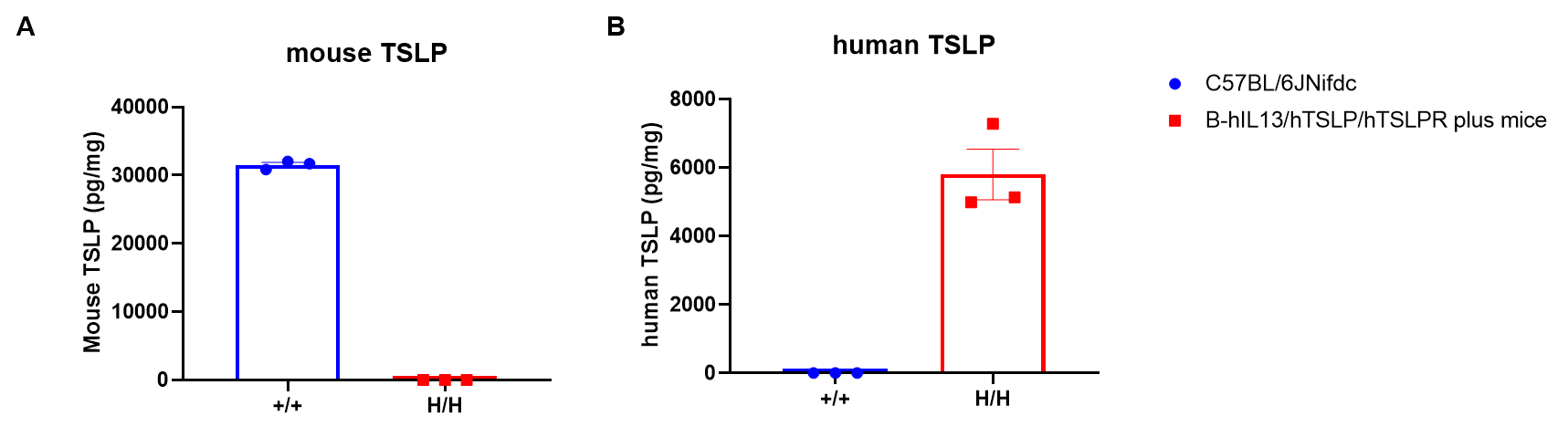
Strain specific TSLP expression analysis in wild-type C57BL/6JNifdc mice and homozygous B-hIL13/hTSLP/hTSLPR plus mice by ELISA. Ear were collected from wild-type C57BL/6JNifdc mice (+/+) and homozygous B-hIL13/hTSLP/hTSLPR plus mice (H/H;H/H;H/H;H/H) (female, n=3, 6-week-old) coated with MC903 (0.2mmol/L, 0.2mL) in ear for 7 days. Expression level of mouse and human TSLP were analyzed by ELISA with species-specific TSLP ELISA kit (mouse TSLP ELISA kit: BioLegend, 434107; human TSLP ELISA kit: BioLegend, 434207). Mouse TSLP was exclusively detectable in wild-type C57BL/6JNifdc mice. Human TSLP was exclusively detectable in homozygous B-hIL13/hTSLP/hTSLPR plus mice but not in wild-type C57BL/6JNifdc mice. Values are expressed as mean ± SEM.
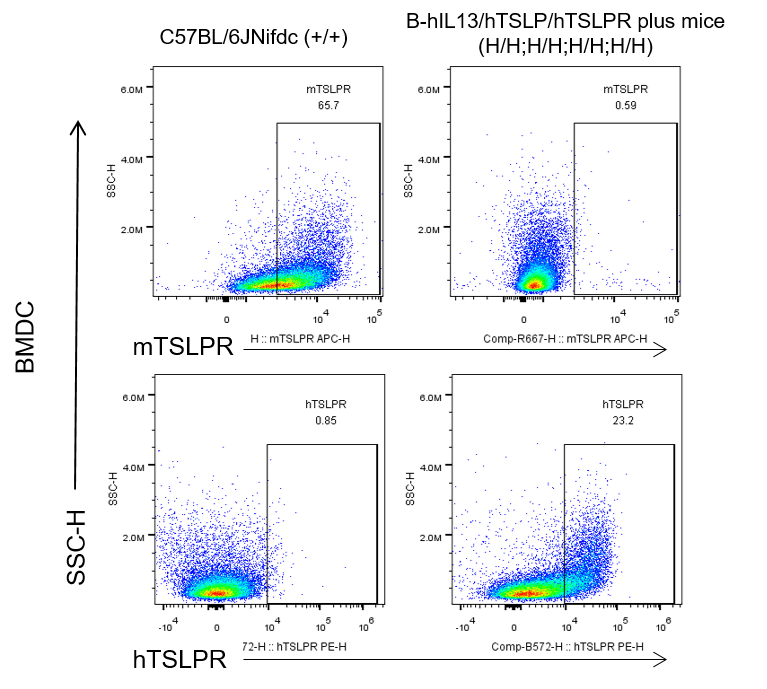
Strain specific TSLPR expression analysis in wild-type C57BL/6JNifdc mice and homozygous B-hIL13/hTSLP/hTSLPR plus mice by flow cytometry. Bone narrow cells were collected from wild-type C57BL/6JNifdc mice (+/+) and homozygous B-hIL13/hTSLP/hTSLPR plus mice (H/H;H/H;H/H;H/H). Protein expression was analyzed with anti-mouse TSLPR antibody (Biolegend, 151805) and anti-human TSLPR antibody (Biolegend, 322805) by flow cytometry. Mouse TSLPR was exclusively detectable in wild-type C57BL/6JNifdc mice, but not in homozygous B-hIL13/hTSLP/hTSLPR plus mice. Human TSLPR was exclusively detectable in homozygous B-hIL13/hTSLP/hTSLPR plus mice, but not in wild-type C57BL/6JNifdc mice.
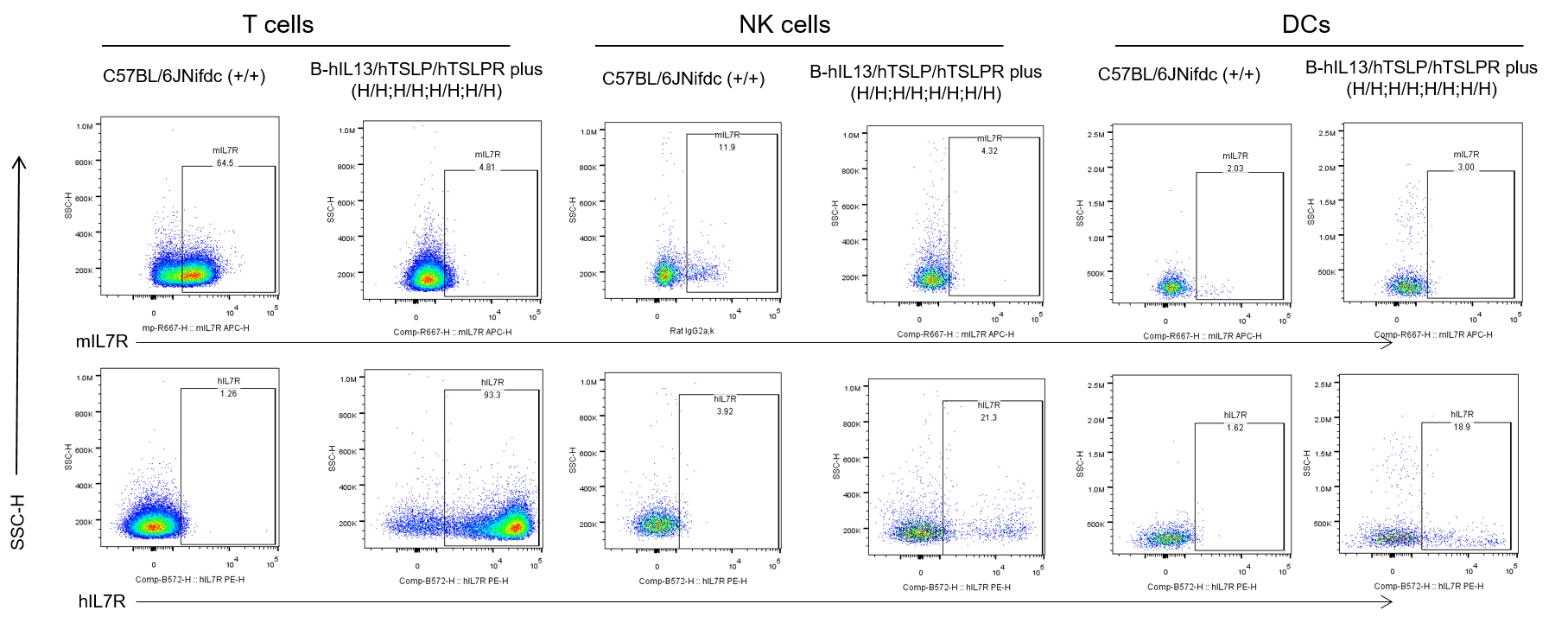
Strain specific IL7R expression analysis in wild-type C57BL/6JNifdc mice and homozygous B-hIL13/hTSLP/hTSLPR plus mice by flow cytometry. Splenocytes were collected from wild-type C57BL/6JNifdc mice (+/+) and homozygous B-hIL13/hTSLP/hTSLPR plus mice (H/H;H/H;H/H;H/H). Protein expression was analyzed with anti-mouse IL7R antibody (Biolegend, 135011) and anti-human IL7R antibody (Biolegend, 351303) by flow cytometry. Mouse IL7R was exclusively detectable in wild-type C57BL/6JNifdc mice, but not in homozygous B-hIL13/hTSLP/hTSLPR plus mice. Human IL7R was exclusively detectable in homozygous B-hIL13/hTSLP/hTSLPR plus mice, but not in wild-type C57BL/6JNifdc mice.