
B-hCCR8 mice(C) plus

BALB/cCrSIcNifdc-Ccr8tm1(CCR8)Bcgen/Bcgen • 113144

B-hCCR8 mice(C) plus

Product nameB-hCCR8 mice(C) plus
Catalog number113144
Strain nameBALB/cCrSIcNifdc-Ccr8tm1(CCR8)Bcgen/Bcgen
Strain backgroundBALB/cCrSlcNifdc
NCBI gene ID1237 (Human)
AliasesCY6; TER1; CCR-8; CKRL1; CDw198; CMKBR8; GPRCY6; CMKBRL2; CC-CKR-8

このページで

  • Description
  • Targeting strategy
  • Phenotypic analysis

ポスター

すべて表示

    出版物

      Description
      • Background: CCR8 is a chemokine receptor prominently expressed on immunosuppressive regulatory T cells (Tregs) within tumors, where it facilitates their recruitment and function, thereby shielding cancers from immune attack. It also plays a role in allergic inflammation by directing pro-inflammatory Th2 cells. Due to its specific expression on tumor-resident Tregs, CCR8 has emerged as a promising target in cancer immunotherapy. Current drug development is focused primarily on antibodies designed to selectively deplete these intratumoral CCR8+ Tregs, with several candidates now in clinical trials.
      • Targeting strategy: The exons 2 of mouse Ccr8 gene that encode the whole molecule (ATG to STOP codon) was replaced by human counterparts in B-hCCR8 mice(C). The promoter, 5’UTR and 3’UTR region of the mouse gene were retained. The human CCR8 expression was driven by endogenous mouse Ccr8 promoter, while mouse Ccr8 gene transcription and translation will be disrupted.

      • Validation: Human CCR8 mRNA and protein were detected in the B-hCCR8 mice(C) but not in BALB/cCrSIcNifdc mice.
      • Application: Tumor cell lines inoculated in B-hCCR8 mice(C) can be used to study the in vivo efficacy and safety evaluation of antibody drugs.
      Targeting Strategy

      Gene targeting strategy for B-hCCR8 mice(C). The exons 2 of mouse Ccr8 gene that encode the whole molecule (ATG to STOP codon) was replaced by human counterparts in B-hCCR8 mice(C). The promoter, 5’UTR and 3’UTR region of the mouse gene were retained. The human CCR8 expression was driven by endogenous mouse Ccr8 promoter, while mouse Ccr8 gene transcription and translation will be disrupted.

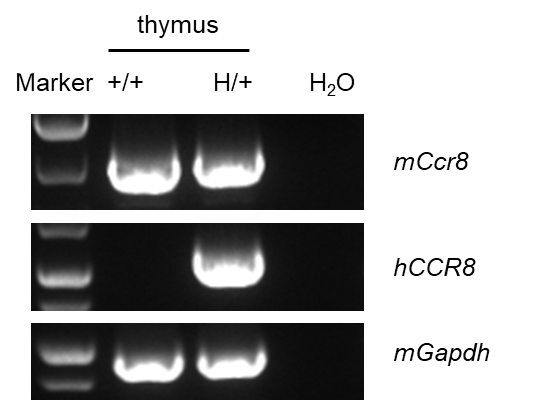
      mRNA Expression Analysis

      Strain specific analysis of CCR8 mRNA expression in wild-type BALB/cCrSIcNifdc mice and B-hCCR8 mice(C) by RT-PCR. Thymus RNA was isolated from wild-type BALB/cCrSIcNifdc mice (+/+) and heterozygous (H/+), then cDNA libraries were synthesized by reverse transcription, followed by PCR with mouse or human CCR8 primers. Mouse Ccr8 mRNA was detectable in wild-type BALB/cCrSIcNifdc mice and heterozygous B-hCCR8 mice(C). Human CCR8 mRNA was detectable in heterozygous B-hCCR8 mice(C) but not in wild-type BALB/cCrSIcNifdc mice.
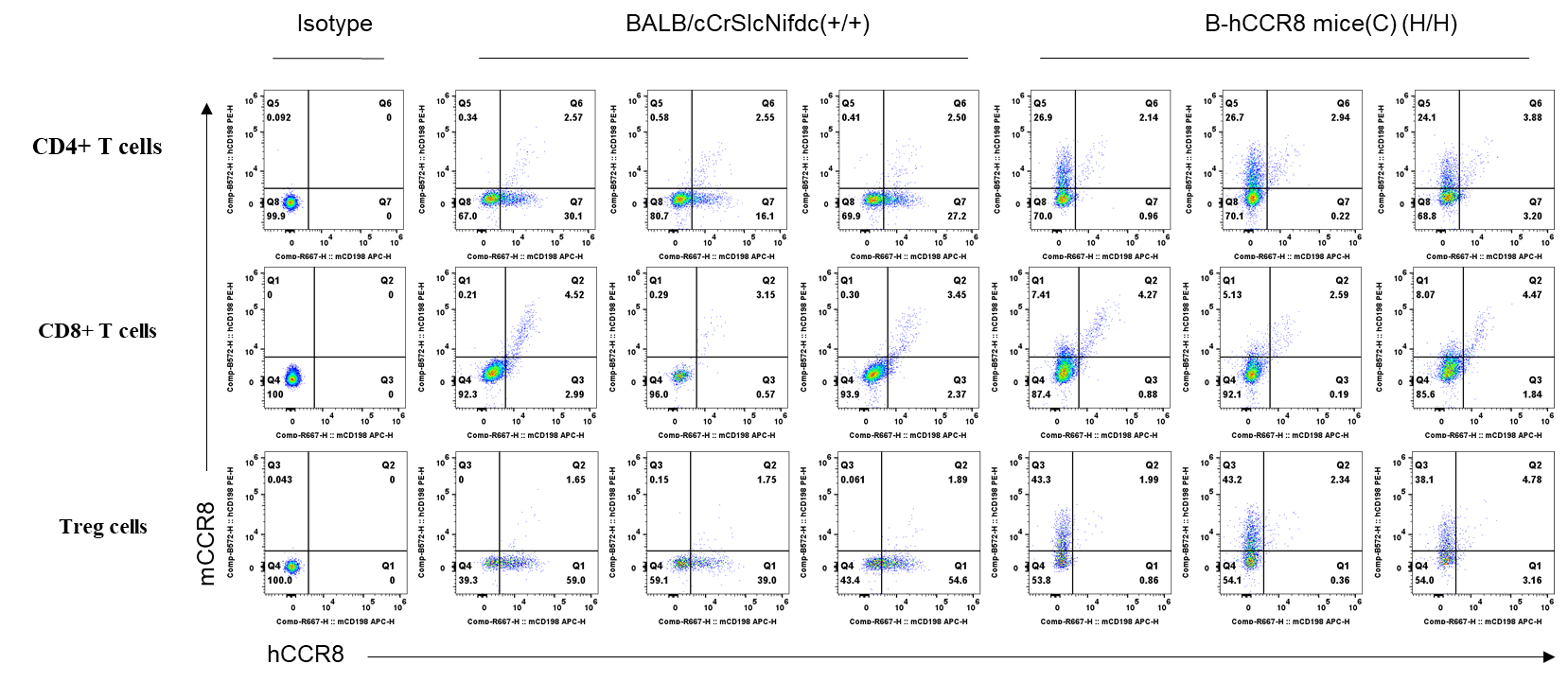
      Protein Expression Analysis in Tumor Infiltrating Cells

      CCR8 expression analysis in B-hCCR8 mice(C) by FACS. Colon cancer CT26.WT cells were inoculated into wild-type BALB/cCrSIcNifdc (+/+) and homozygous B-hCCR8 mice(C) (H/H). Tumor cells were harvested after tumor growth and analyzed by flow cytometry with species-specific anti-mouse CCR8 antibody (Biolegend, 150310) and anti-human CCR8 antibody (Biolegend, 365804). Mouse CCR8 was both detectable on CD4+ T cells and Treg cells in tumors of wild-type BALB/cCrSIcNifdc mice but not in homozygous B-hCCR8 mice(C), and human CCR8 was only detectable in homozygous B-hCCR8 mice(C).

      * When publishing results obtained using this animal model, please acknowledge the source as follows: The animal model [B-hCCR8 mice(C) plus] (Cat# 113144) was purchased from Biocytogen.