Description
GPR15: A crucial G protein-coupled receptor in the transport of immune cells
- Gene Information: G protein-Coupled Receptor 15 (GPR15) is a protein-coding gene located on chromosome 3q11.2. It acts a chemokine receptor for human immunodeficiency virus 1 and 2.
- Protein Expression: In the immune system, GPR15 is highly expressed mainly in T cell subsets, while its expression is low or absent in B cells or myeloid cells.
- Signaling Pathway: During the onset of inflammatory bowel disease (IBD), intestinal epithelial cells secrete a large amount of the natural ligand of GPR15, GPR15L, which induces T cells expressing GPR15 to pass through the vascular endothelium and infiltrate into the lamina propria of the colon.
- Therapeutic Inhibition: Blocking the GPR15/GPR15L signaling axis helps prevent the migration of pathogenic effector T cells to the colon.
Targeting strategy
GPR15
- The exons 1 of mouse Gpr15 gene that encode the whole molecule (ATG to STOP codon), including 3’UTR were replaced by human counterparts in B-hGPR15 mice.
- The promoter and 5’UTR region of the mouse gene are retained. The human GPR15 expression is driven by endogenous mouse Gpr15 promoter, while mouse Gpr15 gene transcription and translation will be disrupted.
GPR15 Protein Expression Analysis
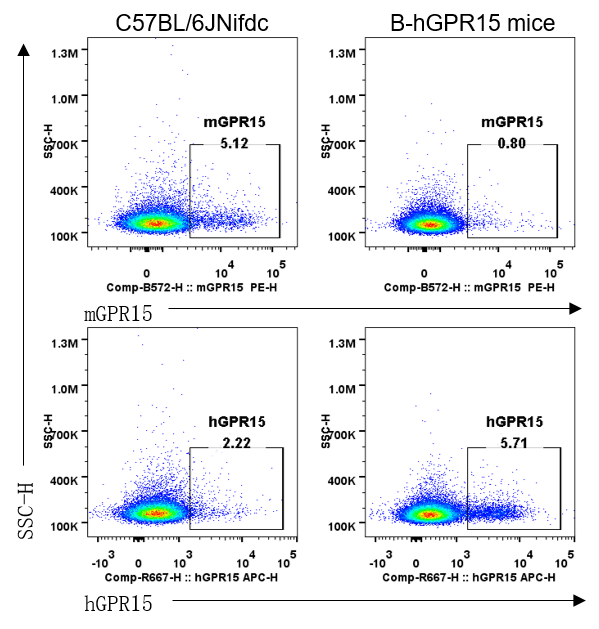
- Mouse GPR15 was only detectable in wild-type C57BL/6JNifdc mice.
- Human GPR15 was exclusively detectable in homozygous B-hGPR15 mice.
Strain specific GPR15 expression analysis in homozygous B-hGPR15 mice by flow cytometry. Splenocytes were collected from wild-type C57BL/6JNifdc mice(+/+) and homozygous B-hGPR15 mice(H/H), protein expression was analyzed by flow cytometry with species-specific anti-mouse GPR15 antibody (Biolegend, 154603) and anti-human GPR15 antibody (Biolegend, 373005). Mouse GPR15 was detectable on T cells of wild-type C57BL/6JNifdc mice. Human GPR15 was detectable on T cells of homozygous B-hGPR15 mice.
* When publishing results obtained using this animal model, please acknowledge the source as follows: The animal model [B-hGPR15 mice] (Cat# 114748) was purchased from Biocytogen.