C57BL/6-Pdcd1tm1(PDCD1)Bcgen Cd274tm1(CD274)Bcgen Vegfatm1(VEGFA)BcgenKdrtm1(KDR)Bcgen/Bcgen • 113803


Gene targeting strategy for B-hPD-1/hPD-L1/hVEGFA/hVEGFR2 mice.
The exon 2 of mouse Pdcd1 gene that encodes the IgV domain was replaced by human PD-1 exon 2.
The exon 3 of mouse Cd274 gene that encodes the IgV domain was replaced by human CD274 exon 3.
The exons 1-8 of mouse Vegfa gene that encode the full-length protein were replaced by human VEGFA exons 1-8.
The exons 2-15 of mouse Vegfr2 gene that encode the extracellular region were replaced by human VEGFR2 exons 2-15.
The B-hPD-1/hPD-L1/hVEGFA/hVEGFR2 mice knock-in model was developed by breeding the B-hPD-1 mice, the B-hPD-L1 mice, B-hVEGFA mice and the B-hVEGFR2 mice .

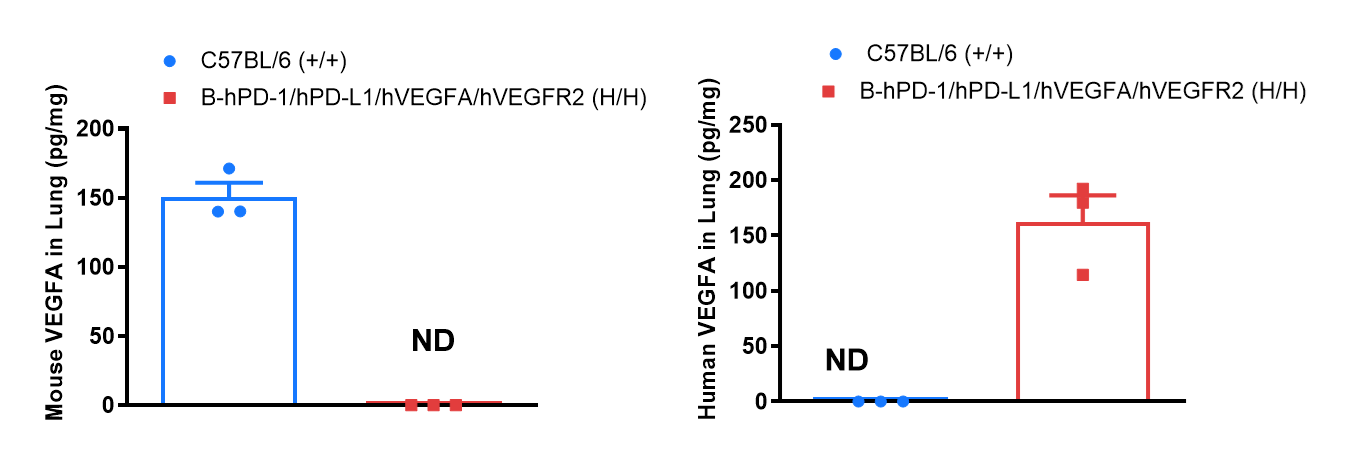
Strain specific VEGFA expression analysis in wild-type C57BL/6 mice and homozygous humanized B-hPD-1/hPD-L1/hVEGFA/hVEGFR2 mice by ELISA. Lung tissue homogenate was collected from wild-type C57BL/6 mice (+/+) (male, n=3, 10-week-old) and homozygous B-hPD-1/hPD-L1/hVEGFA/hVEGFR2 mice (H/H) (male, n=3, 10-week-old). Expression level of mouse and human VEGFA were analyzed by ELISA (anti-mouse VEGFA ELISA kit: RD, MVR100; anti-human VEGFA ELISA kit: RD, DVR100C). Human VEGFA was only detectable in homozygous B-hPD-1/hPD-L1/hVEGFA/hVEGFR2 mice but not in wild-type C57BL/6 mice, with an expression level of approximately 150 pg per milligram of total protein. Mouse VEGFA was only detectable in wild-type C57BL/6 mice. Values are expressed as mean ± SEM.
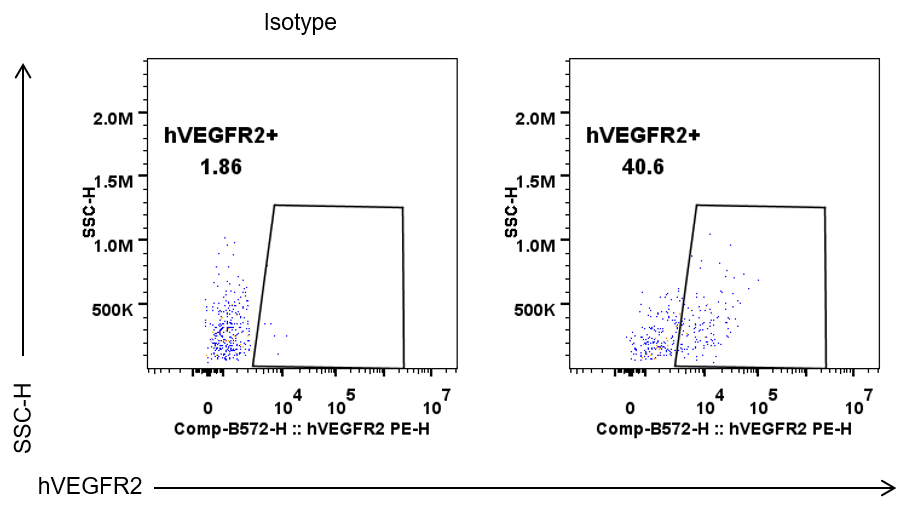
VEGFR2 expression analysis in homozygous B-hPD-1/hPD-L1/hVEGFA/hVEGFR2 mice by flow cytometry. Fetal mouse lung endothelial cells were collected from homozygous B-hPD-1/hPD-L1/hVEGFA/hVEGFR2 mice (H/H). Protein expression was analyzed with anti-human VEGFR2 antibody (Biolegend, 359904) by flow cytometry. Human VEGFR2 was exclusively detectable in homozygous B-hPD-1/hPD-L1/hVEGFA/hVEGFR2 mice.
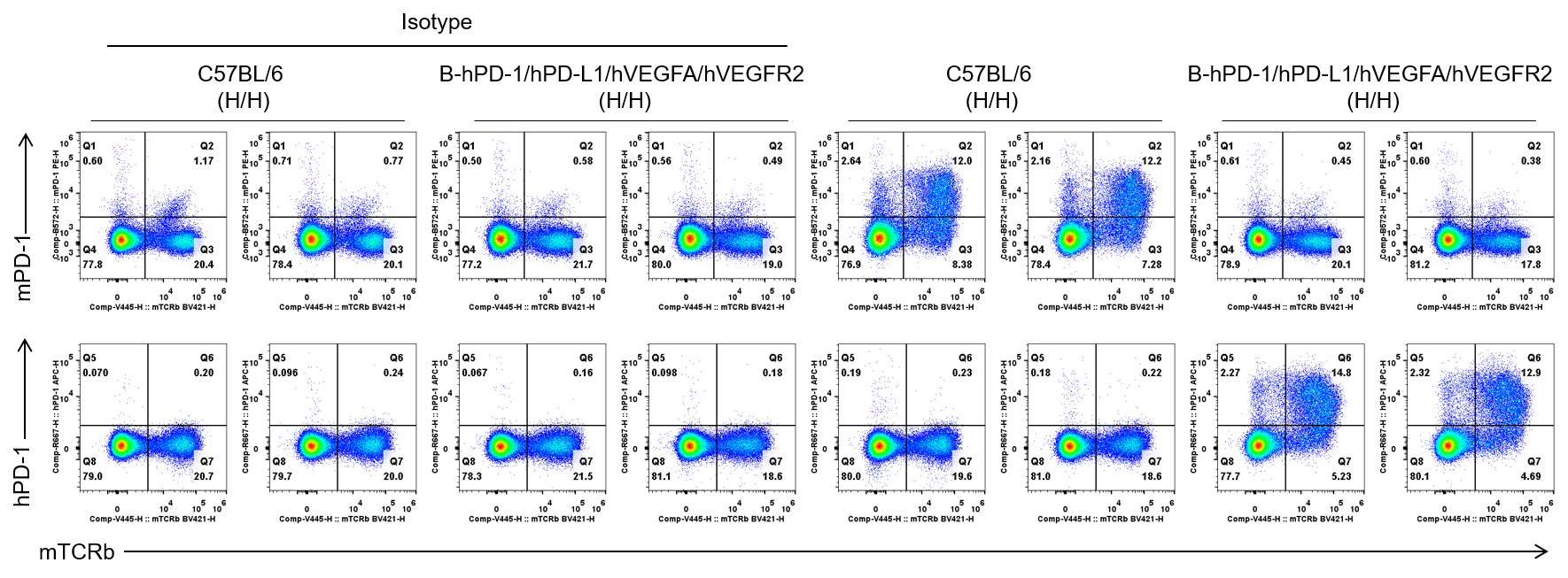
Strain specific PD-1 expression analysis in wild-type C57BL/6 mice and homozygous B-hPD-1/hPD-L1/hVEGFA/hVEGFR2 mice by flow cytometry. Splenocytes were collected from wild-type C57BL/6 mice (+/+) (male, 17-week-old, n=2) and homozygous B-hPD-1/hPD-L1/hVEGFA/hVEGFR2 mice (H/H) (male, 17-week-old, n=2). Cells were stimulated in vivo via intraperitoneal injection of 7.5 μg/mouse anti-CD3ε antibodies (clone 145-2C11, BioXCell: BE0001-1) for 24 hours. Protein expression was analyzed with anti-mouse PD-1 antibody (Biolegend, 109104) and anti-human PD-1 antibody (Biolegend, 329908) by flow cytometry. Human PD-1 was exclusively detectable in homozygous B-hPD-1/hPD-L1/hVEGFA/hVEGFR2 mice, but not in wild-type C57BL/6 mice.
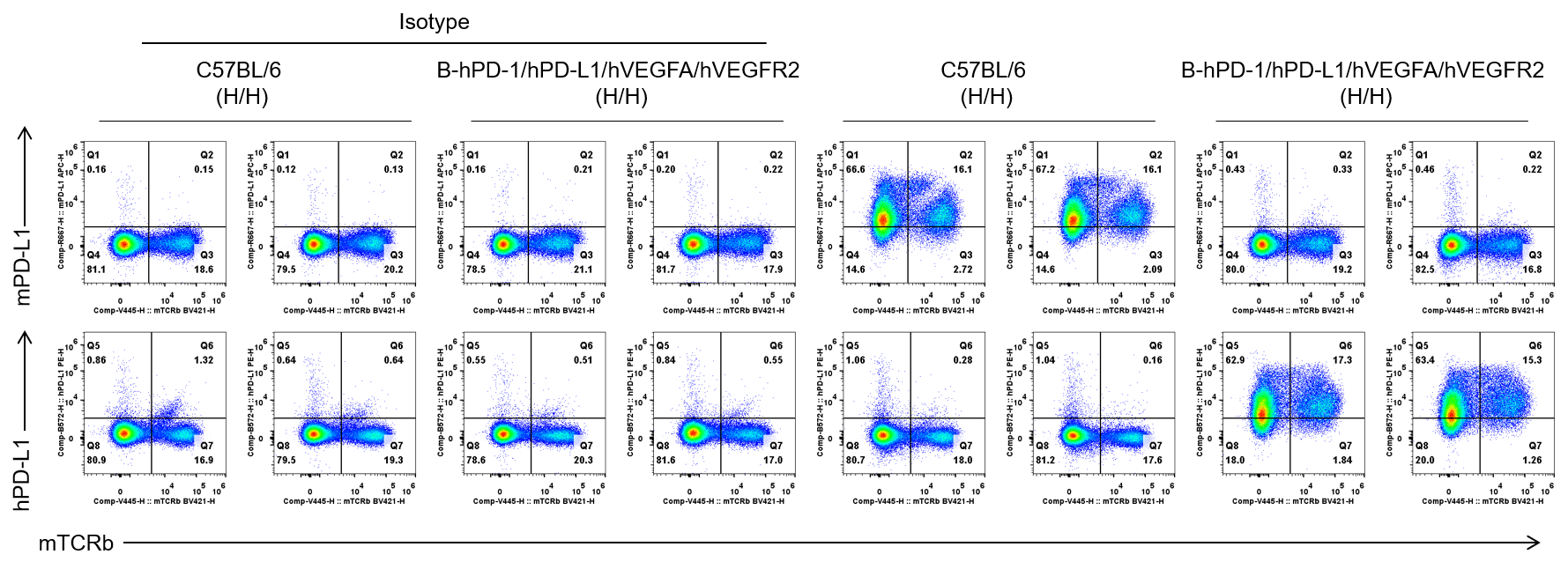
Strain specific PD-L1 expression analysis in wild-type C57BL/6 mice and homozygous B-hPD-1/hPD-L1/hVEGFA/hVEGFR2 mice by flow cytometry. Splenocytes were collected from wild-type C57BL/6 mice (+/+)(male, 17-week-old, n=2). and homozygous B-hPD-1/hPD-L1/hVEGFA/hVEGFR2 mice (H/H)(male, 17-week-old, n=2). Cells were stimulated in vivo via intraperitoneal injection of 7.5 μg/mouse anti-CD3ε antibodies (clone 145-2C11, BioXCell: BE0001-1) for 24 hours. Protein expression was analyzed with anti-mouse PD-L1 antibody (Biolegend, 124312) and anti-human PD-L1 antibody (Biolegend, 329706) by flow cytometry. Human PD-L1 was exclusively detectable in homozygous B-hPD-1/hPD-L1/hVEGFA/hVEGFR2 mice, but not in wild-type C57BL/6 mice.