Description
SCN8A: Variants are linked to multiple neurological conditions, most notably epilepsy and neurodevelopmental disorders.
- Gene Information: The sodium voltage-gated channel alpha subunit 8 (SCN8A) gene encodes the Nav1.6 sodium channel protein, a member of the sodium channel alpha subunit gene family.
- Protein Expression: Nav1.6 is highly expressed in the central nervous system. This protein is essential for the rapid membrane depolarization that occurs during the formation of the action potential in excitable neurons.
- Signaling Pathway: Nav1.6 modulates sodium permeability via sensing membrane potential shifts. Upon depolarization reaching threshold, the sodium channel quickly opens to permit sodium influx, driving further membrane depolarization and action potential generation.
- Therapeutic Inhibition: Therapeutic strategies for SCN8A-related diseases have rapidly diverged into three major approaches: precision small molecules designed to modulate sodium channel activity, antisense nucleic acids intended to reduce expression of pathogenic alleles, and gene therapy aimed at restoring or replacing defective functions.
Targeting Strategy
SCN8A
- The exons 1-27 of mouse Scn8a gene that encode the whole molecule (ATG to STOP codon), including 3’UTR were replaced by human counterparts in B-hSCN8A mice. The promoter and 5’UTR region of the mouse gene were also replaced.
- The human SCN8A expression is driven by human SCN8A promoter, while mouse Scn8a gene transcription and translation will be disrupted.
SCN8A mRNA Expression Analysis
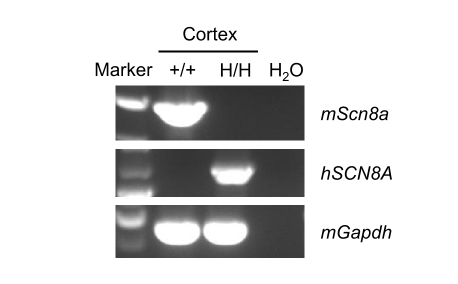
Strain-specific SCN8A expression analysis in wild-type C57BL/6JNifdc mice and homozygous B-hSCN8A mice. Cortex RNA was isolated from wild-type C57BL/6JNifdc mice (+/+) and homozygous B-hSCN8A mice (H/H), then cDNA libraries were synthesized by reverse transcription, followed by PCR with mouse or human SCN8A primers. Human SCN8A mRNA was detectable only in homozygous B-hSCN8A mice but not in wild-type mice.
SCN8A Protein Expression Analysis
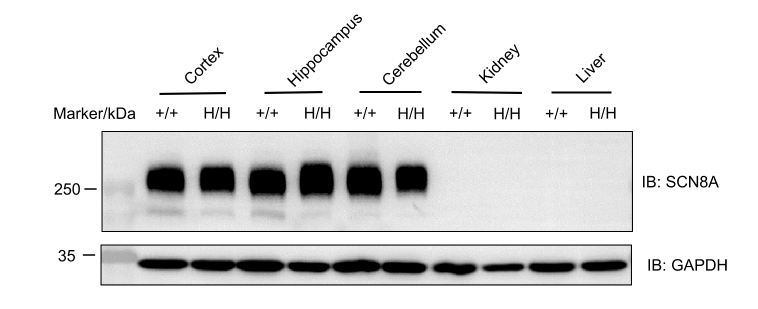
Protein expression analysis of SCN8A in homozygous B-hSCN8A mice. Various tissue lysates were collected from wild-type C57BL/6JNifdc mice (+/+) and homozygous B-hSCN8A mice (H/H), and then analyzed by western blot with anti-SCN8A antibody (Abcam, ab302786). 40 μg total protein was loaded for western blotting analysis. SCN8A protein was detectable in cortex, hippocampus and cerebellum from homozygous B-hSCN8A mice and wild-type C57BL/6 mice, as the antibody was cross-reactive between human and mouse.
* When publishing results obtained using this animal model, please acknowledge the source as follows: The animal model [B-hSCN8A mice] (Cat# 113852) was purchased from Biocytogen.