Description
- Background: SPA17 is a secretion-competent protein with crucial intracellular roles in actin regulation. Its expression is tightly confined to germ cells in physiology but is hijacked in cancer. Leveraging this unique expression pattern, it has emerged as a high-value target for two distinct therapeutic areas: reversible male contraception and precision oncology, particularly through ADC and cellular immunotherapy platforms. While no SPA17-targeted drug has reached clinical trials yet, active preclinical research underscores its strong translational potential.
- Targeting strategy: The exons 2-5 of mouse SPA17 gene that encode the molecule, including 3’UTR were replaced by human counterparts in B-hSPA17 mice. The promoter and 5’UTR region of the mouse gene were retained. The human SPA17 expression was driven by endogenous mouse Spa17 promoter, while mouse Spa17 gene transcription and translation will be disrupted.
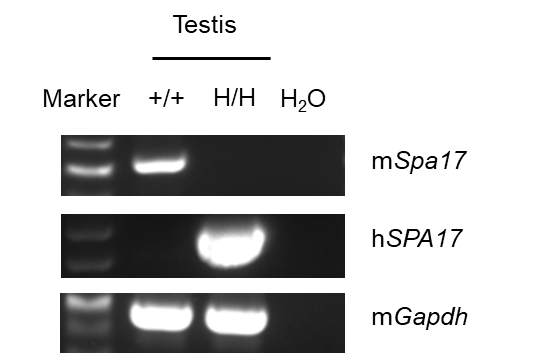
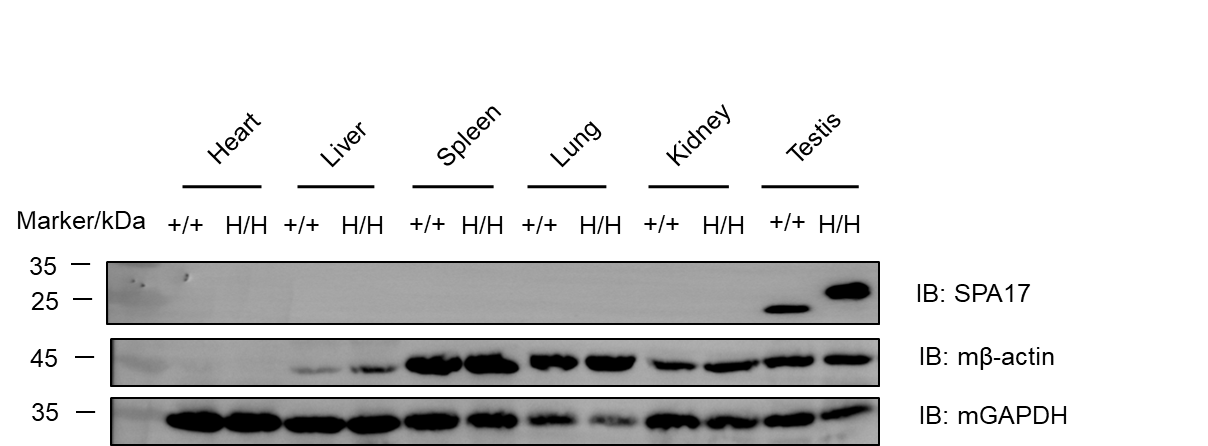
- Validation: SPA17 was detected in testis of C57BL/6JNifdc wide-type mice and homozygous B-hSPA17 mice, and the antibody was cross-reactive between human and mouse. Human SPA17 mRNA was detected in the testis of homozygous B-hSPA17 mice but not in C57BL/6JNifdcJNifdc mice.
- Application: Tumor cell lines inoculated in B-hSPA17 mice can be used to study the in vivo efficacy and safety evaluation of antibody drugs.
Targeting Strategy
Gene targeting strategy for B-hSPA17 mice. The exons 2-5 of mouse SPA17 gene that encode the molecule, including 3’UTR were replaced by human counterparts in B-hSPA17 mice. The promoter and 5’UTR region of the mouse gene were retained. The human SPA17 expression was driven by endogenous mouse Spa17 promoter, while mouse Spa17 gene transcription and translation will be disrupted.
mRNA Expression Analysis
Strain specific analysis of SPA17 mRNA expression in wild-type C57BL/6JNifdc mice and B-hSPA17 mice by RT-PCR. Testis RNA were isolated from wild-type C57BL/6JNifdc mice (+/+) and homozygous B-hSPA17 mice (H/H), then cDNA libraries were synthesized by reverse transcription, followed by PCR with mouse or human SPA17 primers. Human SPA17 mRNA was exclusively detectable in homozygous B-hSPA17 mice but not in wild-type mice. Mouse Spa17 mRNA was detectable in wild-type mice.
Protein Expression Analysis
Western blot analysis of SPA17 protein expression in homozygous B-hSPA17 mice. Various tissue lysates were collected from C57BL/6JNifdc (+/+) and homozygous B-hSPA17 mice (H/H), and then analyzed by western blot with anti-SPA17 antibody (abcam, ab172626). 40 μg total proteins were loaded for western blotting analysis. SPA17 was detected in testis of C57BL/6JNifdc wide-type mice and homozygous B-hSPA17 mice, the antibody was cross-reactive between human and mouse.
* When publishing results obtained using this animal model, please acknowledge the source as follows: The animal model [B-hSPA17 mice] (Cat# 113736) was purchased from Biocytogen.