Description
- Background: Tryptophan 2,3-dioxygenase (TDO/TDO2) and indoleamine 2,3-dioxygenase (IDO1/2) are the initiating and rate-limiting enzymes in tryptophan metabolism, playing crucial roles in mediating immunosuppression within the tumor microenvironment (the catabolite kynurenine [KYN] of the tryptophan pathway can inhibit immune responses against tumor cells). IDO1 and TDO are highly expressed in many malignant tumors, and their expression is often associated with reduced tumor-infiltrating immune cells, increased infiltration of regulatory T cells, as well as cancer progression and poor prognosis in malignancies.
- Targeting strategy: The exons 1-12 of mouse Tdo2 gene that encode the whole molecule (ATG to STOP codon), including The promoter, 5’UTR and 3’UTR are replaced by human counterparts in B-hTDO2 mice.
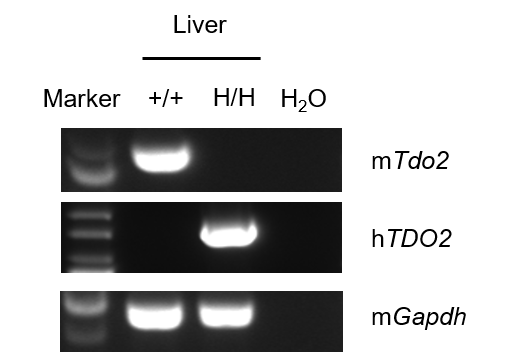
- Validation: Human TDO2 mRNA and protein were detected in the B-hTDO2 mice but not in C57BL/6 mice.
- Application: Tumor cell lines inoculated in B-hTDO2 mice can be used to study the in vivo efficacy and safety evaluation of antibody drugs.
Targeting Strategy
Gene targeting strategy for B-hTDO2 mice. The exons 1-12 of mouse Tdo2 gene that encode the whole molecule (ATG to STOP codon), including The promoter, 5’UTR and 3’UTR are replaced by human counterparts in B-hTDO2 mice.
mRNA Expression Analysis
Strain specific analysis of TDO2 mRNA expression in wild-type C57BL/6 mice and B-hTDO2 mice by RT-PCR. Liver RNA were isolated from wild-type C57BL/6 mice (+/+) and homozygous B-hTDO2 mice (H/H), then cDNA libraries were synthesized by reverse transcription, followed by PCR with mouse or human TDO2 primers. Human TDO2 mRNA was exclusively detectable in homozygous B-hTDO2 mice but not in wild-type mice.
* When publishing results obtained using this animal model, please acknowledge the source as follows: The animal model [B-hTDO2 mice] (Cat# 113409) was purchased from Biocytogen.