
NOD.CB17-Prkdcscid Il2rgtm1Bcgen Tfrctm2(TFRC)Bcgen/Bcgen • 113863


Gene targeting strategy for B-NDG hTFR1 mice plus. The exons 4-19 of mouse Tfr1 gene that encode extracellular domain are replaced by human counterparts in B-NDG hTFR1 mice plus. The genomic region of mouse Tfr1 gene that encodes cytoplasmic portion is retained. The promoter, 5’UTR and 3’UTR region of the mouse gene are also retained. The chimeric TFR1 expression is driven by endogenous mouse Tfr1 promoter, while mouse Tfr1 gene transcription and translation will be disrupted.

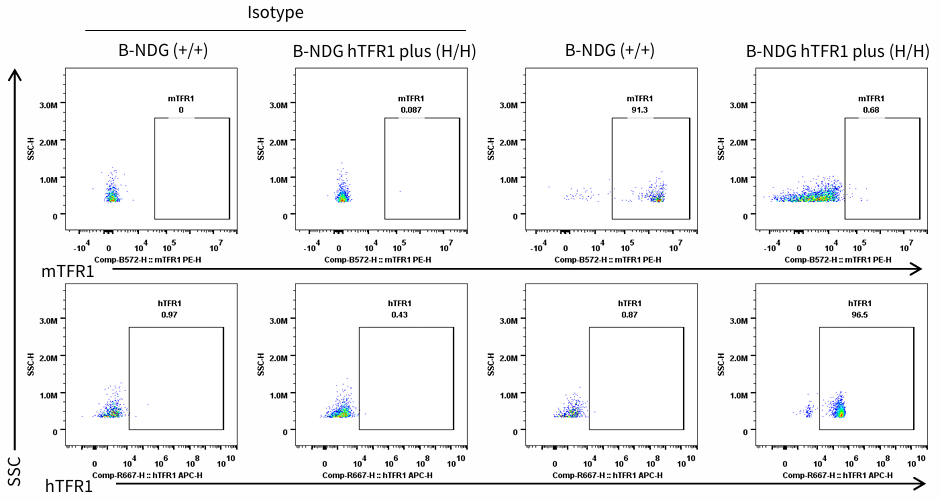
Strain specific TFR1 expression analysis in homozygous B-NDG hTFR1 mice plus by flow cytometry. Bone marrow was collected from wild-type B-NDG mice (+/+) and homozygous B-NDG hTFR1 mice plus (H/H) (female, 6-week-old). Protein expression was analyzed with anti-mouse TFR1 antibody (Biolegend, 113808) and anti-human TFR1 antibody (Biolegend, 334108) by flow cytometry.
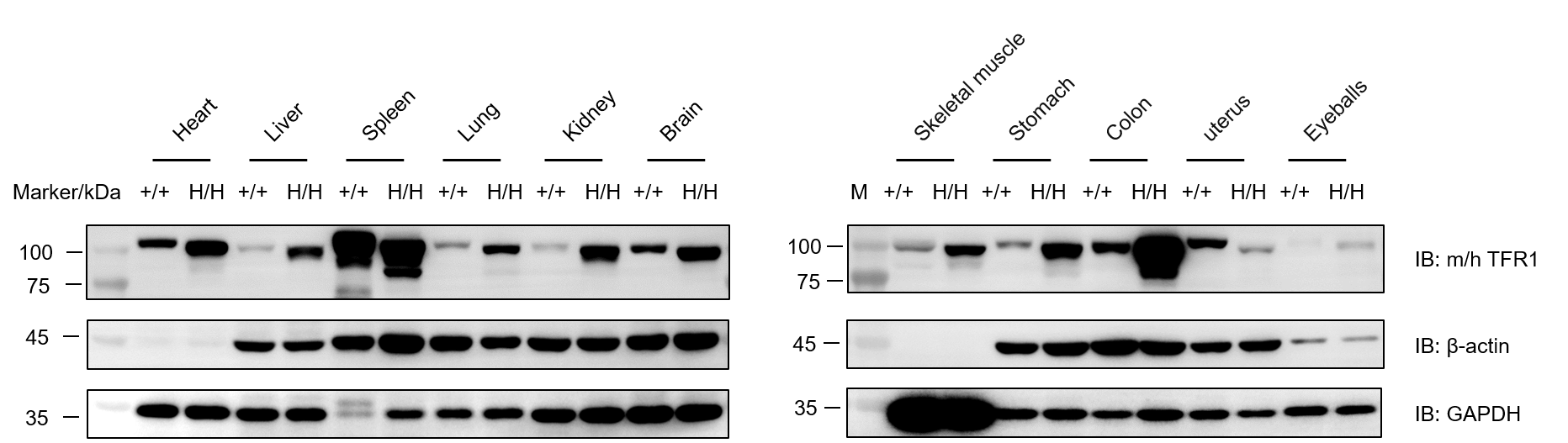
Western blot analysis of TFR1 protein expression in wild-type B-NDG mice and homozygous B-NDG hTFR1 mice plus by WB. Various tissues were collected from wild-type B-NDG mice (+/+) and homozygous B-NDG hTFR1 mice plus (H/H) (female, 6-week-old), and then analyzed by western blot with anti-TFR1 antibody (abcam, ab214039). 40 μg total proteins were loaded for western blotting analysis. GAPDH were detected as internal control. M, marker.
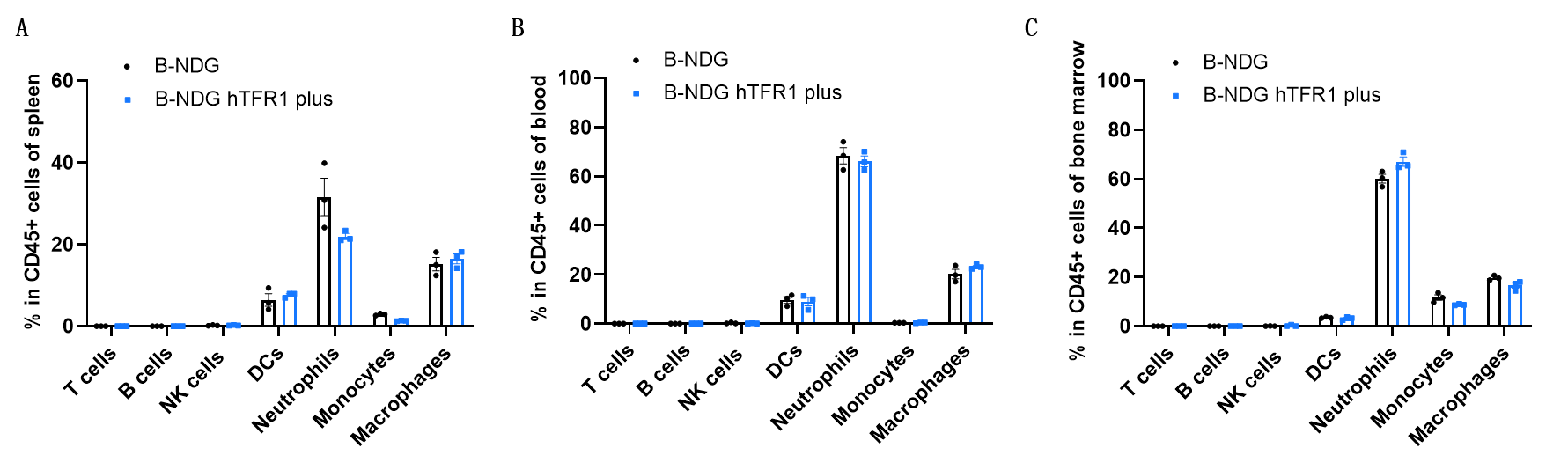
Frequency of leukocyte subpopulations by flow cytometry. Splenocytes (A), blood cells (B) and bone marrow cells (C) were isolated from wild-type B-NDG mice (female, n=3, 9-week-old) and homozygous B-NDG hTFR1 mice plus (female, n=3, 9-week-old). Flow cytometry analysis was performed to assess the frequency of leukocyte subpopulations. B-NDG mice and B-NDG hTFR1 mice plus lack T cells, B cells and NK cells. DCs, neutrophils, monocytes and macrophages in homozygous B-NDG hTFR1 mice plus were similar as in B-NDG mice. Humanization of TFR1 does not change the overall frequency or distribution of immune cell types in spleen, blood and bone marrow. Values are expressed as mean ± SEM. Significance was determined by two-way ANOVA test.