Description
- ACVR1C (ALK7) serves as a receptor for specific ligands within the TGF-β superfamily, such as Activin E, Activin B, and GDF-3. This receptor demonstrates high expression levels in both rodent and human adipose tissue. Through inhibition of ALK7 in adult mice has been shown to inhibit diet-induced weight gain, reduce fat accumulation and adipocyte size, and enhance adipocyte lipolysis alongside β-adrenergic signaling activity (DOI: 10.7554/eLife.03245).
- The genome sequences between exons 2-9 in the mouse Acvr1c gene were depleted in B-Acvr1c KO mice.
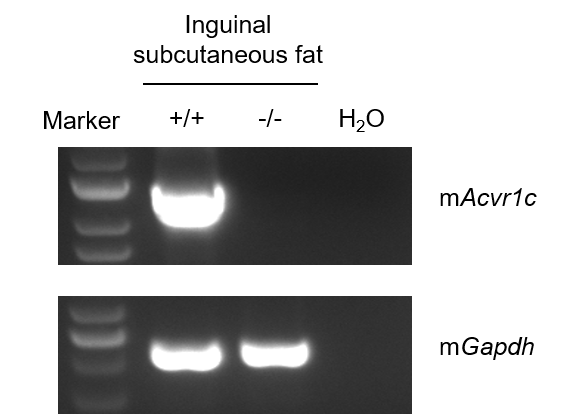
- Mouse Acvr1c mRNA was exclusively detectable in wild-type mice but not in B-Acvr1c KO mice
Targeting Strategy
Gene targeting strategy for B-Acvr1c KO mice. The genome sequences between exons 2-9 in the mouse Acvr1c gene were depleted in B-Acvr1c KO mice.
mRNA Expression Analysis
Strain specific analysis of Acvr1c mRNA expression in wild-type C57BL/6JNifdc mice and B-Acvr1c KO mice by RT-PCR. Inguinal subcutaneous fat RNA was isolated from wild-type C57BL/6JNifdc mice (+/+) and homozygous B-Acvr1c KO mice (-/-), then cDNA libraries were synthesized by reverse transcription, followed by PCR with mouse Acvr1c primers. Mouse Acvr1c mRNA was only detectable in wild-type mice but not in B-Acvr1c KO mice.
* When publishing results obtained using this animal model, please acknowledge the source as follows: The animal model [B-Acvr1c KO mice] (Cat# 114681) was purchased from Biocytogen.