Description
- The Nav1.9 channel, which is a voltage-gated sodium channel and highly expressed in small diameter neurons of dorsal root ganglions and Dogiel II neurons in enteric nervous system, plays a vital role in the generation of pain and the formation of neuronal hyperexcitability after inflammation. The Nav1.9 channel consists of α and β subunits. The α subunit is the main functional subunit and forms ion-selective channels. The β subunit is the coregulatory subunit.
- Gene editing strategy: The exons 2-30 of mouse Scn11a gene that encode the whole molecule (ATG to STOP codon) were replaced by human counterparts in B-hSCN11A mice. The promoter, 5’UTR and 3’UTR region of the mouse gene are retained. The human SCN11A expression is driven by endogenous mouse Scn11a promoter, while mouse Scn11a gene transcription and translation will be disrupted.
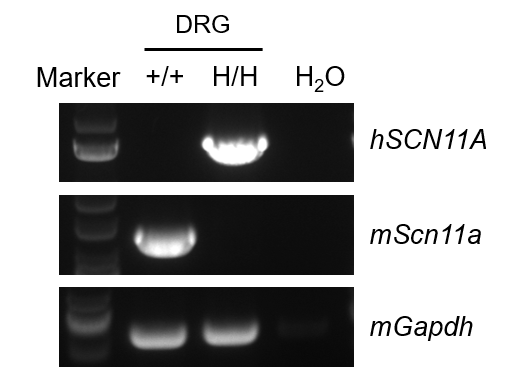
- mRNA expression analysis: Human SCN11A mRNA was detectable only in homozygous B-hSCN11A mice but not in wild-type mice.
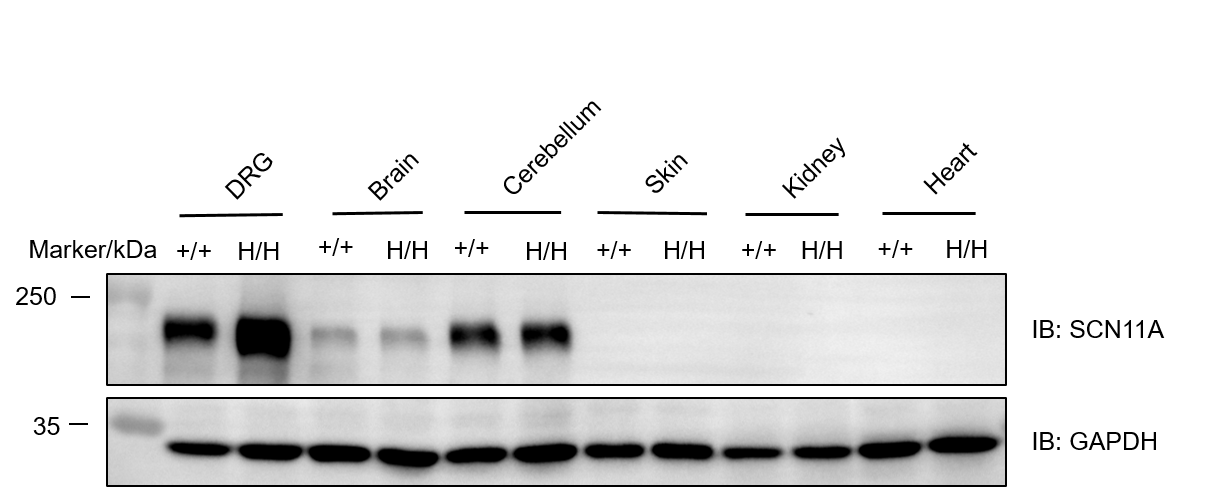
- Protein expression analysis: SCN11A protein was detectable in DRG, brain and cerebellum from homozygous B-hSCN11A mice and wild-type C57BL/6 mice.
- Application: This product is used for the efficacy research and safety evaluation of analgesic drugs.
Targeting Strategy
Gene targeting strategy for B-hSCN11A mice. The exons 2-30 of mouse Scn11a gene that encode the whole molecule (ATG to STOP codon) were replaced by human counterparts in B-hSCN11A mice. The promoter, 5’UTR and 3’UTR region of the mouse gene are retained. The human SCN11A expression is driven by endogenous mouse Scn11a promoter, while mouse Scn11a gene transcription and translation will be disrupted.
mRNA Expression Analysis
Strain specific analysis of SCN11A mRNA expression in wild-type C57BL/6JNifdc mice and homozygous B-hSCN11A mice by RT-PCR. Dorsal root ganglia (DRG) RNA were isolated from wild-type C57BL/6JNifdc mice (+/+) and homozygous B-hSCN11A mice (H/H), then cDNA libraries were synthesized by reverse transcription, followed by PCR with mouse or human SCN11A primers. Mouse Scn11a mRNA was detectable in wild-type C57BL/6JNifdc mice. Human SCN11A mRNA was detectable only in homozygous B-hSCN11A mice but not in wild-type mice.
Protein Expression Analysis
Western blot analysis of SCN11A protein expression in homozygous B-hSCN11A mice. Various tissue lysates were collected from wild-type C57BL/6 mice (+/+) and homozygous B-hSCN11A mice (H/H), and then analyzed by western blot with anti-hSCN11A antibody (Proteintech, 85740-1-RR). 40 μg total proteins were loaded for western blotting analysis. SCN11A protein was detectable in DRG, brain and cerebellum from homozygous B-hSCN11A mice and wild-type C57BL/6 mice.
* When publishing results obtained using this animal model, please acknowledge the source as follows: The animal model [B-hSCN11A mice] (Cat# 113421) was purchased from Biocytogen.