
C57BL/6JNifdc-Igs2tm3(Thy1-SNCA*A53T)Bcgen/Bcgen • 114200


Gene targeting strategy for B-Thy1-hSNCA*A53T mice. The full coding sequences of human SNCA with A53T mutation including the 3’UTR that is driven by mouse Thy1 promoter are inserted into mouse Hipp11 (H11) locus in B-Thy1-hSNCA*A53T mice.

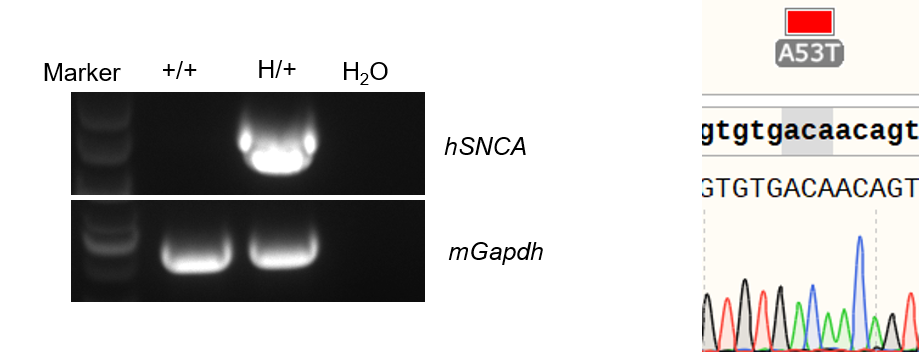
Strain specific analysis of SNCA mRNA expression in wild-type C57BL/6JNifdc mice and B-Thy1-hSNCA*A53T mice by RT-PCR. Cortex RNA were isolated from wild-type C57BL/6HNifdc mice (+/+) and heterozygous B-Thy1-hSNCA*A53T mice (H/+), then cDNA libraries were synthesized by reverse transcription, followed by PCR with human SNCA primers. Human SNCA mRNA was exclusively detectable in heterozygous B-Thy1-hSNCA*A53T mice but not in wild-type mice. The point mutation was confirmed via Sanger sequencing.

Species specific analysis of SNCA gene expression in heterozygous B-Thy1-hSNCA*A53T mice. Striatum, midbrain, hippocampus and cortex were collected from heterozygous B-Thy1-hSNCA*A53T mice (H/+) (male, n=3, 6-7-week-old). As the human SNCA expression cassette was inserted into mouse Hipp11 (H11) locus in B-Thy1-hSNCA*A53T mice, the expression level of mouse and human SNCA could be detected at the same mice. The mRNA expression pattern of human SNCA in heterozygous B-Thy1-hSNCA*A53T mice was similar to those in the wild-type C57BL/6JNifdc mice. Values are expressed as mean ± SEM.
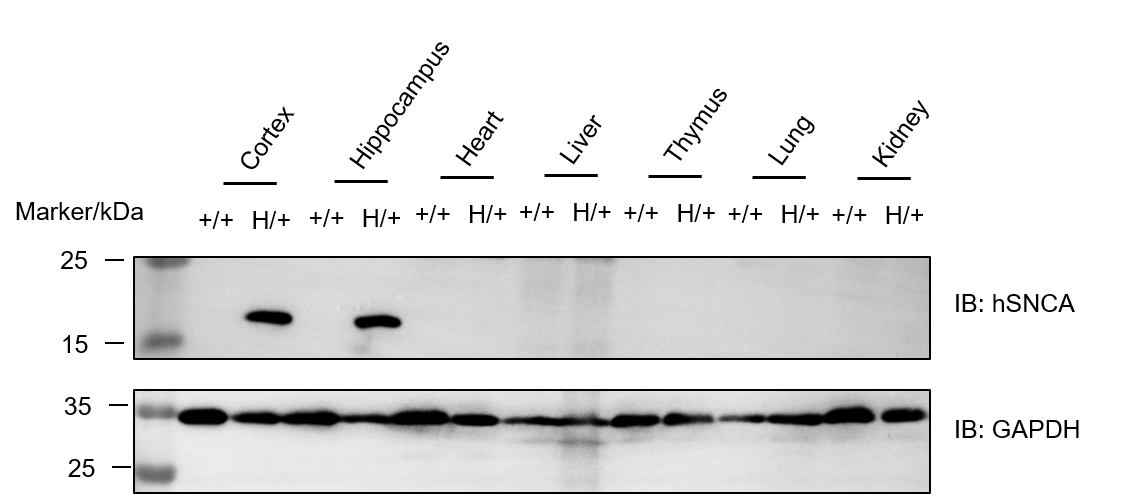
Western blot analysis of SNCA protein expression in heterozygous B-Thy1-hSNCA*A53T mice. Various tissue lysates were collected from C57BL/6JNifdc wild-type (+/+) mice and heterozygous B-Thy1-hSNCA *A53T mice (H/+), and then analyzed by western blot with human-specific anti-SNCA antibody (abcam, ab138501). 40 μg total proteins were loaded for western blotting analysis. SNCA was only detected in hippocampus, cortex from heterozygous B-Thy1-hSNCA*A53T mice, but not from wild-type mice.
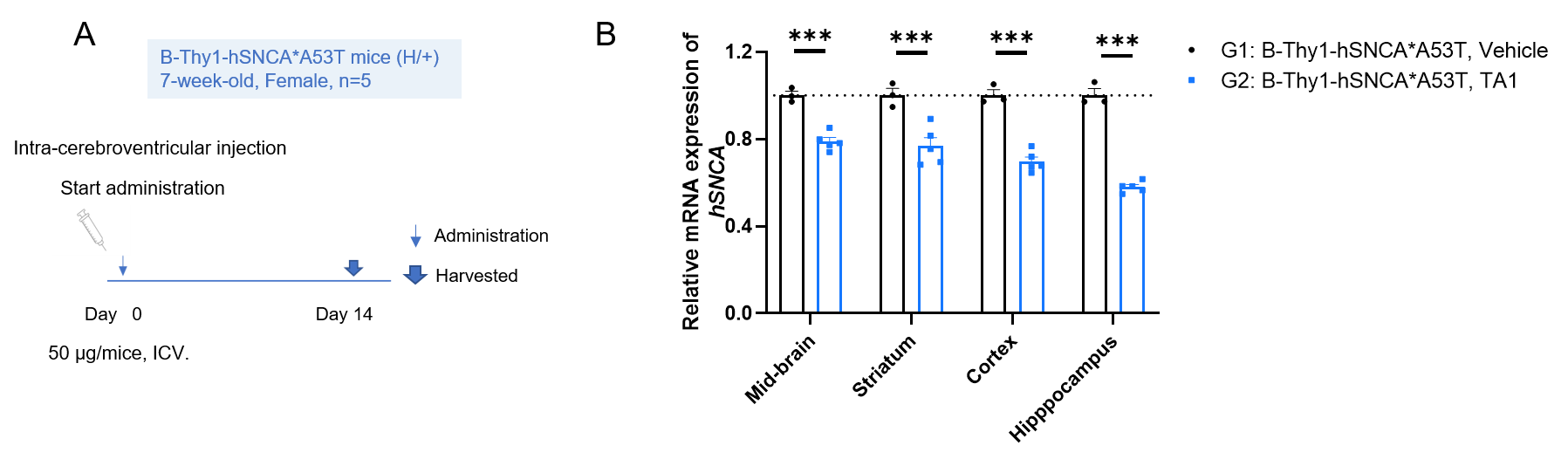
The inhibitory efficiency of the SNCA-targeted small nucleic acid drug in heterozygous B-Thy1-hSNCA*A53T mice. B-Thy1-hSNCA*A53T mice were randomly divided into 2 groups (n=8, 7-week-old, female). The human SNCA-targeted nucleic acid drug (Test Article 1, TA1, produced in-house according to a patent) and artificial cerebrospinal fluid (αCSF) were administered to the mice individually. The mice were sacrificed on day 14, and the brains (cortex, hippocampus, mid-brain and striatum) were collected to detect the human SNCA expression by qRT-PCR. (A) The schematic diagram of experimental processing. (B) The expression of human SNCA mRNA in cortex, hippocampus, mid-brain and striatum. Mouse Gapdh served as an internal reference gene, and SNCA expression in each tissues was normalized to that in the vehicle control. The human SNCA mRNA in the treatment group was significantly reduced compared to the control group. Values are expressed as mean ± SEM. Significance was determined by 2-way ANOVA. *P < 0.05, **P < 0.01, ***P < 0.001.