Description
- Amyloid β (Aβ): Aβ is one of the key pathological features of Alzheimer's disease (AD). In the brains of AD patients, Aβ abnormally accumulates to form amyloid plaques. These plaques interfere with signal transmission between nerve cells, leading to neuronal dysfunction and death, subsequently causing symptoms such as cognitive decline and memory loss.
- Transferrin Receptor 1 (TFR1): TfR1 is a transmembrane protein primarily responsible for mediating cellular iron uptake via transferrin endocytosis. In the central nervous system, TfR1 is highly expressed on the endothelial cells of the blood-brain barrier (BBB), making it a key receptor target for antibody-mediated transcytosis to transport therapeutic agents into the brain.
- Solute Carrier Family 3 Member 2 (CD98hc): CD98hc (encoded by SLC3A2) is highly enriched in cerebral capillaries and microvessels, localizing to both the luminal and abluminal surfaces of brain endothelial cells. It serves as an alternative receptor target for facilitating drug delivery across the BBB via receptor-mediated transcytosis.
- Therapeutic Applications: Multispecific therapeutic antibodies (or brain shuttle constructs) target TfR1 or CD98hc to exploit receptor-mediated transcytosis, markedly enhancing drug permeability across the blood-brain barrier (BBB). Once within the central nervous system, the anti-Aβ arm specifically binds to Aβ plaques to promote their clearance and alleviate neurotoxicity.
Targeting strategy
5XFAD
- The Tg(5XFAD) mouse line was introduced from Northwest University. A transgene was designed with a mutant human amyloid beta precursor protein (APP) cDNA sequence—containing the Swedish (K670N/M671L), Florida (I716V), and London (V717I) mutations—inserted into exon 2 of the mouse Thy1 gene. A second transgene was designed with a mutant human presenilin 1 (PSEN1) cDNA sequence—containing the M146L and L286V mutations—inserted into exon 2 of the mouse Thy1 gene. Both transgenes were combined in equal proportions and co-injected into the pronuclei of single-cell embryos to generate Tg(5XFAD) mice.
TFR1
- The exons 4–19 of mouse Tfr1 gene that encode the extracellular domain were replaced by human counterparts in B-hTFR1 mice. The genomic region of mouse Tfr1 gene that encodes the transmembrane and cytoplasmic portions was retained. The promoter, 5′ UTR, and 3′ UTR regions of the mouse gene were also retained. The chimeric TFR1 expression is driven by the endogenous mouse Tfr1 promoter, while mouse Tfr1 gene transcription and translation are disrupted.
CD98HC
- The exons 2–10 of mouse Slc3a2 (Cd98) gene that encode the extracellular domain were replaced by human SLC3A2 (CD98HC) exons 4–12. The promoter, 5′ UTR, and 3′ UTR regions, as well as the transmembrane and intracellular domains of the mouse gene, were retained.
- Tg(5XFAD)/B-hTFR1/hCD98HC mice were obtained by crossbreeding Tg(5XFAD) mice, B-hTFR1 mice, and B-hCD98HC mice.
Histopathological analysis in Tg(5XFAD)/B-hTFR1/hCD98HC mice
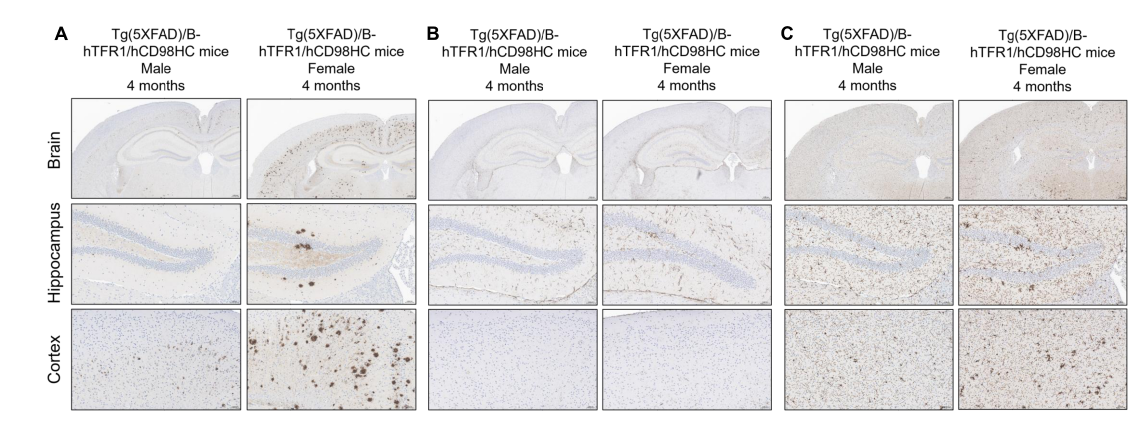
Histopathological analysis in 4-month-old Tg(5XFAD)/B-hTFR1/hCD98HC mice. Brain was collected from Tg(5XFAD)/B-hTFR1/hCD98HC mice and processed into paraffin sections. The Aβ plaque, astrocytes and microglia cells were detected by IHC. Female mice presented more severe Aβ plaques relative to males. (A) Aβ plaque; (B) Astrocytes; (C) microglia cells; Scale bar: 200 μm.
* When publishing results obtained using this animal model, please acknowledge the source as follows: The animal model [Tg(5XFAD)/B-hTFR1/hCD98HC mice] (Cat# 114762) was purchased from Biocytogen.