このページで

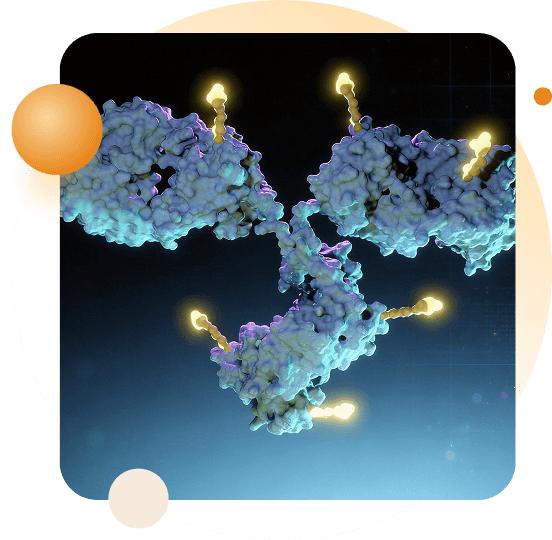
Built on the RenLite® platform, BCG040 utilizes common light chain technology to eliminate heavy/light chain mispairing, ensure seamless assembly, simplify manufacturing, and provide a developable antibody backbone for the B7-H4 biparatopic ADC drug development.
BCG040 is conjugated with Biocytogen's proprietary BLD1102 linker–payload system containing BCPT02, a topoisomerase I (TOP1) inhibitor payload designed to drive potent ADC-mediated cytotoxicity in solid tumor drug development.
BCG040 is being evaluated as a B7-H4-targeting biparatopic ADC drug development asset for epithelial malignancies. Potential development areas include ovarian, breast, biliary tract and pancreatic cancers.

The supporting preclinical data package for BCG040, generated from Biocytogen internal preclinical studies, includes SPR-based binding affinity, internalization, in vivo efficacy in PDX models, and pharmacokinetic (PK) evaluation. Together, these data support the development of BCG040 as a differentiated B7-H4-targeting biparatopic ADC for heterogeneous solid tumors.
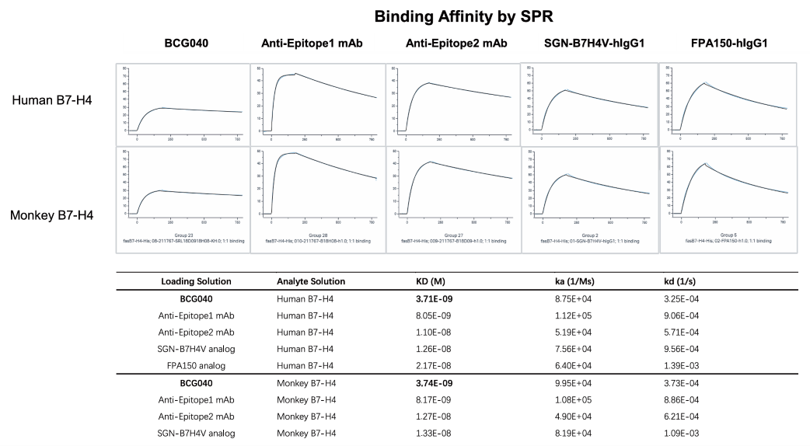
Figure 1. Surface plasmon resonance (SPR)-based affinity analysis of BCG040 binding to B7-H4. BCG040 demonstrated strong binding to human and cynomolgus monkey B7-H4, with KD values of 3.71E-09 M and 3.74E-09 M, respectively. This cross-reactivity profile, together with stronger affinity than the SGN-B7H4V and FPA150 benchmark analogs, supports enhanced target engagement for B7-H4 biparatopic ADC development. In addition, no off-target binding to other B7 family members was observed.
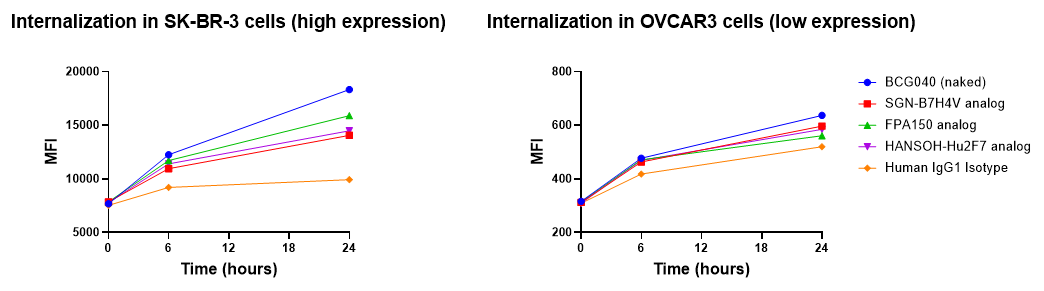
Figure 2. Internalization kinetics of BCG040 B7-H4 antibody backbone compared with benchmark B7-H4 antibody analogs. BCG040 (naked) showed faster internalization than both benchmark analogs in breast (SK-BR-3) and ovarian (OVCAR3) cells, supporting the biparatopic B7-H4 antibody design for accelerated intracellular trafficking and ADC payload delivery. In addition, BCG040 (naked) exhibited stronger binding activity than the benchmark analogs in these tumor cell models.
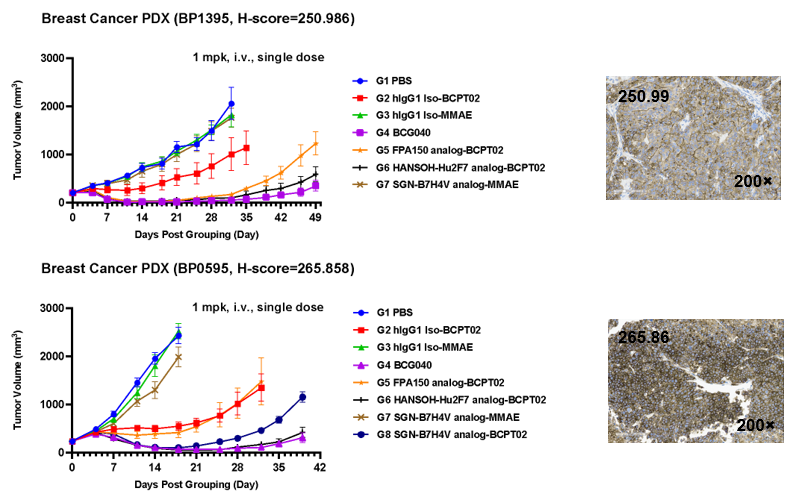
Figure 3. Antitumor efficacy of BCG040 B7-H4 biparatopic ADC in breast cancer PDX models. A single dose of BCG040 at 1 mg/kg induced sustained tumor regression for approximately 40 days in breast cancer PDX models. BCG040 significantly suppressed tumor growth and outperformed benchmark B7-H4 ADC analogs, including Hu2F7, SGN-B7H4V, and FPA150 (conjugated with MMAE or BCPT02), demonstrating robust in vivo efficacy. In addition, no body weight loss was observed in any of the mouse models, supporting the preliminary tolerability profile of BCG040. (Data are expressed as mean ± SEM.)
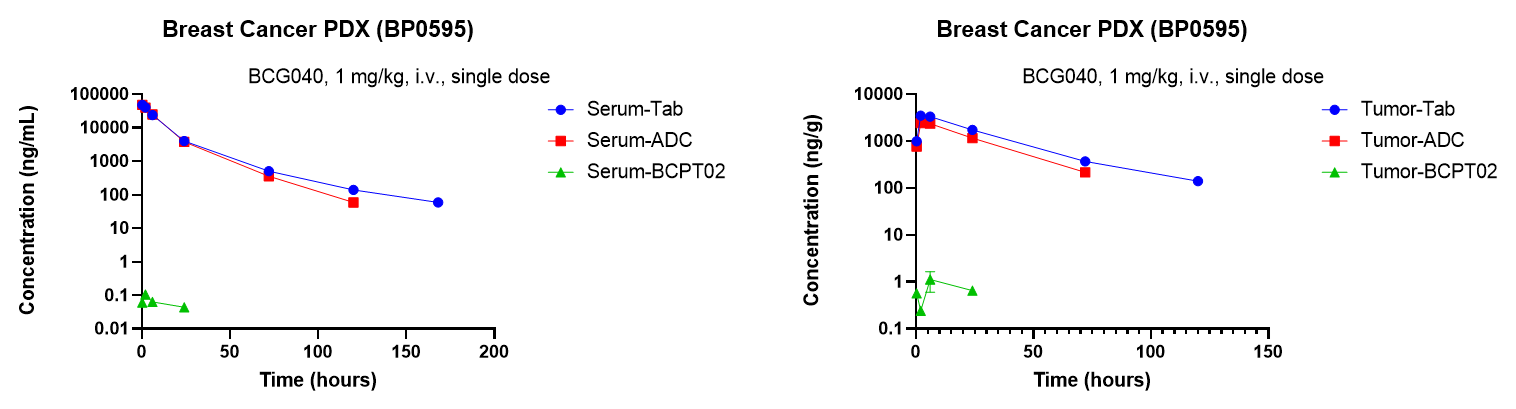
Figure 4. Pharmacokinetic (PK) profile of BCG040 B7-H4 biparatopic ADC in serum and tumor compartments in a breast cancer PDX model. Following a single administration of BCG040 at 1 mg/kg, concentration-time profiles were evaluated for total antibody (-Tab), intact ADC (-ADC), and released payload (-BCPT02) in both serum and tumor samples. BCG040 showed a favorable PK profile, with robust bloodstream stability and tumor accumulation, supporting systemic ADC stability and tumor delivery. Together with the observed antitumor efficacy and no apparent body weight loss in the tested models, this favorable PK profile supports the continued preclinical development of BCG040 as a B7-H4-targeting biparatopic ADC.

Biocytogen welcomes partnership discussions to further evaluate this B7-H4 biparatopic ADC asset.

BCG040 is designed as a first-in-class, fully human B7-H4 biparatopic ADC that binds two non-overlapping epitopes on B7-H4. This dual-epitope design promotes affinity-driven receptor clustering, accelerated internalization, and enhanced intracellular trafficking, supporting efficient ADC payload delivery compared with conventional single-epitope B7-H4 ADC approaches.
B7-H4 (VTCN1) is overexpressed in multiple epithelial malignancies, including ovarian cancer, breast cancer, biliary tract cancer, and pancreatic cancer. These tumor types often present limited treatment options, therapeutic resistance, and heterogeneous antigen expression. By targeting B7-H4-positive tumor cells with a biparatopic ADC design, BCG040 is being evaluated as a potential ADC development candidate for selected B7-H4-expressing epithelial tumors.
BCG040 is conjugated with Biocytogen's proprietary BLD1102 linker–payload system containing BCPT02, a topoisomerase I (TOP1) inhibitor payload. The BLD1102 linker–payload design is engineered to support potent ADC-mediated cytotoxicity, controlled payload release, hydrophilicity, circulation stability, and overall ADC developability.
BCG040 is built on Biocytogen's RenLite® common light chain technology, which supports fully human antibody generation and developable antibody backbone design. For BCG040, the RenLite-derived biparatopic antibody format enables dual-epitope B7-H4 recognition while supporting efficient antibody assembly, ADC engineering, and downstream developability.
Human/cynomolgus B7-H4 cross-reactivity supports translational preclinical evaluation by enabling species-relevant assessment of BCG040. Strong binding to both human and cynomolgus monkey B7-H4 highlights BCG040 as a promising B7-H4-targeting biparatopic ADC candidate for translational development.