
C57BL/6-Cd3etm1(CD3E)Bcgen Cd3dtm1(CD3D)BcgenCd3gtm1(CD3G)Bcgen Tnfrsf17tm1(TNFRSF17)Bcgen/Bcgen • 112602
| Product name | B-hCD3EDG/hBCMA mice |
|---|---|
| Catalog number | 112602 |
| Strain name | C57BL/6-Cd3etm1(CD3E)Bcgen Cd3dtm1(CD3D)BcgenCd3gtm1(CD3G)Bcgen Tnfrsf17tm1(TNFRSF17)Bcgen/Bcgen |
| Strain background | C57BL/6 |
| NCBI gene ID | 916,915,917,608 (Human) |
| Aliases | T3E; TCRE; IMD18; CD3epsilon; T3D; IMD19; CD3DELTA; CD3-DELTA; T3G; IMD17; CD3GAMMA; CD3-GAMMA; BCM; BCMA; CD269; TNFRSF13A |

Key Advantages
Validation
Application

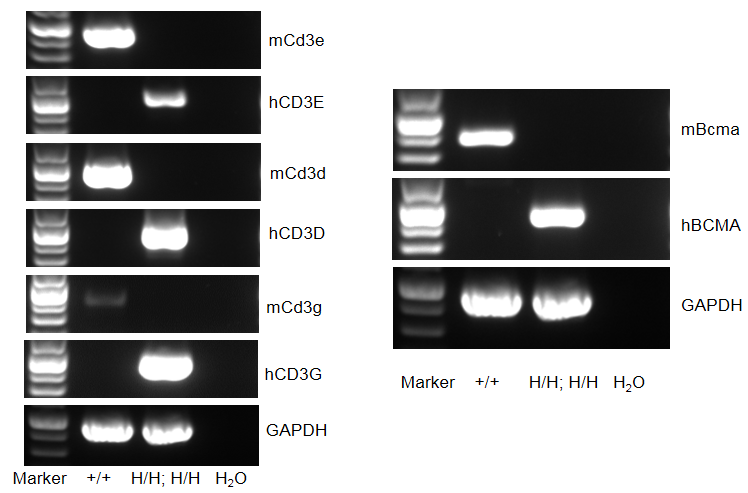
Strain-specific analysis of human CD3EDG and BCMA gene expression was performed in wild-type mice and CD3EDG/BCMA humanized mice by RT-PCR. Mouse Cd3edg and Bcma mRNA were detectable in splenocytes of wild-type mice (+/+). Human CD3EDG and BCMA mRNA were detectable in homozygous CD3EDG/BCMA humanized mice (H/H; H/H), but not in wild-type mice (+/+). The positive band was confirmed by sequencing.
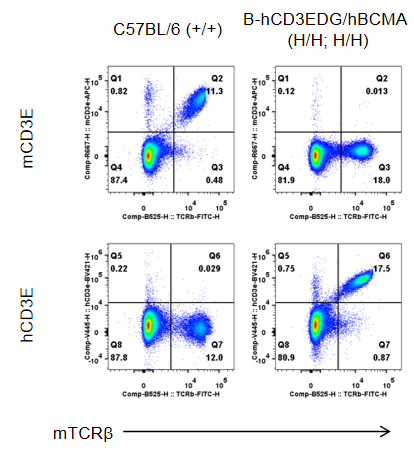
Strain-specific human CD3E expression analysis was performed in homozygous CD3EDG/BCMA humanized mice by flow cytometry. Splenocytes were collected from wild-type mice (+/+) and homozygous CD3EDG/BCMA humanized mice (H/H; H/H), and analyzed by flow cytometry using species-specific anti-CD3E antibody. Mouse CD3E was detectable in wild-type mice (+/+). Human CD3E was detectable in homozygous CD3EDG/BCMA humanized mice (H/H; H/H), but not in wild-type mice (+/+).
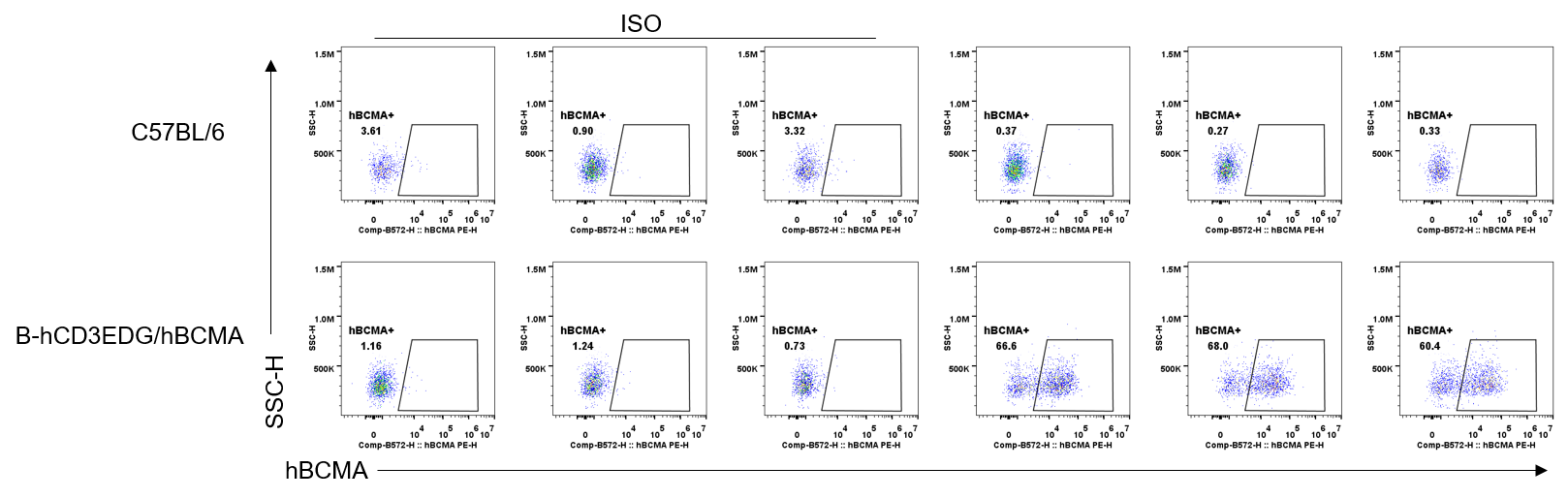
BCMA expression was analyzed in wild-type C57BL/6 mice and homozygous CD3EDG/BCMA humanized mice by flow cytometry. Spleen plasma cells were collected from wild-type C57BL/6 mice and homozygous CD3EDG/BCMA humanized mice. Protein expression was analyzed using human BCMA antibody (BioLegend, 357504). Human BCMA was detectable in plasma cells of spleen from CD3EDG/BCMA humanized mice but not in wild-type C57BL/6 mice.

Q1:What are CD3EDG/hBCMA Humanized Mice?
CD3EDG/hBCMA Humanized Mice are genetically engineered mice expressing humanized CD3EDG and BCMA targets for translational immuno-oncology and hematologic malignancy research.
Q2: Why is hBCMA an important therapeutic target?
BCMA is highly expressed on plasma cells and multiple myeloma cells and plays important roles in B cell maturation, plasma cell survival, and tumor biology, making it a promising target for multiple myeloma and other B cell malignancy therapeutics.
Q3: Can these mice be used for bispecific antibody evaluation?
Yes. The model is designed for evaluation of BsADCs, T cell engagers, and other human-specific BCMA-targeted therapeutics.
Q4: What tissues express humanized hBCMA in this model?
Humanized CDH17 expression was confirmed in spleen plasma cells .
Q5: Are these mice suitable for toxicity studies?
Yes. The model supports both efficacy and toxicity assessment of hBCMA-targeted immunotherapies in vivo.