
C57BL/6-F11tm1(F11)Bcgen/Bcgen • 112749

Key Advantages
Validation
Applications

In FXI Humanized Mice, exons 1-15 of the mouse Fxi gene encoding the full-length protein (from ATG to STOP codon, including 3' UTR) are replaced by the corresponding exons of the human FXI gene. The human FXI expression is driven by the human FXI promoter and 5' UTR. Concurrently, mouse Fxi gene transcription and translation are disrupted, ensuring that human FXI is expressed in the knock-in mice.

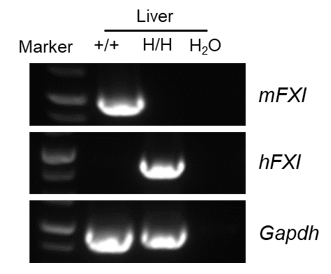
Strain-specific analysis of FXI mRNA expression was performed in wild-type C57BL/6 mice and FXI humanized mice by RT-PCR. Liver RNA was isolated from wild-type C57BL/6 mice (+/+) and homozygous FXI humanized mice (H/H). cDNA libraries were synthesized by reverse transcription followed by PCR using mouse or human FXI-specific primers.
Mouse FXI mRNA was detectable in wild-type C57BL/6 mice, whereas human FXI mRNA was detectable in homozygous FXI humanized mice.
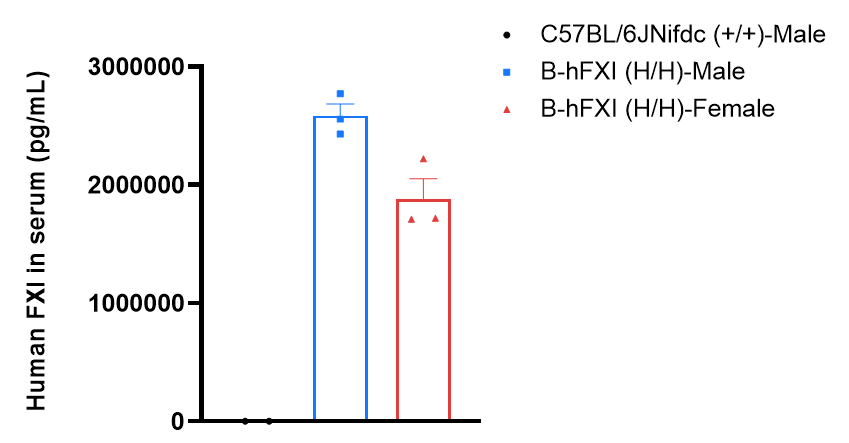
Strain-specific FXI protein expression analysis was performed in wild-type C57BL/6JNifdc mice and homozygous FXI humanized mice by ELISA. Serum samples were collected from wild-type C57BL/6JNifdc mice (+/+) (n=2, male, 7-week-old) and homozygous FXI humanized mice (H/H) (n=3, male, 7-week-old; n=3, female, 7-week-old).
Serum samples were analyzed using a species-specific FXI ELISA kit (Human Coagulation Factor XI ELISA Kit, Invitrogen, ab272776). Human FXI was detectable in homozygous FXI humanized mice but not in wild-type mice. Values are expressed as mean ± SEM.

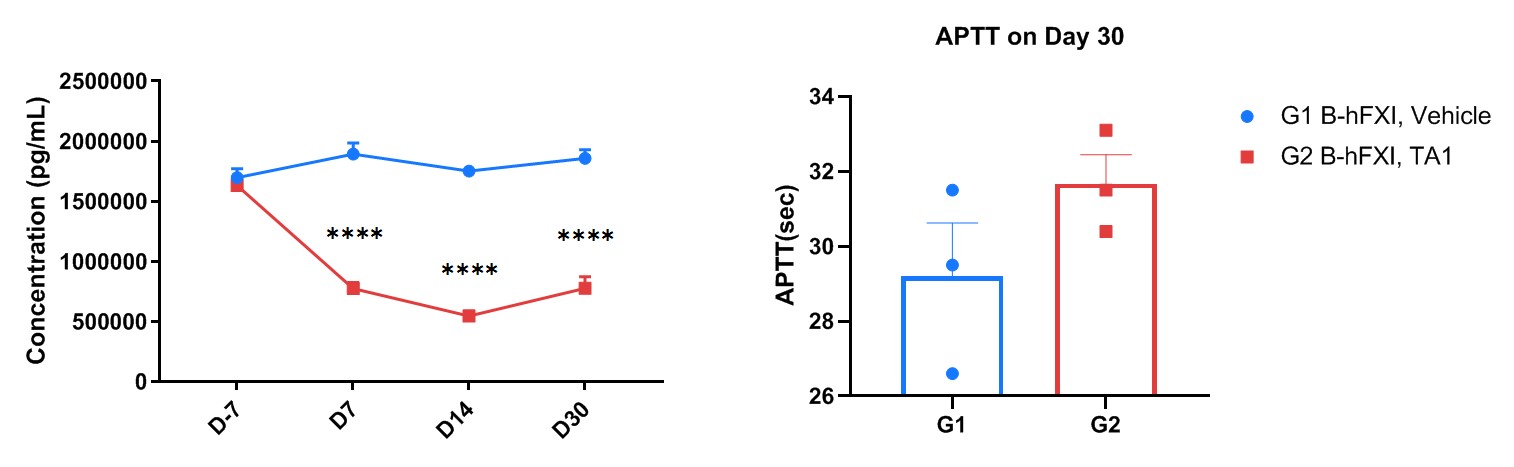
The inhibitory efficiency of FXI-targeted nucleic acid drug was evaluated in homozygous FXI humanized mice. FXI humanized mice were randomly divided into two groups (8-week-old, female). Human FXI-targeted nucleic acid drug provided by the client or saline control were individually administered to mice.
Mice were sacrificed on day 30.
(A) Changes in serum FXI protein expression levels on days -7, 7, 14, and 30 after administration relative to baseline levels before treatment. Human FXI levels in the treatment group were reduced compared with the control group (G1).
(B) Activated Partial Thromboplastin Time (aPTT) assay on Day 30.
Values are expressed as mean ± SEM. Statistical significance was determined using two-way ANOVA. *P<0.05, **P<0.01, ***P<0.001, ****P<0.0001.

Activated Partial Thromboplastin Time (aPTT) analysis was performed following anti-human FXI antibody treatment in FXI humanized mice. FXI humanized mice were randomly divided into six groups (6-week-old, male). Anti-human FXI antibody abelacimab analog or PBS control was individually administered to mice.
Mice were sacrificed on Day 1 or Day 7.
(A) Activated Partial Thromboplastin Time (aPTT) assay on Day 1.
(B) Activated Partial Thromboplastin Time (aPTT) assay on Day 7.
aPTT values in treatment groups were increased compared with control groups. Values are expressed as mean ± SEM. Statistical significance was determined using two-way ANOVA. *P<0.05, **P<0.01, ***P<0.001, ****P<0.0001.

What are FXI humanized mice?
FXI humanized mice are genetically engineered mice expressing human coagulation factor XI instead of mouse Fxi, enabling translational coagulation and thrombosis studies.
Why is FXI an important therapeutic target?
FXI plays a critical role in intrinsic coagulation and thrombosis. Targeting FXI may provide anticoagulant efficacy with reduced bleeding risk.
Can FXI humanized mice be used for antibody evaluation?
Yes. FXI humanized mice support in vivo efficacy studies of anti-human FXI antibodies, including aPTT-based pharmacodynamic assessment.
Are these mice suitable for nucleic acid therapeutic studies?
Yes. FXI-targeted siRNA and nucleic acid therapeutics can be evaluated using FXI humanized mice.
What disease areas can be studied using FXI humanized mice?
These mice are suitable for thrombosis, coagulation disorders, cardiovascular disease, and anticoagulant drug development research.