
SD-Egfrtm1(EGFR)Bcgen/Bcgen • 113308


Gene targeting strategy for B-hEGFR rats. A chimeric CDS that encodes human EGFR extracellular domain, rats EGFR signal peptide, transmembrane and cytoplasmic domain, followed by rats 3’UTR-STOP is inserted right after rats Egfr exon2. The chimeric EGFR protein expression will be driven by endogenous rats Egfr promoter, while rats Egfr gene transcription and translation will be disrupted.

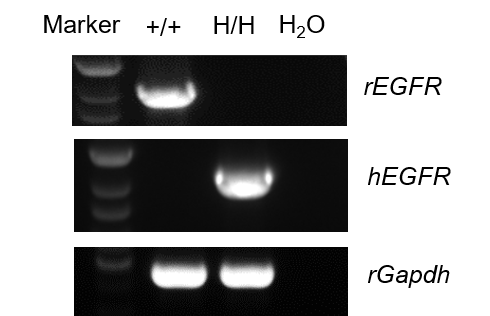
Strain specific analysis of EGFR mRNA expression in wild-type SD rats and B-hEGFR rats by RT-PCR. Liver RNA were isolated from wild-type SD rats (+/+) and homozygous B-hEGFR rats (H/H), then cDNA libraries were synthesized by reverse transcription, followed by PCR with rats or human EGFR primers. Rats Egfr mRNA was only detectable in wild-type SD rats. Human EGFR mRNA was exclusively detectable in homozygous B-hEGFR rats but not in wild-type SD rats.
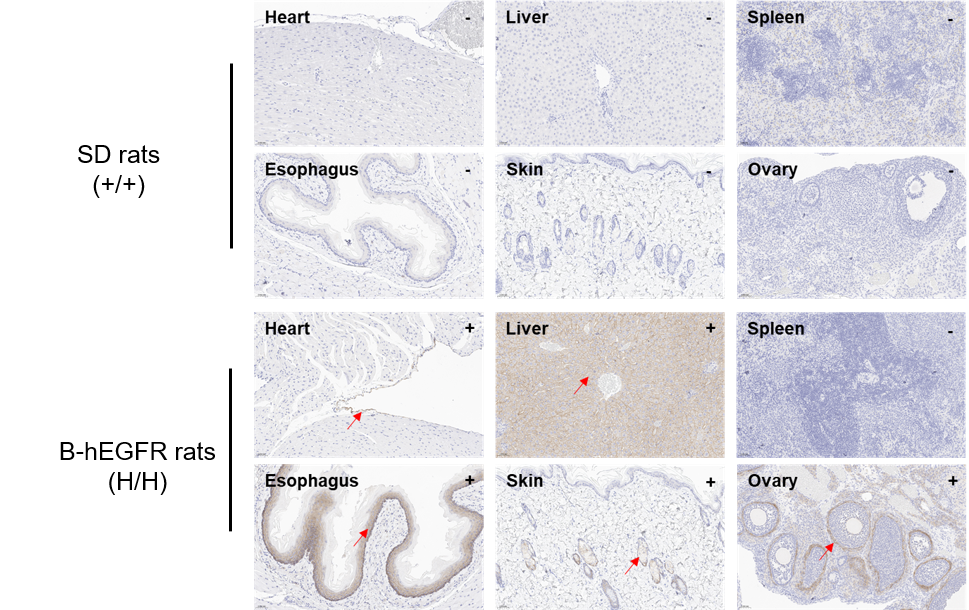
Immunohistochemical (IHC) analysis of EGFR expression in homozygous B-hEGFR rats. The heart, liver, spleen, esophagus, skin and ovary were collected from wild-type rats and homozygous B-hEGFR rats (H/H) (female, 8-week-old, n=1), analyzed by IHC with anti-EGFR (Invitrogen, MA5-49312). Human EGFR was detectable in heart, liver, esophagus, skin and ovary of B-hEGFR rats. The arrow indicates tissue cells with positive EGFR staining (brown). “+” indicates that the tissue is positive, and “-” indicates that the tissue is negative.