

BALB/cCrSlcNifdc-Her2tm1(HER2)Bcgen/Bcgen • 113474

Background:
Targeting strategy:
Validation:
Application:

Gene targeting strategy for B-hHER2 mice(C). The exons 2-17 of mouse Erbb2 gene that encode extracellular domain and transmembrane domain were replaced by human counterparts in B-hHER2 mice(C). The genomic region of mouse Erbb2 gene that encodes cytoplasmic portion was retained. The promoter, 5’UTR and 3’UTR region of the Erbb2 gene were also retained. The chimeric ERBB2 expression was driven by endogenous mouse Erbb2 promoter, while mouse Erbb2 gene transcription and translation will be disrupted.

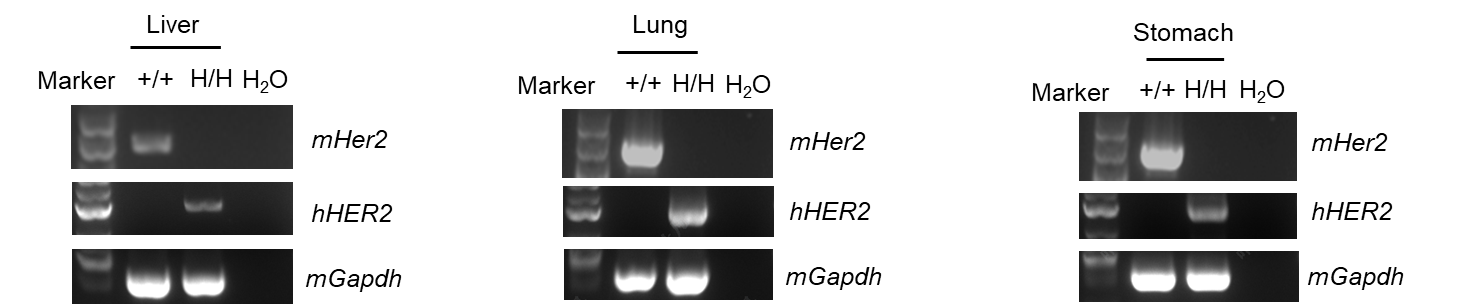
Strain specific analysis of HER2 mRNA expression in wild-type BALB/cCrSlcNifdc and B-hHER2 mice(C) by RT-PCR. Liver, lung and stomach RNA were isolated from wild-type BALB/cCrSlcNifdc (+/+) and homozygous B-hHER2 mice(C) (H/H), then cDNA libraries were synthesized by reverse transcription, followed by PCR with mouse or human HER2 primers. Mouse Her2 mRNA was detectable only in wild-type B-NDG mice. Human HER2 mRNA was detectable only in homozygous B-hHER2 mice(C) but not in wild-type mice.
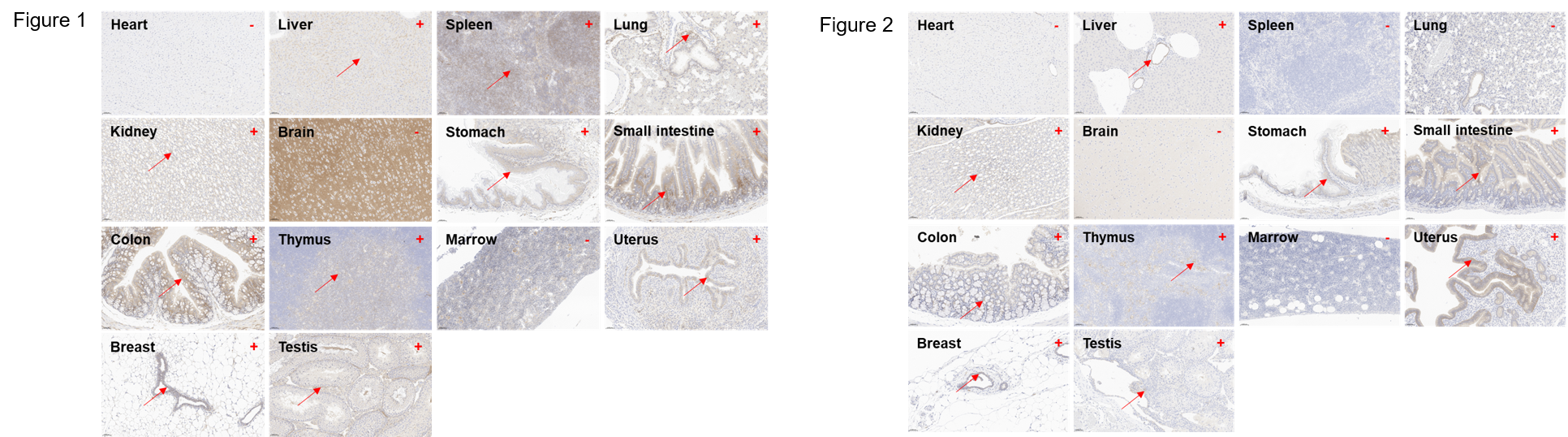
Immunohistochemical (IHC) analysis of HER2 protein expression in wild-type BALB/cCrSlcNifdc mice and B-hHER2 mice(C). Fourteen major tissues were collected from wild-type BALB/cCrSlcNifdc mice and homozygous B-hHER2 mice(C) and analyzed by IHC with anti-mouse HER2 antibodies (ab214275) and anti-human HER2 antibodies (ab16662). Mouse HER2 was detected in the lung, kidney, stomach, small intestine, colon, thymus, uterus, breast, testis, liver and spleen of wild-type mice (Figure 1). Human HER2 was detected in the lung, kidney, stomach, small intestine, colon, thymus, uterus, breast and testis of homozygous B-hHER2 mice(C) (Figure 2).


Antitumor activity of anti-human HER2 ADC (ERBB2-trastuzumab-L-hIgG1-T1, in-house) in B-hHER2 mice(C). (A) Anti-human HER2 ADC inhibited B-hHER2 CT26.WT tumor growth in B-hHER2 mice(C). Murine colon cancer B-hHER2 CT26.WT cells were subcutaneously implanted into B-hHER2 mice(C) (female, 8-week-old, n=6). Mice were grouped when tumor volume reached approximately 80 mm3, at which time they were intraperitoneally injected with anti-human HER2 ADC ERBB2-trastuzumab-L-hIgG1-T1 (in-house) indicated in panel. (B) Body weight changes during treatment. As shown in panel A, anti-human HER2 ADC was efficacious in controlling tumor growth in B-hHER2 mice(C), demonstrating that B-hHER2 mice(C) provide a powerful preclinical model for in vivo evaluation of anti-human HER2 antibodies. Values are expressed as mean ± SEM.