Description
LAYN: LAYN Serves as a Prognostic Biomarker and Downregulates Tumor-Infiltrating CD8+ T Cell Function in Hepatocellular Carcinoma
- Gene Information: LAYN is a widely expressed membrane receptor for hyaluronic acid. It serves as a prognostic biomarker and an indicator of immune cell infiltration in a variety of tumors. LAYN mediates functional exhaustion of CD8⁺ T cells, rendering the immune system incapable of efficiently killing cancer cells and thereby directly promoting tumor growth.
- Protein Expression: This 55-kDa transmembrane protein contains a C-type lectin-like domain. LAYN is preferentially expressed in intratumoral-infiltrating CD8+ TILs. LAYN+CD8+ T cells have increased levels of exhaustion markers, weakened proliferation ability, and decreased effector molecules.
- Signaling Pathway: In the tumor microenvironment (TME), high expression of LAYN is positively correlated with the potent immunosuppressive activity of Tregs. Overexpression of LAYN inhibits the secretion of IFN-γ by T cells and induces functional dysfunction (exhaustion). Blockade of LAYN signaling helps to maintain or restore the cytotoxic vitality of T cells.
- Therapeutic : The development of LAYN-blocking drugs can remodel tumor metabolism, restore the tumoricidal activity of T cells, and inhibit tumor progression.
Targeting strategy
Gene Targeting Strategy
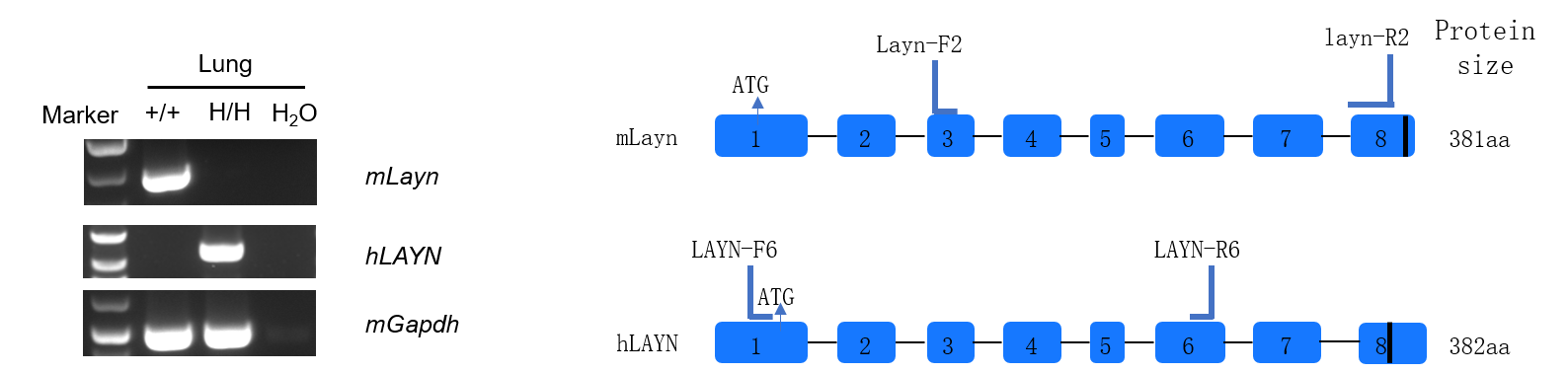
- Exons 1-8 of mouse Layn gene that encode signal peptide, extracellular domain, transmembrane domain, cytoplasmic region and 3’UTR are replaced by human counterparts in B-hLAYN mice.
- The promoter and 5’UTR region of the mouse gene are replaced by human counterparts.
mRNA expression analysis
- Human LAYN mRNA was exclusively detectable in homozygous B-hLAYN mice but not in wild-type mice.
Strain specific analysis of LAYN mRNA expression in wild-type C57BL/6JNifdc mice and B-hLAYN mice by RT-PCR. Lung RNA were isolated from wild-type C57BL/6JNifdc mice (+/+) and homozygous B-hLAYN mice (H/H), then cDNA libraries were synthesized by reverse transcription, followed by PCR with mouse LAYN primers. Mouse LAYN mRNA was detectable in wild-type mice but not in homozygous B-hLAYN mcie. Human LAYN mRNA was exclusively detectable in homozygous B-hLAYN mice but not in wild-type mice.
Protein Expression Analysis
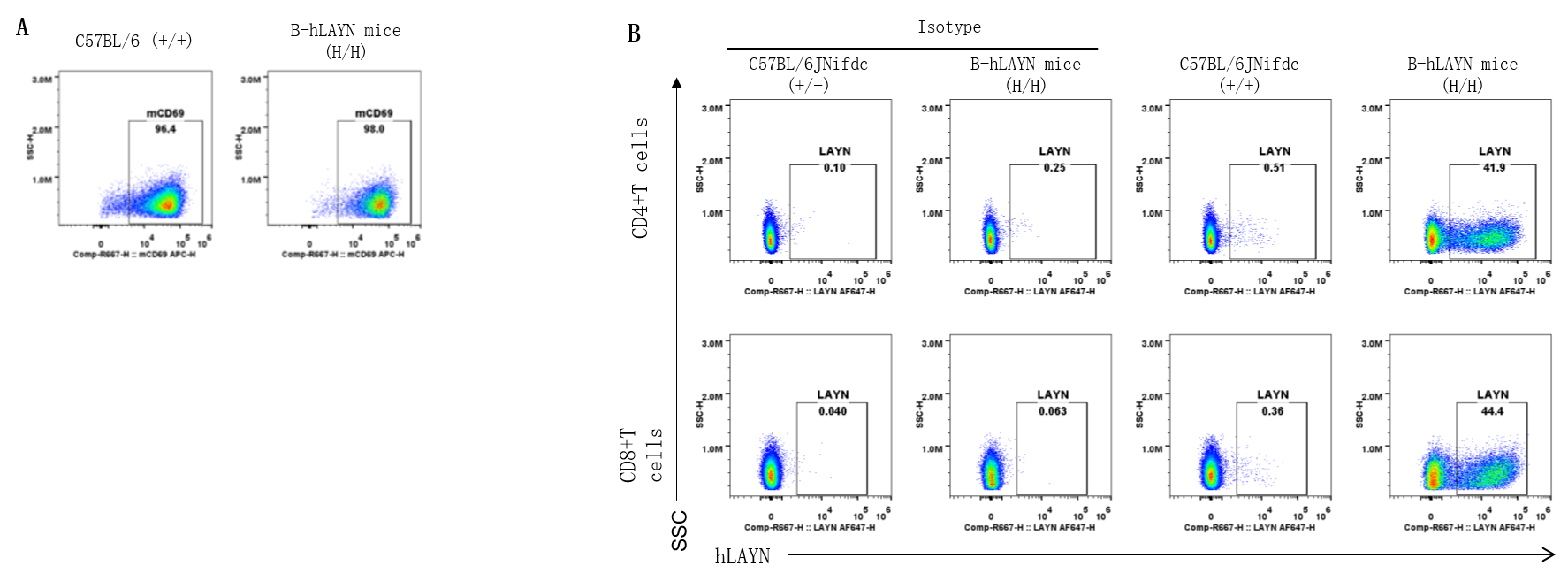
- About 100% of spleen T cells are activated in wild-type C57BL/6JNifdc mice (+/+) and homozygous B-hLAYN mice (H/H).
- hLAYN was detectable only in homozygous B-hLAYN mice,but not in wild-type C57BL/6JNifdc mice.
A: Evaluation of T cells activation in homozygous B-hLAYN mice by flow cytometry. CD69 is an early activation surface marker of T cells, whose expression can be upregulated upon stimulation with CD3/CD28. About 100% of T cells are activated.
B: Strain specific LAYN expression analysis in homoozygous B-hLAYN mice by flow cytometry. Spleen T cells was isolated from wild-type C57BL/6JNifdc mice (+/+) and homozygous B-hLAYN mice (H/H), anti-mCD3 (2 ug/ml)and anti-mCD28 (5 ug/ml) and analyzed by flow cytometry with anti-LAYN antibody(Sino Biological, 10208-MM02). hLAYN was detectable in homozygous B-hLAYN mice.
* When publishing results obtained using this animal model, please acknowledge the source as follows: The animal model [B-hLAYN mice] (Cat# 113694) was purchased from Biocytogen.