C57BL/6-Tg(CH17-70O18)1Bcgen Tfrctm1(TFRC)Bcgen/Bcgen • 114306


Gene targeting strategy for B-Tg(hPMP22)/hTFR1 mice.
The exons 4-19 of mouse Tfr1 gene that encode extracellular domain are replaced by human counterparts in B-hTFR1 mice. The genomic region of mouse Tfr1 gene that encodes cytoplasmic portion is retained. The promoter, 5’UTR and 3’UTR region of the mouse gene are also retained. The chimeric TFR1 expression is driven by endogenous mouse Tfr1 promoter, while mouse Tfr1 gene transcription and translation will be disrupted.
The BAC containing the whole human PMP22 genome sequence was randomly inserted into mouse genome in B-Tg(hPMP22) mice.
B-Tg(hPMP22)/hTFR1 mice were ontained by crossing B-Tg(hPMP22) mice (113146) and B-hTFR1 mice (110861).


Behavioral performance in wild-type C57BL/6JNifdc and B-Tg(hPMP22)/hTFR1 mice.
Clasping tests were conducted to assay the behavioral performance in wild-type C57BL/6JNifdc (4-month-old, n=10) and B-Tg(hPMP22)/hTFR1 mice (4-month-old, n=10). A, female. B, male.
B-Tg(hPMP22)/hTFR1 mice show significantly higher neuroscores versus wild-type mice, suggesting impaired neurological function. Values are expressed as mean ± SEM. Significance was determined by unpaired t-test, *P < 0.05, **P < 0.01, ***P < 0.001.
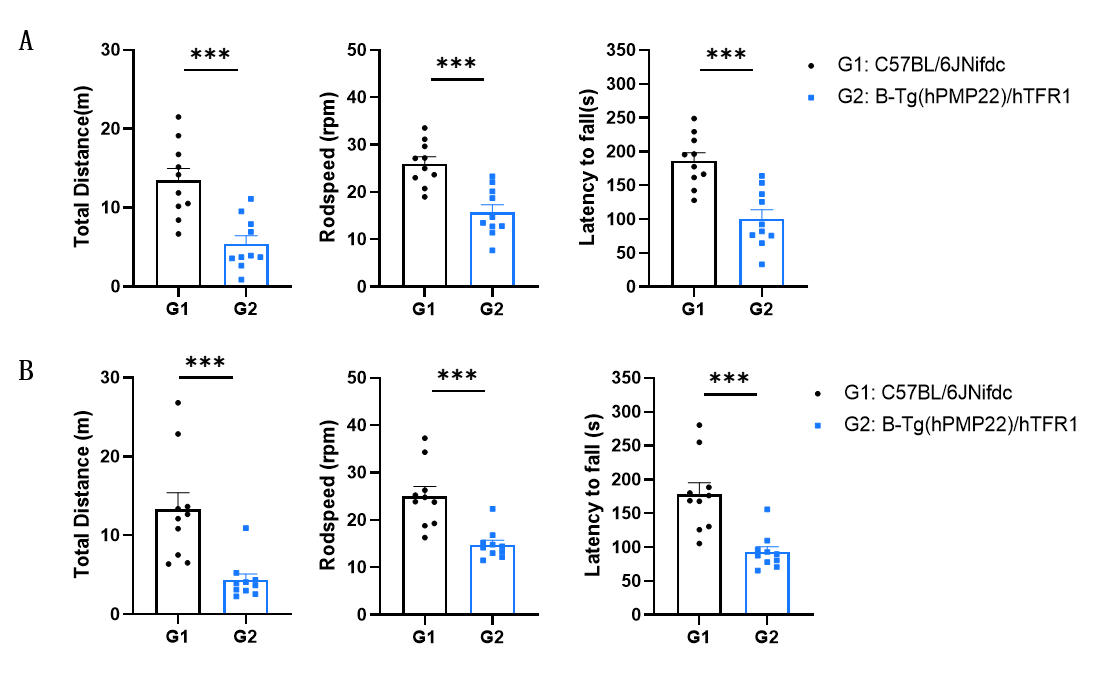
Behavioral performance in wild-type C57BL/6JNifdc and B-Tg(hPMP22)/hTFR1 mice. Rotarod tests were conducted to assay the behavioral performance in wild-type C57BL/6JNifdc and B-Tg(hPMP22)/hTFR1 mice (4-month-old, n=10). A, female. B, male. B-Tg(hPMP22)/hTFR1 mice showed decreased fall latency, glide speed and total distance, showing motor dysfunction at 4 months of age. Values are expressed as mean ± SEM. Significance was determined by unpaired t-test. *P < 0.05, **P < 0.01, ***P < 0.001.