Description
- Fms-like tyrosine kinase receptor 3 (Flt3) is a membrane protein that is strongly expressed on hematopoietic stem cells (HSCs). FLT3LG (FLT3 ligand) is a growth factor that can stimulate the proliferation, differentiation, and survival of these cells when it binds to its receptor FLT3. The Flt3/Flt3L signaling axis indeed plays an important role in the production of conventional dendritic cells (cDCs) and plasmacytoid dendritic cells (pDCs). Both types of dendritic cells are critical members of the immune system involved in processes such as fighting infections and regulating immune responses.
- The exons 2-9 of mouse Flt3 gene are replaced by the reverse inserted exons 1-9 of human FLT3LG including promoter, 5’UTR and 3’UTR region in B-NDG hFLT3LG, Flt3 KO mice.
- Mouse Flt3 mRNA was detectable only in B-NDG mice but not in homozygous B-NDG hFLT3LG, Flt3 KO mice. Human FLT3LG mRNA was detectable only in homozygous B-NDG hFLT3LG, Flt3 KO mice. mFLT3 was detectable in DCs and CD117+ cells of B-NDG mice, but not in homozygous B-NDG hFLT3LG, Flt3 KO mice. Mouse FLT3L was detectable in B-NDG mice and homozygous B-NDG hFLT3LG, Flt3 KO mice. Human FLT3LG was exclusively detectable in homozygous B-NDG hFLT3LG, Flt3 KO mice. Frequencies of DCs in B-NDG hFLT3LG, Flt3 KO mice were lower than those in B-NDG mice. The frequency and absolute number of reconstituted human T cells, NK cells, monocytes, cDCs, and pDCs in B-NDG hFLT3LG, Flt3 KO mice were all slightly higher than that in B-NDG mice. The reconstitution levels were different among different donors.
- Application: huHSC-B-NDG hFLT3LG, Flt3 KO mice enable robust reconstitution of multiple human immune lineages after engraftment of human CD34+ HSCs, especially human dendritic cells (cDCs and pDCs), together with T cells, B cells, and limited myeloid populations (e.g., monocytes/macrophages and granulocytes), making the model suitable for in vivo efficacy and toxicity evaluation of therapeutics targeting T-cell and myeloid cells.
Engraftment of Human CD34+ HSCs in B-NDG hFLT3LG, Flt3 KO mice to Reconstitute Human Immune System (Neonatal Mice)
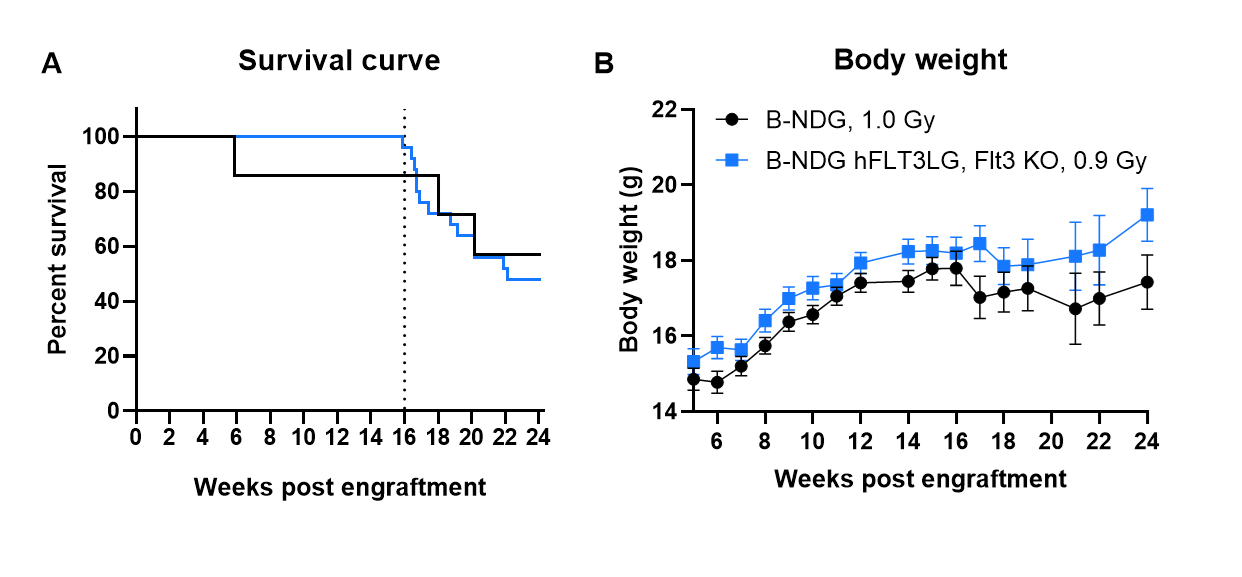
Human CD34+ HSCs (3×10⁴) were intravenously (temporal vein) engrafted into B-NDG mice and homozygous B-NDG hFLT3LG, Flt3 KO mice (female, 24-48 hr after birth, n=25). Results showed that the survival rate of B-NDG hFLT3LG, Flt3 KO mice was 100% after engraftment of human CD34+ HSCs for 16 weeks. The body weight of B-NDG hFLT3LG, Flt3 KO mice was increased steadily until 16 weeks’ reconstitution. Values are expressed as mean ± SEM. HSCs: hematopoietic stem cells.
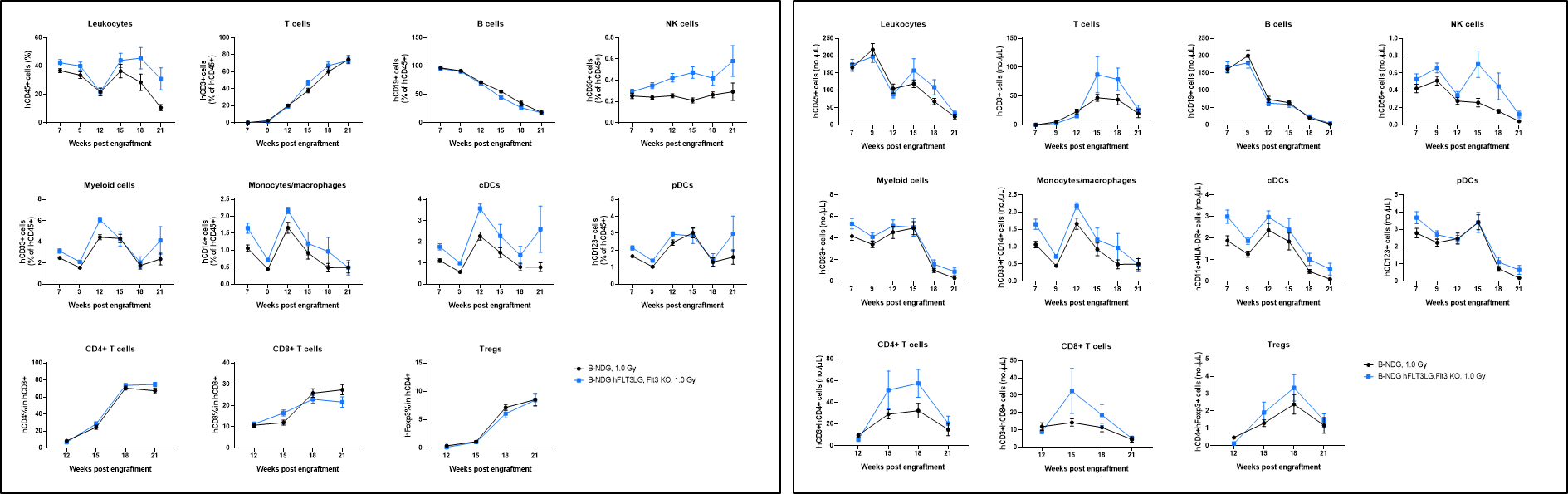
Human CD34+ HSCs (3×10⁴) were intravenously (temporal vein) engrafted into B-NDG mice and homozygous B-NDG hFLT3LG, Flt3 KO mice (female, 24-48 hr after birth, n=25). The reconstituted human immune cells in peripheral blood was analyzed by flow cytometry. Results showed that the frequency and absolute number of reconstituted human T cells, NK cells, monocytes, cDCs, and pDCs in B-NDG hFLT3LG, Flt3 KO mice were all slightly higher than that in B-NDG mice. The reconstitution levels were different among different donors (Data not shown). Values are expressed as mean ± SEM.
* When publishing results obtained using this animal model, please acknowledge the source as follows: The animal model [huHSC-B-NDG hFLT3LG, Flt3 KO mice] (Cat# 115048) was purchased from Biocytogen.