
Background
The long-term effectiveness of targeting the key oncogenic driver EGFR can be limited by acquired drug resistance, along with concerns related to on-target toxicity. PTK7, a member of the receptor tyrosine kinase (RTK) family, plays a significant role in Wnt signaling and influences cancer progression and metastasis. PTK7 is overexpressed in various types of solid tumors and has been shown to interact with the extracellular region of EGFR. BCG017, a first-in-class bispecific ADC specifically designed to target both EGFR and PTK7, aims to overcome the resistance mechanisms associated with EGFR while enhancing tumor selectivity through its dual targeting approach.
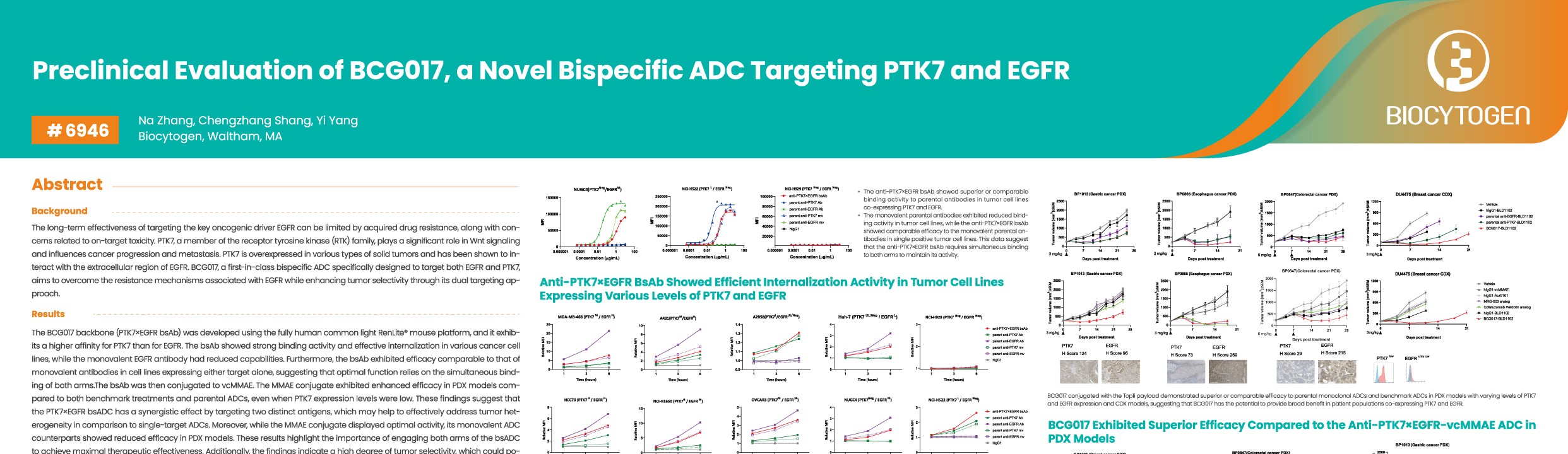
The BCG017 backbone (PTK7×EGFR bsAb) was developed using the fully human common light RenLite® mouse platform, and it exhibits a higher affinity for PTK7 than for EGFR. The bsAb showed strong binding activity and effective internalization in various cancer cell lines, while the monovalent EGFR antibody had reduced capabilities. Furthermore, the bsAb exhibited efficacy comparable to that of monovalent antibodies in cell lines expressing either target alone, suggesting that optimal function relies on the simultaneous binding of both arms.
Results
The bsAb was then conjugated to vcMMAE. The MMAE conjugate exhibited enhanced efficacy in PDX models compared to both benchmark treatments and parental ADCs, even when PTK7 expression levels were low. These findings suggest that the PTK7×EGFR bsADC has a synergistic effect by targeting two distinct antigens, which may help to effectively address tumor heterogeneity in comparison to single-target ADCs. Moreover, while the MMAE conjugate displayed optimal activity, its monovalent ADC counterparts showed reduced efficacy in PDX models. These results highlight the importance of engaging both arms of the bsADC to achieve maximal therapeutic effectiveness. Additionally, the findings indicate a high degree of tumor selectivity, which could potentially minimize EGFR-related toxicity in normal tissues.
Then, BCG017 was conjugated with BLD1102, a proprietary topoisomerase 1 inhibitor (TOP1i) linker-payload. BCG017 demonstrated potent in vivo efficacy in PDX models representing various tumor types expressing both EGFR and PTK7, including gastric, colorectal, esophageal, breast, and lung cancers. BCG017 consistently showed superior efficacy to MMAE conjugate using the same bsAb backbone in PDX models. BCG017 exhibited favorable pharmacokinetics in mice, effective tumor delivery in a xenograft model, and good plasma stability.
Conclusion
These results highlight the promising efficacy of BCG017 in preclinical models, indicating improved tumor selectivity and suggesting that it could address the limitations of EGFR-targeting therapies while expanding treatment options for PTK7 and EGFR co-expressed settings.