
Abstract:
Background:
T-cell engagers (TCEs), a class of bispecific antibodies, redirect T cells to kill tumor cells by simultaneously binding to the CD3ε subunit of the T cell receptor (TCR) complex and tumor-associated antigens (TAAs). CD20, a surface protein expressed on most malignant B lymphocytes, is a clinically validated target in B-cell lymphomas and autoimmune diseases. Glofitamab, a CD3/CD20 bispecific antibody, has demonstrated potent efficacy in treating relapsed/refractory large B-cell lymphoma. However, CD3-mediated T-cell activation can lead to cytokine release syndrome (CRS), highlighting the need for robust preclinical models to assess both efficacy and safety. The development of reliable animal models is critical to supporting drug discovery across cancer and autoimmune disease indications.
Methods:
Biocytogen generated a double humanized mouse model co-expressing human CD3E, CD3D, and CD3G (CD3EDG), along with human CD20, on a C57BL/6 background (B-hCD3EDG/hCD20 mice). RT-PCR confirmed mRNA expression of the human CD3EDG genes, and flow cytometry validated protein expression of human CD3E on T cells and human CD20 on B cells in the spleen. To support efficacy evaluation, syngeneic tumor models were established by inoculating B-hCD3EDG/hCD20 mice with B-hCD20 MC38 cells, a CD20-humanized colon cancer cell line. A clinical-grade Glofitamab analog was administered to evaluate therapeutic activity in both tumor-bearing and autoimmune disease settings. In vivo toxicity was assessed via cytokine profiling following antibody treatment. Autoimmune relevance was further evaluated through B cell depletion studies and an experimental autoimmune encephalomyelitis (EAE) model induced by MOG₁₋₁₂₅ immunization.
Results:
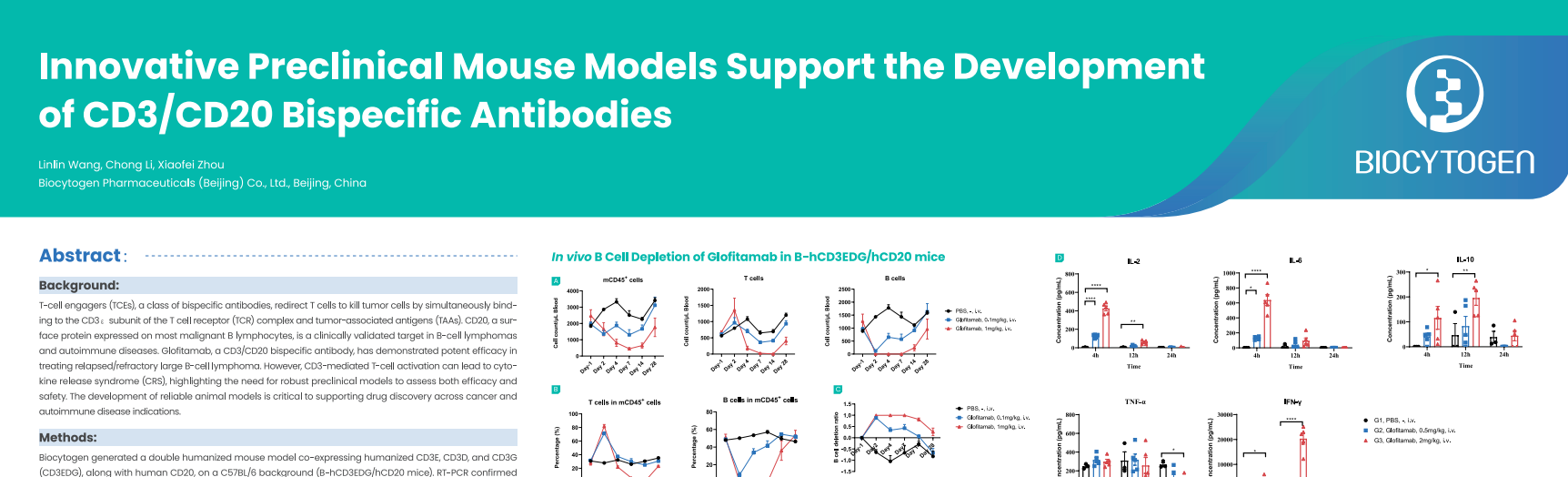
The B-hCD3EDG/hCD20 mice exhibited functional co-expression of human CD3 and CD20 in T and B cells, respectively. In the syngeneic tumor model, Glofitamab analog treatment significantly suppressed tumor growth. Toxicity studies revealed notable cytokine release in response to treatment, mimicking clinical CRS. In autoimmune studies, the bispecific antibody efficiently depleted B cells in vivo. Moreover, in the EAE model, Glofitamab analog treatment alleviated neurological symptoms, supporting its therapeutic potential in autoimmune diseases.
Conclusion:
Biocytogen’s B-hCD3EDG/hCD20 mice provide a versatile and physiologically relevant platform for evaluating CD3/CD20-targeted therapeutics across oncology and autoimmune indications. These models enable comprehensive pharmacological and safety assessments of bispecific antibodies, monoclonal antibodies, CAR-T cell therapies, and other CD20-directed agents, supporting their translational development.
