このページで

Built on the RenLite® platform , BCG026 utilizes common light chain technology to eliminate heavy/light chain mispairing, ensure seamless assembly, simplify manufacturing, and provide a developable antibody backbone for the FAP × GPC1 bispecific ADC drug development.
BCG026 is conjugated with Biocytogen's proprietary BLD1102 linker–payload system containing BCPT02 , a topoisomerase I (TOP1) inhibitor payload designed to drive potent ADC-mediated cytotoxicity in solid tumor drug development.
BCG026 is being evaluated as a FAP/GPC1-directed bispecific ADC drug development asset for solid tumors. Potential development areas include pancreatic cancer, non-small cell lung cancer (NSCLC), and esophageal cancer.

The supporting preclinical data package for BCG026 include strong binding activity to both stromal and tumor cells, efficient internalization of the bispecific antibody backbone, a CAF-mediated bystander killing effect, and synergistic in vivo efficacy in multiple PDX models, supporting the development of BCG026 as a novel FAP × GPC1 bispecific ADC for solid tumors, with a primary focus on pancreatic cancer.
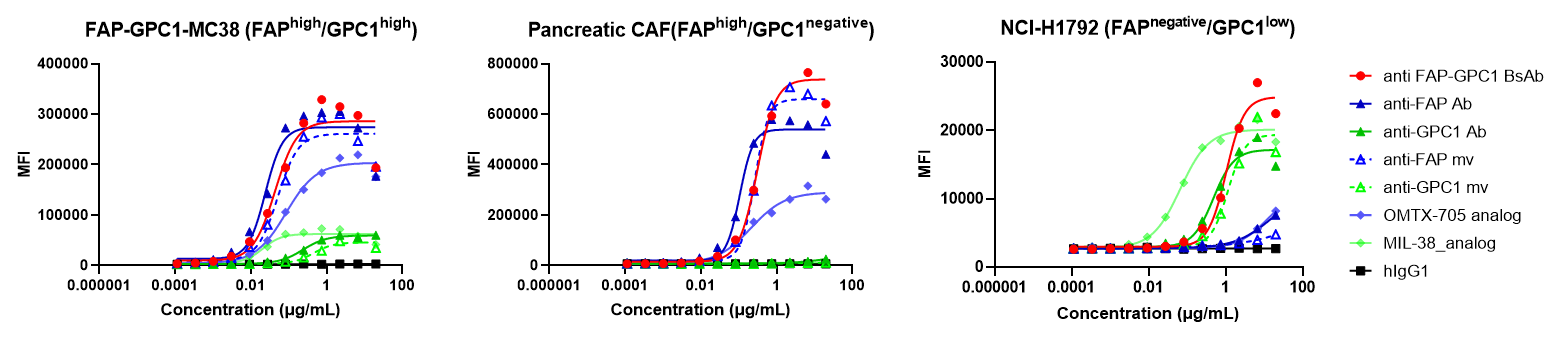
Figure 1. Antigen binding analysis of the FAP × GPC1 bispecific antibody across target-expressing cell lines. The FAP×GPC1 bispecific antibody demonstrated binding activity comparable to its respective parental antibodies in FAP/GPC1 co-expressing cells (FAP-GPC1-MC38), FAP single-positive CAFs (pancreatic CAF), and GPC1 single-positive cells (NCI-H1792), supporting preserved dual-target engagement across stromal and tumor cell contexts.
(Note: mv, monovalent; MIL-38-analog, GPC1 benchmark antibody; OMTX-705 Ab-analog, FAP benchmark antibody.)
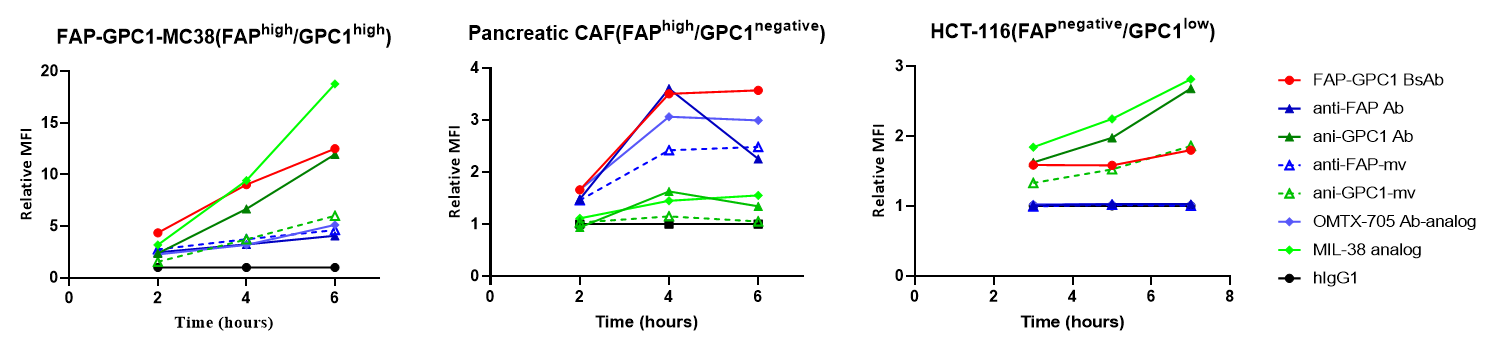
Figure 2. Internalization kinetics of the BCG026 FAP × GPC1 bispecific antibody backbone in stromal and tumor cell lines. Internalization was evaluated in MC38 and NCI-H1792 cells, as well as pancreatic CAFs, with different FAP and GPC1 expression levels. The BCG026 bsAb showed efficient internalization across these models, with activity comparable to or higher than parental antibody controls, supporting the FAP × GPC1 bispecific antibody design for ADC payload delivery.
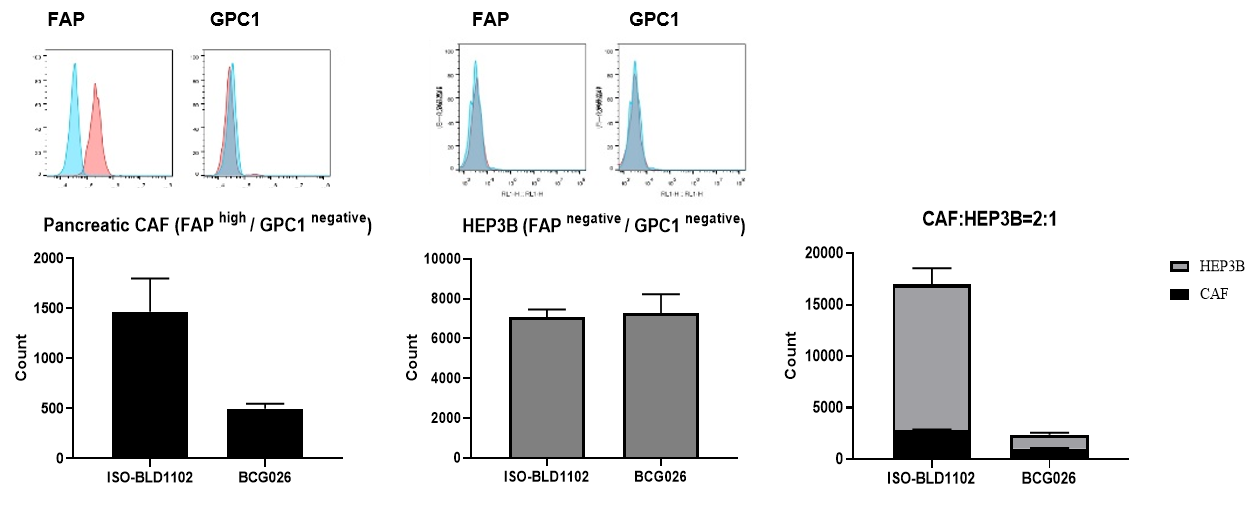
Figure 3. Bystander killing activity of BCG026 in FAP-positive CAFs and FAP/GPC1-negative tumor cells. BCG026 induced cytotoxic activity in FAP-positive CAFs and triggered CAF-mediated bystander killing of FAP/GPC1-negative HEP3B tumor cells, supporting its potential to eliminate antigen-negative tumor cells through stromal cell–mediated payload delivery.
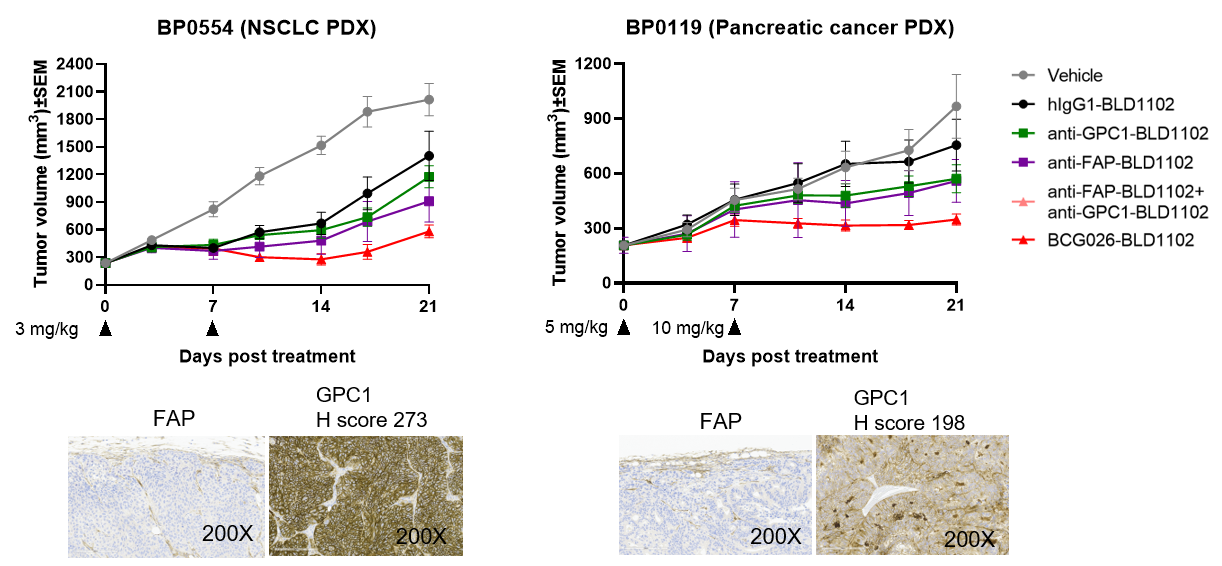
Figure 4. Antitumor efficacy of BCG026 (~DAR8) in PDX models with varying GPC1 and FAP-positive CAF expression levels. BCG026 showed superior tumor growth inhibition compared with single-target parental ADCs (GPC1 ADC and FAP ADC) administered individually or in combination, supporting the synergistic antitumor potential of the FAP × GPC1 bispecific ADC design targeting both tumor cells and the stromal compartment.

Biocytogen welcomes partnership discussions to further evaluate this FAP × GPC1 bispecific ADC asset.

BCG026 is designed as a FAP × GPC1 bispecific ADC drug development asset that engages both GPC1-expressing tumor cells and FAP-positive stromal CAFs. This stroma–tumor dual-compartment design may broaden target coverage in heterogeneous solid tumors compared with traditional single-target ADC approaches, including GPC1 ADC that primarily rely on tumor-cell antigen expression.
BCG026 induced cytotoxicity in FAP-positive CAFs and triggered CAF-mediated bystander killing of nearby FAP/GPC1-negative tumor cells in vitro . This activity supports a stromal cell–mediated payload delivery strategy designed to extend cytotoxic coverage beyond antigen-positive tumor cells in heterogeneous tumor microenvironments.
BCG026 uses Biocytogen's proprietary BLD1102 linker–payload system containing BCPT02, a TOP1 inhibitor payload. In this design, BCPT02 provides the cytotoxic payload component, while the linker is engineered for hydrophilicity, cleavability, and circulation stability to support ADC performance.
RenLite® provides a fully human common light chain antibody backbone for FAP × GPC1 bispecific ADC engineering. This design helps reduce heavy/light chain mispairing, supports correct bispecific antibody assembly, and simplifies downstream ADC development.
BCG026 is designed to engage both tumor cells and CAFs in the tumor stroma, enabling activity within stromal-barrier-rich solid tumors such as PAAD. This strategy is relevant because PAAD is characterized by dense fibrotic and desmoplastic stroma, where CAF accumulation and extracellular matrix remodeling are associated with invasion, recurrence, and treatment resistance.