このページで

Built on the RenLite® platform , BCG039 utilizes common light chain technology to eliminate heavy/light chain mispairing, ensure seamless assembly, simplify manufacturing, and provide a developable antibody backbone for the Nectin-4 × TROP2 bispecific ADC drug development.
BCG039 can be developed with two linker–payload options to support different ADC development strategies: either vcMMAE (DAR~4) or Biocytogen's proprietary BLD1102 linker–payload system (DAR~4 or 8), which contains BCPT02 , a topoisomerase I (TOP1) inhibitor payload.
BCG039 is being evaluated as a Nectin-4 × TROP2 bispecific ADC drug development asset, with primary focus on urothelial carcinoma (UC) and broader development potential in other solid tumors, including cholangiocarcinoma (CC), endometrial cancer (EC), triple-negative breast cancer (TNBC), and non-small cell lung cancer (NSCLC) .

The supporting preclinical data package for BCG039, generated from Biocytogen internal preclinical studies, includes Nectin-4 × TROP2 dual-target affinity characterization, cooperative and strong internalization, and enhanced antitumor efficacy across syngeneic, CDX, and PDX tumor models. Together, these data support the development of BCG039 as a next-generation, safety-enhanced Nectin-4 × TROP2 bispecific ADC for urothelial carcinoma (UC) and other solid tumors.
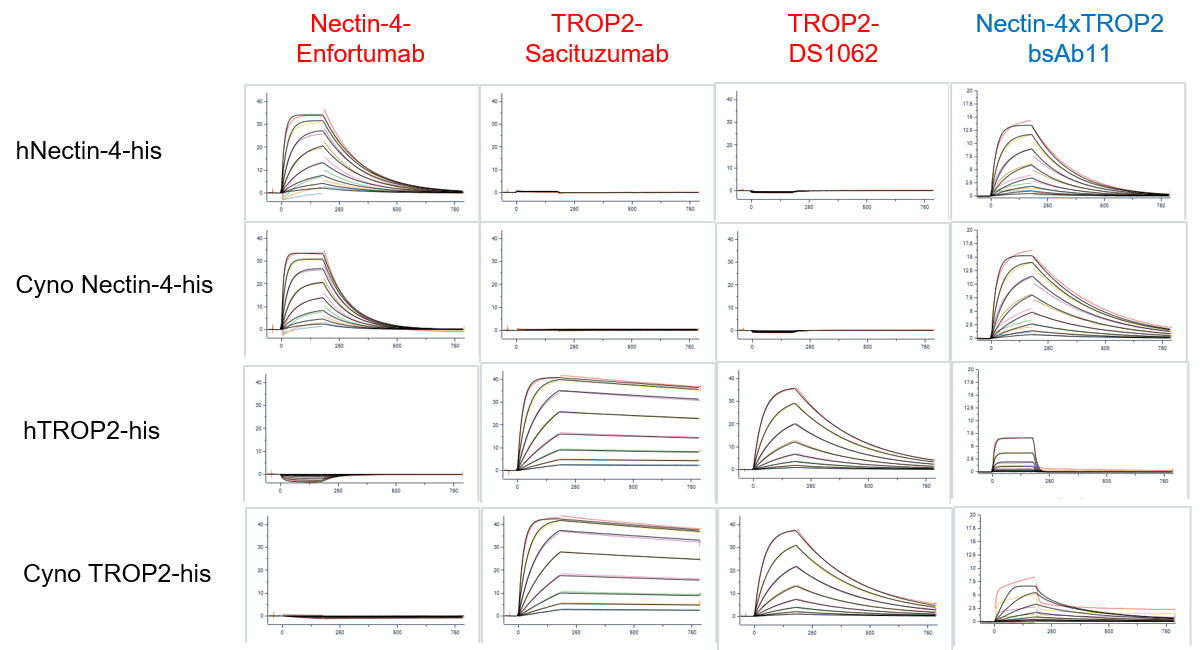
Figure 1. Affinity characterization of Nectin-4 × TROP2 bsAb11 and benchmark antibodies. Multi-concentration surface plasmon resonance (SPR) affinity analysis was performed using antibody capture and antigen as the analyte. Nectin-4 × TROP2 bsAb11 was evaluated for dual-target binding across human and cynomolgus antigens, showing an attenuated TROP2 affinity profile relative to relevant benchmark antibodies. These data support dual-target recognition, human/cynomolgus cross-reactivity, and the safety-oriented bispecific ADC design of BCG039.
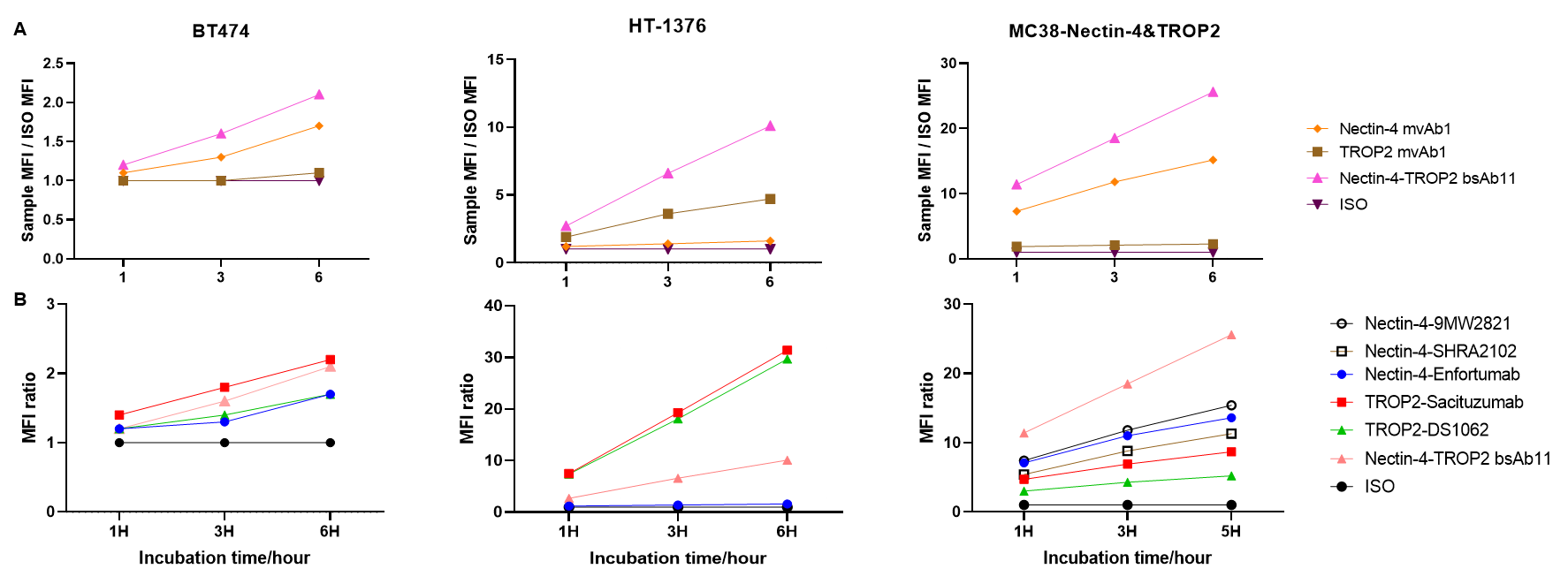
Figure 2. Internalization activity of Nectin-4 × TROP2 bsAb11 across multiple tumor cell lines. (A) Internalization activity was evaluated for Nectin-4 × TROP2 bsAb11 versus parental monovalent antibodies in BT474, HT-1376, and MC38-Nectin-4&TROP2 cells. The results show that the Nectin-4 and TROP2 arms cooperate in the bispecific format to enhance internalization compared with the corresponding monovalent parental Nectin-4 and TROP2 antibodies. (B) Internalization activity was further evaluated in the same cell lines. Nectin-4 × TROP2 bsAb11 showed stronger internalization activity than benchmark antibodies across multiple tumor cell lines, supporting enhanced intracellular trafficking and ADC payload delivery through dual-target engagement.
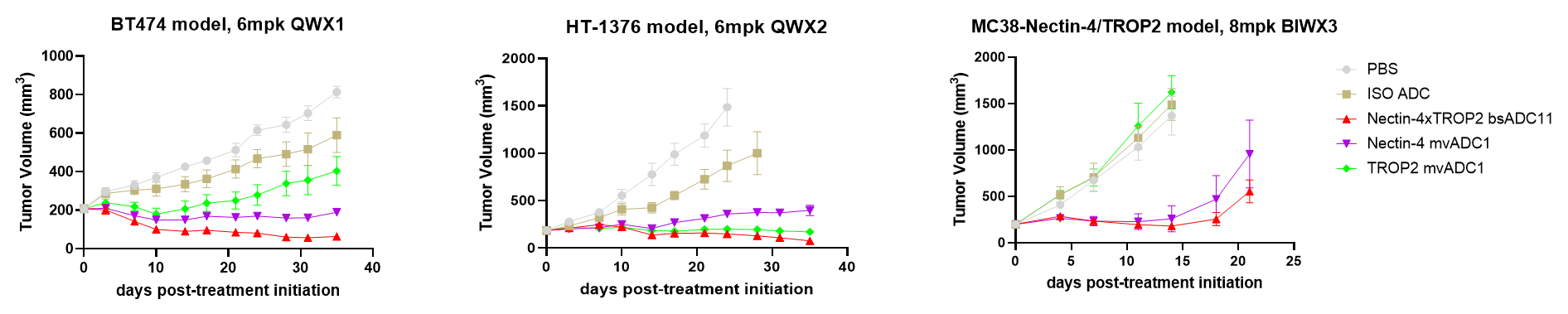
Figure 3. Antitumor efficacy of Nectin-4 × TROP2 bsADC11 versus parental monovalent ADCs. Nectin-4 × TROP2 bsADC11 (BCG039) and parental monovalent ADCs were evaluated in the BT-474 breast cancer CDX model at 6 mg/kg QW × 1, the HT-1376 bladder cancer CDX model at 6 mg/kg QW × 2, and the MC38 colorectal cancer syngeneic model at 8 mg/kg BIW × 3. BCG039 demonstrated more potent antitumor efficacy than parental monovalent Nectin-4 ADC and TROP2 ADC controls with MMAE payloads (DAR~4), showing enhanced in vivo tumor inhibition across CDX and syngeneic tumor models.
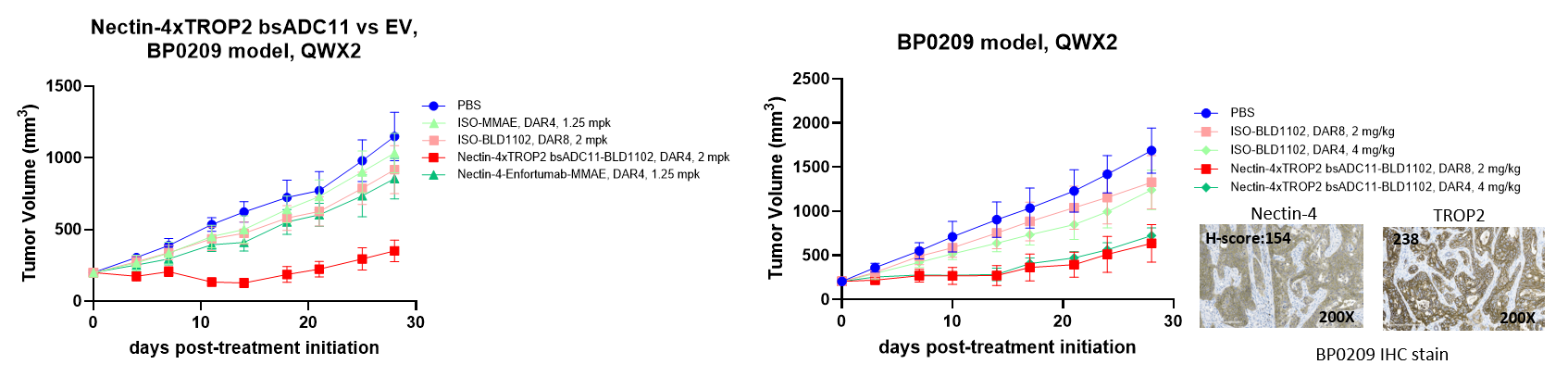
Figure 4. Antitumor efficacy of Nectin-4 × TROP2 bsADC11-BLD1102 in the BP0209 pancreatic PDX model. (A) Nectin-4 × TROP2 bsADC11-BLD1102 at DAR4 and 2 mg/kg demonstrated superior antitumor activity compared with enfortumab vedotin (EV, a benchmark Nectin-4 ADC) at DAR4 and 1.25 mg/kg under the tested preclinical conditions. (B) BCG039-BLD1102 showed similarly potent antitumor activity at DAR8, 2 mg/kg and DAR4, 4 mg/kg, supporting robust dose-adjusted activity of the BLD1102-based bispecific ADC design.


BCG039 is a next-generation, fully human Nectin-4 × TROP2 bispecific ADC combining clinically validated targets for UC. Engineered with attenuated TROP2 binding, it is safety-enhanced to minimize the on-target, off-tumor toxicities typical of first-generation TROP2 therapies. Moreover, leveraging tumor-specific avidity to drive an efficacy-tolerability balanced cooperative internalization helps defeat tumor escape and expand therapeutic window. Finally, its common-light chain backbone driven by RenLite® secures superior developability and seamless downstream development.
Attenuated TROP2 affinity is a key design feature that helps differentiate BCG039 from conventional TROP2-targeted ADC approaches. By reducing binding to normal tissues that express TROP2, BCG039 is engineered to mitigate on-target, off-tumor toxicity risk. At the same time, dual engagement of Nectin-4 and TROP2 on tumor cells enables balanced cooperative internalization, preserving efficient payload delivery where it is needed most. This approach is designed to optimize the efficacy–tolerability balance and potentially expand the therapeutic window.
RenLite® provides a fully human common light chain antibody backbone for Nectin-4 × TROP2 bispecific ADC engineering. This design helps reduce heavy/light chain mispairing, supports correct bispecific antibody assembly, simplifies manufacturing, and improves downstream ADC developability.
BCG039 supports both vcMMAE and Biocytogen's proprietary BLD1102 linker–payload system. BLD1102 contains BCPT02, a TOP1 inhibitor payload, with linker properties engineered for hydrophilicity, controlled payload release, and circulation stability, enabling payload strategy optimization for bispecific ADC development.
UC is the primary development focus for BCG039, with more than 600,000 patients affected worldwide each year and metastatic UC (mUC) associated with a poor 5-year survival rate of approximately 10–15%. Based on the tumor-associated biology of Nectin-4 and TROP2, BCG039 may also have development potential in other solid tumors, including cholangiocarcinoma (CC), endometrial cancer (EC), triple-negative breast cancer (TNBC), and non-small cell lung cancer (NSCLC).