
このページで

Built on the RenLite® platform, BCG033 utilizes common light chain technology to eliminate heavy/light chain mispairing, ensure seamless assembly, simplify manufacturing, and provide a developable antibody backbone for the PTK7 × TROP2 bispecific ADC drug development.
BCG033 has been evaluated with two linker–payload formats to support different ADC development strategies: vcMMAE in earlier studies and Biocytogen’s proprietary BLD1102 linker–payload system, which contains BCPT02, a topoisomerase I (TOP1) inhibitor payload.
BCG033 is being evaluated as a PTK7 × TROP2 bispecific ADC drug development asset for solid tumors. Potential development areas include non-small cell lung cancer (NSCLC), triple-negative breast cancer (TNBC), ovarian cancer, colorectal cancer, gastric cancer, esophageal cancer, and cervical cancer.

The preclinical data package for BCG033, generated from Biocytogen’s internal studies, demonstrates a differentiated PTK7 × TROP2 bispecific ADC profile characterized by broad target co-expression across solid tumors, antigen-dependent binding, and efficient internalization across heterogeneous target-expression patterns. BCG033 also showed enhanced antitumor efficacy relative to parental ADCs in PDX models, with activity favored by PTK7 and TROP2 co-expression and evidence of synergistic efficacy with different payload formats. Together, these findings support the potential of BCG033 to improve tumor coverage, payload delivery, and antitumor efficacy in heterogeneous solid tumors.
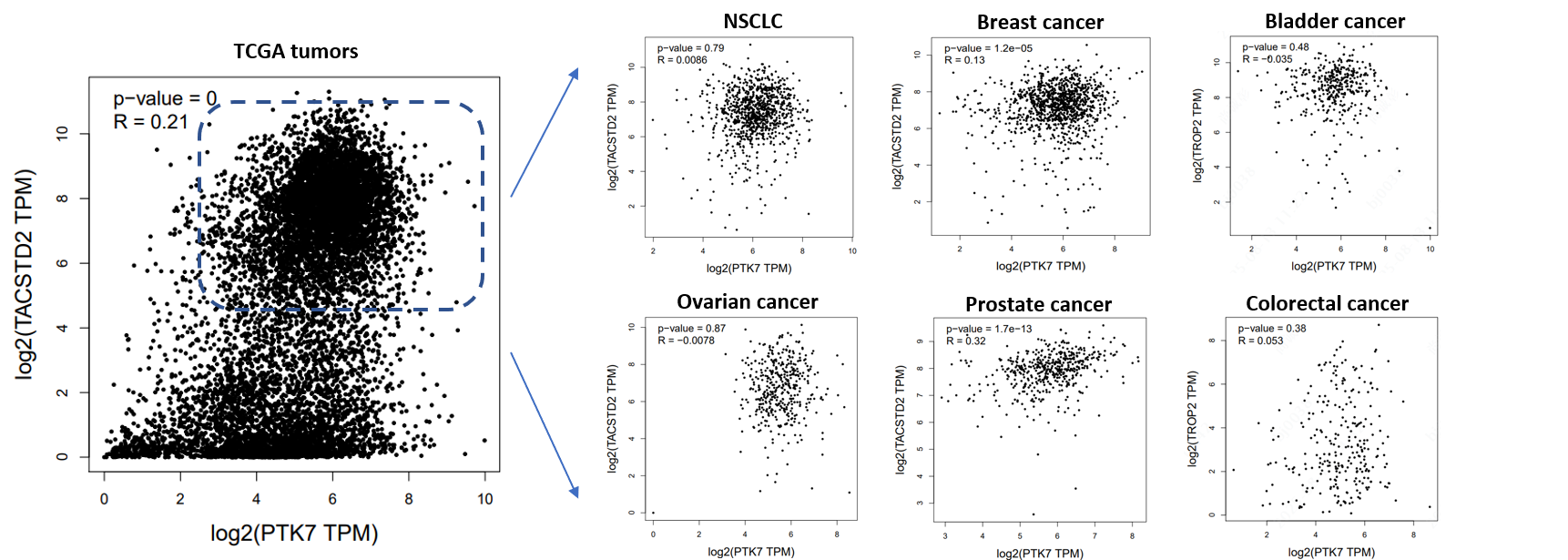
Figure 1. Co-expression analysis of PTK7 and TROP2 across TCGA tumor datasets. PTK7 and TROP2 showed overlapping expression patterns in multiple solid tumor types, including non-small cell lung cancer (NSCLC), breast cancer, bladder cancer, ovarian cancer, prostate cancer, and colorectal cancer, supporting the rationale for a dual-targeting strategy across broad patient populations.
(Note: The co-expression percentage of PTK7 and TROP2 was extrapolated from separated literature reports.)
In addition, RNA-sequencing analysis also showed PTK7 and TROP2 co-expression across multiple tumor cell lines, including triple-negative breast, lung, ovarian, colorectal, esophageal, and gastric cancer models.

Figure 2. Binding analysis of the PTK7 × TROP2 bispecific antibody across tumor cell lines. BCG033 showed strong binding to A431 skin cancer cells (PTK7high/TROP2high), NCI-N87 gastric cancer cells (PTK7low/TROP2high), NCI-H226 lung cancer cells (PTK7moderate/TROP2negative), and NUGC4 gastric cancer cells (PTK7negative/TROP2moderate), while showing no binding to double-negative cells. These findings support broad coverage of antigen-heterogeneous tumors with antigen-dependent selectivity.
In addition, BCG033 features balanced affinity for PTK7 and TROP2 and cross-reactivity with the corresponding human and cynomolgus monkey targets, supporting effective dual-target engagement and translational evaluation.

Figure 3. Internalization kinetics of the PTK7 × TROP2 bispecific antibody across tumor cell lines. BCG033 demonstrated efficient internalization in tumor cells with varying PTK7 and TROP2 expression levels, supporting effective intracellular payload delivery across heterogeneous target-expression profiles. Monovalent (mv) parental antibody formats showed reduced internalization, particularly for the TROP2 arm, indicating that the bispecific format enhances cellular uptake and may increase tumor selectivity and reduce on-target toxicity.
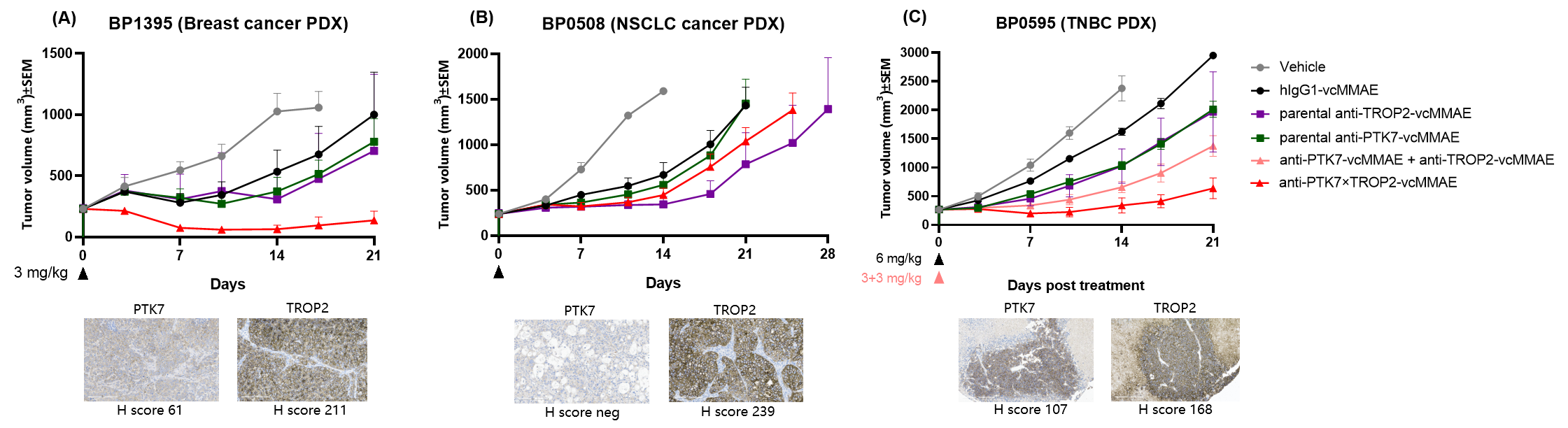
Figure 4. Antitumor efficacy of BCG033 across PDX models with different target-expression profiles. (A) In the BP1395 breast cancer PDX model, BCG033 conjugated with the BLD1102 TOP1 inhibitor linker–payload system showed superior efficacy compared with parental ADCs. Superior or comparable efficacy was also observed across additional PTK7- and TROP2-expressing PDX models, supporting broad potential in tumors co-expressing both targets. (B) In the BP0508 (PTK7negative/TROP2high) NSCLC PDX model, BCG033 showed reduced efficacy, indicating that enhanced antitumor activity is favored by PTK7 and TROP2 co-expression and supporting the tumor selectivity of the bispecific design. (C) In the BP0595 TNBC PDX model, the PTK7 × TROP2-vcMMAE bispecific ADC achieved greater tumor growth inhibition than parental monoclonal ADCs administered alone or in combination, supporting a synergistic effect of the bispecific format and its potential to address tumor heterogeneity.
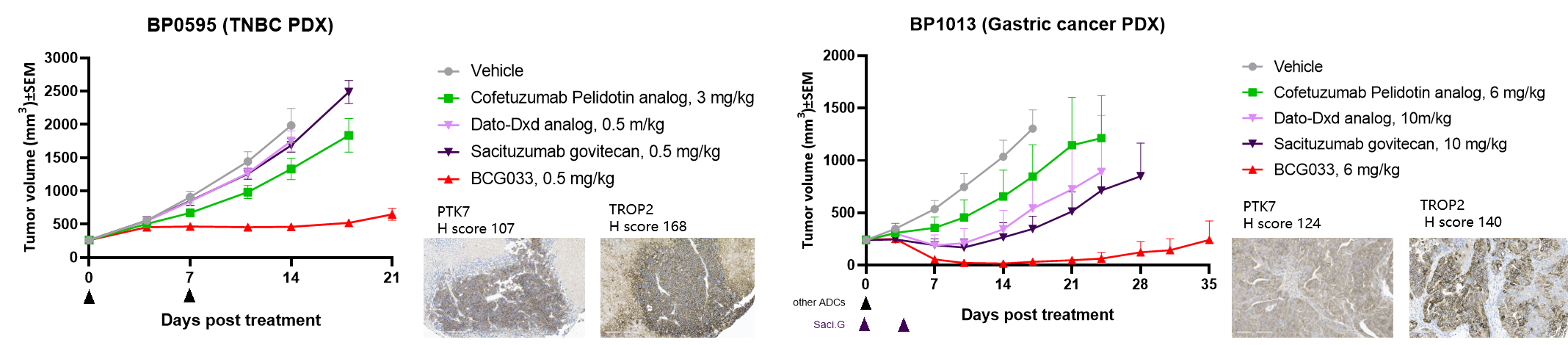
Figure 5. Antitumor efficacy of BCG033 in the BP0595 TNBC and BP1013 gastric cancer PDX models. BCG033 demonstrated greater tumor growth inhibition than benchmark analogs—including the PTK7 ADC cofetuzumab pelidotin and the TROP2 ADCs datopotamab deruxtecan (Dato-DXd) and sacituzumab govitecan—in both models, supporting the differentiated in vivo efficacy and broad therapeutic potential of the PTK7 × TROP2 bispecific ADC strategy.

Biocytogen welcomes partnership discussions to further evaluate this PTK7 × TROP2 bispecific ADC asset.

BCG033 combines PTK7-mediated tumor selectivity with a tuned TROP2 arm to address two major challenges of single-target ADCs: antigen heterogeneity and normal-tissue exposure. By enabling dual-target engagement and efficient internalization in PTK7/TROP2-expressing tumor cells, BCG033 is designed to broaden tumor coverage while supporting more tumor-selective payload delivery.
Single-target TROP2 ADCs may be limited by on-target, off-tumor toxicity because TROP2 is also expressed in normal tissues. BCG033 incorporates a TROP2 arm selected for reduced monovalent internalization, helping limit cellular uptake in TROP2-only settings while preserving efficient engagement and internalization through PTK7 co-binding in dual-positive tumor cells. This design supports more tumor-selective payload delivery in PTK7/TROP2 co-expressing tumors.
RenLite® provides a fully human common light chain antibody backbone for PTK7 × TROP2 bispecific ADC engineering. This design helps reduce heavy/light chain mispairing, supports correct bispecific antibody assembly, simplifies manufacturing, and improves downstream ADC developability.
BCG033 has been evaluated with vcMMAE in earlier studies and with Biocytogen’s proprietary BLD1102 linker–payload system in subsequent development. BLD1102 contains BCPT02, a topoisomerase I (TOP1) inhibitor payload designed for high potency and bystander-killing potential, together with a hydrophilic linker engineered for controlled payload release and circulation stability. This design supports ADC developability and systemic payload delivery.
BCG033 is being evaluated for PTK7- and/or TROP2-expressing solid tumors. Potential development areas include non-small cell lung cancer (NSCLC), triple-negative breast cancer (TNBC), ovarian cancer, colorectal cancer, gastric cancer, esophageal cancer, and cervical cancer. Preclinical activity across breast, gastric, colorectal, and lung tumor models supports its broader pan-tumor development potential.