Description
- Gene Information: CD3: Encoded by CD3E, D, G; part of the Ig superfamily. It forms the essential signaling backbone of the T-cell receptor (TCR) complex. STEAP1: It belongs to the six-transmembrane epithelial antigen of prostate (STEAP) family and encodes a cell-surface transmembrane protein involved in membrane-associated ion/metal homeostasis and tumor progression.
- Protein Expression: CD3: Constitutive and universal marker for all mature T cells (CD4+, CD8+). Always present on the cell surface. STEAP1: A tumor-associated cell-surface antigen with relatively low expression in most normal tissues but markedly elevated expression in multiple cancers, particularly prostate cancer. Its preferential expression on malignant cells makes it an attractive target for cancer immunotherapy.
- Signaling Pathway: CD3: Operates via ITAM phosphorylation and ZAP-70. It triggers the initial "on" switch, Ca2+ flux, and immediate cytotoxicity. STEAP1: Unlike classical receptor tyrosine kinases, STEAP1 is not a conventional signaling receptor. It has been associated with regulation of cellular redox status and downstream pathways such as AKT/FOXO1, JAK2/STAT3, and ROS-related signaling, contributing to tumor cell proliferation, survival, migration, and invasion.
- Therapeutic Inhibition: CD3×STEAP1 bispecific antibodies recruit and activate T cells by simultaneously binding CD3 on T cells and STEAP1 on tumor cells, thereby inducing targeted T-cell–mediated killing of STEAP1-positive cancer cells. STEAP1-targeted T-cell engagers and other modalities are being investigated, particularly in prostate cancer and mCRPC. Key challenges include minimizing on-target/off-tumor toxicity, overcoming antigen escape, and improving efficacy in solid tumors.
Targeting Strategy
STEAP1
- Exons 2-5 of mouse Steap1 gene that full coding region sequences are replaced by human counterparts in B-hSTEAP1 mice.
- The promoter, 5’UTR and 3’UTR region of the mouse gene are retained. The human STEAP1 expression is driven by endogenous mouse Steap1 promoter, while mouse Steap1 gene transcription and translation will be disrupted.
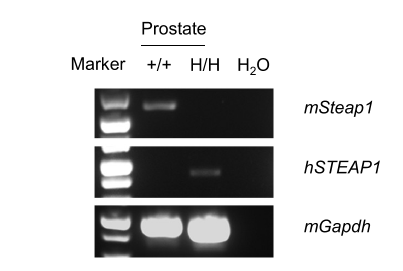
STEAP1 mRNA Expression by RT-PCR
Human STEAP1 were detectable in B-hSTEAP1 mice by RT-PCR and sequencing. Prostate tissue RNA was isolated from wild-type C57BL/6 mice (+/+) and homozygous B-hSTEAP1 mice (H/H), then cDNA libraries were synthesized by reverse transcription, followed by PCR with mouse or human STEAP1 primers. Sequencing of the PCR products confirmed that the amplified sequences were consistent with database reference sequences.
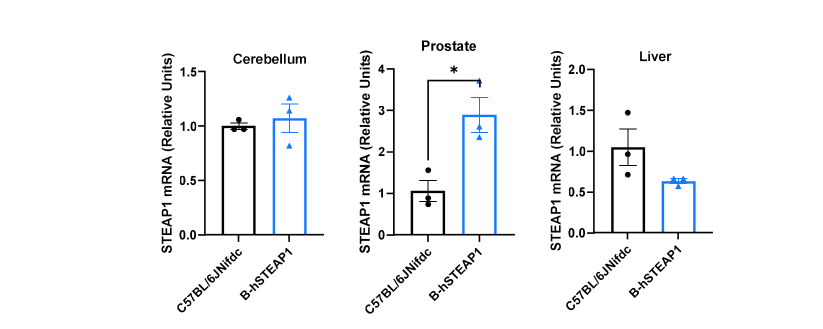
STEAP1 mRNA Expression by qPCR
STEAP1 expression in homozygous B-h-hSTEAP1 mice was analyzed by qPCR. Total RNA was isolated from various tissues of wild-type C57BL/6JNifdc mice (+/+) and homozygous B-hSTEAP1 mice (H/H) (male, 7 weeks old, n=3 per group). cDNA was synthesized by reverse transcription, followed by qPCR using STEAP1 primers that recognize both mouse and humanized STEAP1 mRNA. Data were normalized to wild-type tissue expression. Data are presented as mean ± SEM and were analyzed for significance using an unpaired t-test. P < 0.05 was considered statistically significant.
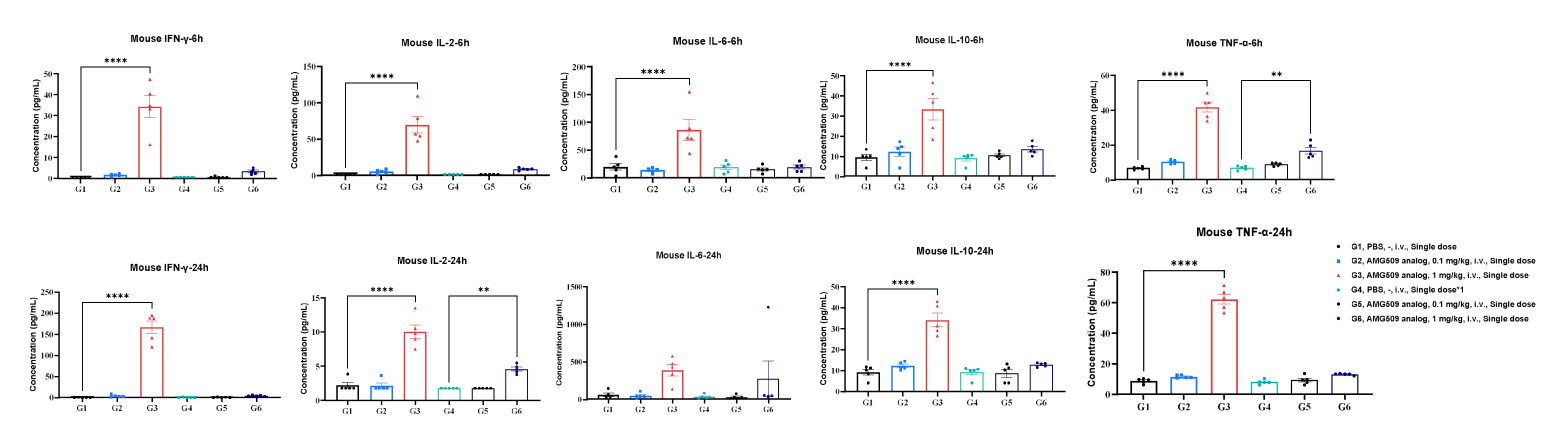
In Vivo Cytokine Release of AMG509 in B-hCD3EDG/hSTEAP1 Mice
In vivo cytokine release of AMG509 (in-house) in B-hCD3EDG/hSTEAP1 mice (G1-G3) and B-hCD3EDG mice (G4-G6). Female mice (n=5) were administered a single intravenous dose of the indicated antibodies on day 0. Serum cytokines were measured by multiplex assay at 6 and 24 hours post-dose. Data are presented as mean ± SEM. Statistical significance was determined by two-way ANOVA. *P < 0.05, P < 0.01, ***P < 0.001.
* When publishing results obtained using this animal model, please acknowledge the source as follows: The animal model [B-hCD3EDG/hSTEAP1 mice] (Cat# 113969) was purchased from Biocytogen.