



B-hLEPR mice

C57BL/6-Leprtm1(LEPR)Bcgen/Bcgen • 113250

B-hLEPR mice

Catalog Number: 113250
Strain Name: C57BL/6-Leprtm1(LEPR)Bcgen/Bcgen
Strain Background: C57BL/6
NCBI gene ID: 3953 (Human)
Aliases: CD295, LEP-R, LEPRD, OB-R, OBR, huB219
---
ライセンスオプション提供可能
B-hLEPR mice

このページで

  • Description
  • Targeting strategy
  • Phenotypic analysis

ポスター

すべて表示

    出版物

      Description
      • LEPR (Leptin receptor), also known as ObR (obese gene receptor), is a member of the cytokine receptor family. It mediates the actions of leptin, a multifunctional hormone primarily produced by adipose tissue, which plays critical roles in food intake, energy metabolism, angiogenesis, reproduction, hematopoiesis, bone metabolism, and immune function. There are six LEPR protein isoforms (LEPRa-f), differing in their intracellular domains. Among them, LEPRa, b, c, d, and f are transmembrane receptors, all containing the Box 1 motif that binds Janus kinase 2 (JAK2). In contrast, LEPRe lacks the transmembrane domain and functions as a soluble LEPR isoform (sLEPR), capable of binding free leptin. Soluble LEPR (sLEPR) serves as the primary leptin-binding protein in circulation, maintaining a pool of bioactive leptin, slowing its clearance from the bloodstream, and downregulating leptin transport across the blood-brain barrier. In humans, sLEPR levels are inversely correlated with obesity and are generally higher in women than in men. Additionally, sLEPR is upregulated in conditions such as chronic heart failure, end-stage renal disease, and anorexia nervosa. It is also expressed by tumor-initiating stem cells and has been proposed as a potential link between cancer and obesity. Mutations in the LEPR gene are associated with obesity and pituitary dysfunction. Antibody-based therapeutics targeting this receptor may help restore leptin signaling balance for therapeutic purposes.
      • The exons 4-17 of mouse Lepr gene that encode extracellular domain is replaced by human counterparts in B-hLEPR mice. The genomic region of mouse Lepr gene that encodes signal peptide, cytoplasmic portion and transmembrane domain is retained. The promoter, 5’UTR and 3’UTR region of the mouse gene are also retained. The chimeric LEPR expression is driven by endogenous mouse Lepr promoter, while mouse Lepr gene transcription and translation will be disrupted.

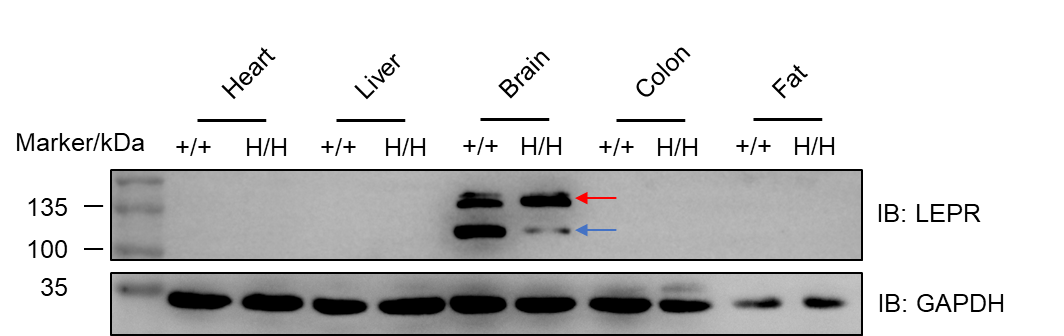
      • LEPR was detected in brain of both wild-type mice and homozygous B-hLEPR mice by western blot.
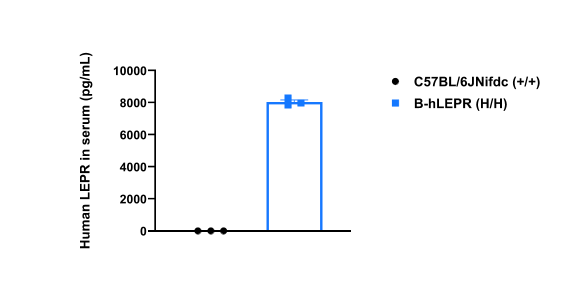
      • Human LEPR was exclusively detectable in homozygous B-hLEPR mice by ELISA, but not in wild-type mice.
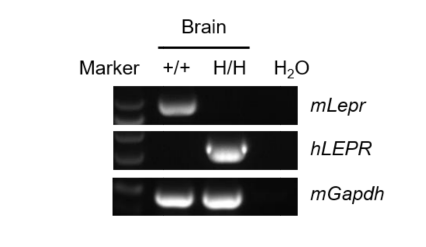
      • Mouse Lepr mRNA was only detectable in wild-type mice.
      • Human LEPR mRNA was exclusively detectable in homozygous B-hLEPR mice but not in wild-type mice.
      Targeting strategy

      Gene targeting strategy for B-hLEPR mice. The exons 4-17 of mouse Lepr gene that encode extracellular domain is replaced by human counterparts in B-hLEPR mice. The genomic region of mouse Lepr gene that encodes signal peptide, cytoplasmic portion and transmembrane domain is retained. The promoter, 5’UTR and 3’UTR region of the mouse gene are also retained. The chimeric LEPR expression is driven by endogenous mouse Lepr promoter, while mouse Lepr gene transcription and translation will be disrupted.

      mRNA Expression by RT-PCR

      Strain specific analysis of LEPR mRNA expression in wild-type C57BL/6JNifdc and B-hLEPR mice by RT-PCR. Brain RNA was isolated from wild-type C57BL/6JNifdc mice (+/+) and homozygous B-hLEPR mice (H/H), then cDNA libraries were synthesized by reverse transcription, followed by PCR with mouse or human LEPR primers. Mouse Lepr mRNA was only detectable in wild-type mice. Human LEPR mRNA was exclusively detectable in homozygous B-hLEPR mice but not in wild-type mice.
      Western blot analysis of LEPR protein expression in homozygous B-hLEPR mice.

       Various tissue lysates were collected from wild-type C57BL/6JNifdc mice (+/+) and homozygous B-hLEPR mice (H/H), and then analyzed by western blot with cross reactive anti-LEPR antibody (Abcam, ab104403). 40 μg total proteins were loaded for western blotting analysis. LEPR was detected in brain of both wild-type mice and homozygous B-hLEPR mice. The red arrow indicates glycosylated LEPR, and the blue arrow indicates non-glycosylated LEPR.
      Protein Expression by ELISA

      Human LEPR expression analysis in wild-type C57BL/6JNifdc mice and homozygous humanized B-hLEPR mice by ELISA. Serum was collected from wild-type C57BL/6JNifdc mice (+/+) (male, n=3, 7-week-old) and homozygous B-hLEPR mice (H/H) (male, n=3, 7-week-old). Expression levels of human LEPR were analyzed by ELISA (Human Leptin Receptor ELISA kit: Abcam, ab282876). Human LEPR was exclusively detectable in homozygous B-hLEPR mice. Values are expressed as mean ± SEM.
      Leptin Expression by ELISA

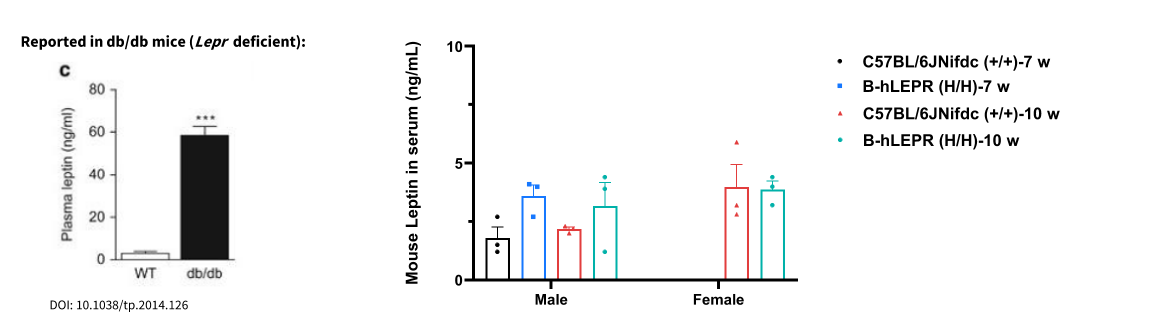
      Mouse Leptin expression analysis in wild-type C57BL/6JNifdc mice and homozygous humanized B-hLEPR mice by ELISA. Serum was collected from wild-type C57BL/6JNifdc mice (+/+) and homozygous B-hLEPR mice (H/H) (male, n=3, 7-week-old; male, n=3, 10-week-old; female, n=3, 10-week-old). Expression levels of mouse Leptin were analyzed by ELISA (Abcam, ab199082). Mouse Leptin was detectable in wild-type mice and homozygous B-hLEPR mice. Values are expressed as mean ± SEM.
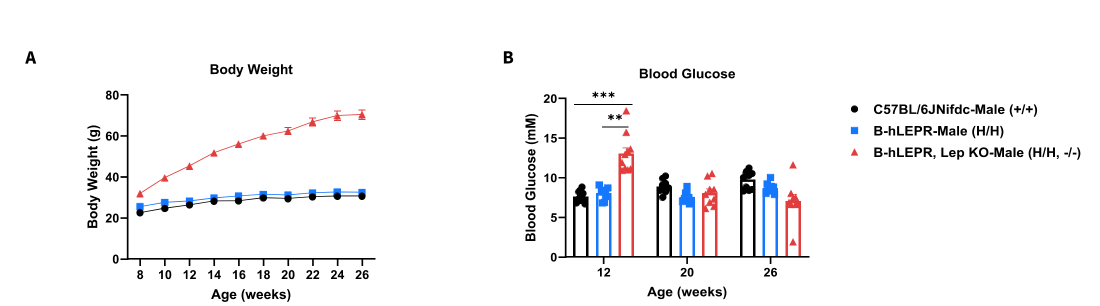
      Body weight and blood glucose in B-hLEPR, Lep KO mice.

      The body weight and blood glucose of wild-type C57BL/6JNifdc mice (+/+), B-hLEPR mice (H/H) and homozygous B-hLEPR, Lep KO mice (H/H, -/-) (male, n=10) were monitored at different ages. (A) The body weight at different ages. (B) The blood glucose levels at different ages. Significance was determined by two-way ANOVA. *p<0.05, p<0.01, ***p<0.001. Values are expressed as mean ± SEM. Note: The B-hLEPR, Lep KO mouse model was developed on the C57BL/6 background. Although it functions as a spontaneous obesity model, the concomitant hyperglycemia is transient and typically improves as the animals age.
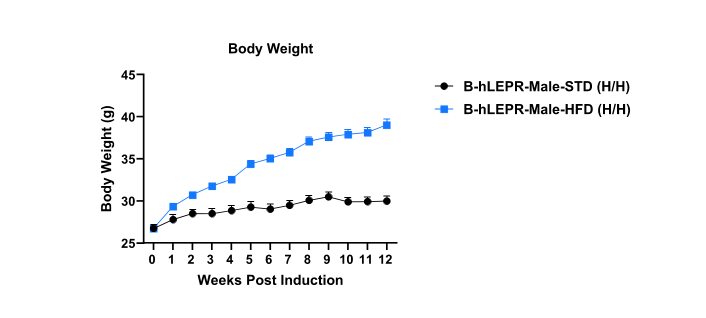
      Body weight of B-hLEPR mice after HFD induction.

      B-hLEPR mice (male, 9-week-old) were fed with 60% High-Fat Diet. The body weight were monitored during the induction period. Body weight of B-hLEPR mice will be increased after HFD induction.

      * When publishing results obtained using this animal model, please acknowledge the source as follows: The animal model [B-hLEPR mice] (Cat# 113250) was purchased from Biocytogen.