Description
CD3: An Important Therapeutic Target in Immunotherapy
- Gene Information: CD3 is a protein complex that forms part of the T-cell receptor (TCR) signaling machinery. It consists of four chains encoded by CD3D, CD3E, CD3G, and CD247. Together with the TCR, CD3 transmits antigen recognition signals from the cell surface to the cell interior and is essential for T-cell development and activation.
- Protein Expression: CD3 is expressed on nearly all mature T cells, including CD4⁺ T cells, CD8⁺ T cells, and γδ T cells. It is generally absent from B cells, NK cells, and myeloid cells.
- Signaling Pathway: CD3 mediates TCR signaling through intracellular ITAM motifs. After antigen recognition, CD3 recruits signaling molecules such as ZAP-70, leading to activation of the NFAT, NF-κB, and MAPK/AP-1 pathways.
- Therapeutic Inhibition: CD3 is an important therapeutic target for modulating T-cell activity. Anti-CD3 antibodies, such as Teplizumab, can suppress or regulate T-cell responses and are used in autoimmune diseases. CD3 is also widely used in bispecific T-cell engagers, which redirect T cells to kill tumor cells, as seen with Blinatumomab.
CXCR6: Highly expressed in tissue-resident memory T cells (TRM)
- Gene Information: C-X-C Motif Chemokine Receptor 6 (CXCR6) is a protein-coding gene located on chromosome 3p21.31, which belongs to the CXC chemokine receptor family.
- Protein Expression: CXCL16 expressed in immune system cells, keratinocytes, and endothelial cells is the only known natural ligand of chemokine receptor CXCR6. This receptor is found on various immune system cells, including natural killer cells, CD4 and CD8 T lymphocytes, innate lymphoid cells (ILCs), as well as on fibroblasts, smooth muscle cells, and endothelial cells.
- Signaling Pathway: CXCR6 and its unique ligand CXCL16 are components of a signaling pathway that regulates the migration of T lymphocytes to various peripheral tissues, including the liver, spleen red pulp, intestine, lungs, and skin. This pathway also facilitates interactions between T lymphocytes and dendritic cells, as well as fibroblastic reticular cells. CXCR6/CXCL16 also controls the localization of resident memory T lymphocytes.
- Therapeutic Inhibition: TRM cells, show increased expression of CXCR6 in recurrent psoriatic lesions and contribute to inflammation. The knockout of CXCR6 significantly improves the psoriatic immune microenvironment by decreasing the retention of TRM cells and reducing the likelihood of disease relapse.
Targeting strategy
CXCR6
- The exons 2 of mouse Cxcr6 gene that encode the whole molecule (ATG to STOP codon were replaced by human counterparts in B-hCD3EDG/hCXCL16/hCXCR6 mice.
- The promoter, 5’UTR and 3’UTR region of the mouse gene are retained. The human CXCR6 expression is driven by endogenous mouse Cxcr6 promoter, while mouse Cxcr6 gene transcription and translation will be disrupted.
CXCL16
- The exons 2-5 of mouse Cxcl16 gene that encode extracellular domain and transmembrane domain is replaced by human counterparts in B-hCD3EDG/hCXCL16/hCXCR6 mice.
- The genomic region of mouse Cxcl16 gene that encodes signal peptide is retained. The promoter, 5’UTR and 3’UTR region of the mouse gene are also retained. The chimeric Cxcl16 expression is driven by endogenous mouse Cxcl16 promoter, while mouse Cxcl16 gene transcription and translation will be disrupted.
Note: B-hCD3EDG/hCXCL16/hCXCR6 mice were obtained by mating B-hCD3EDG mice and B-hCXCL16/hCXCR6 mice.
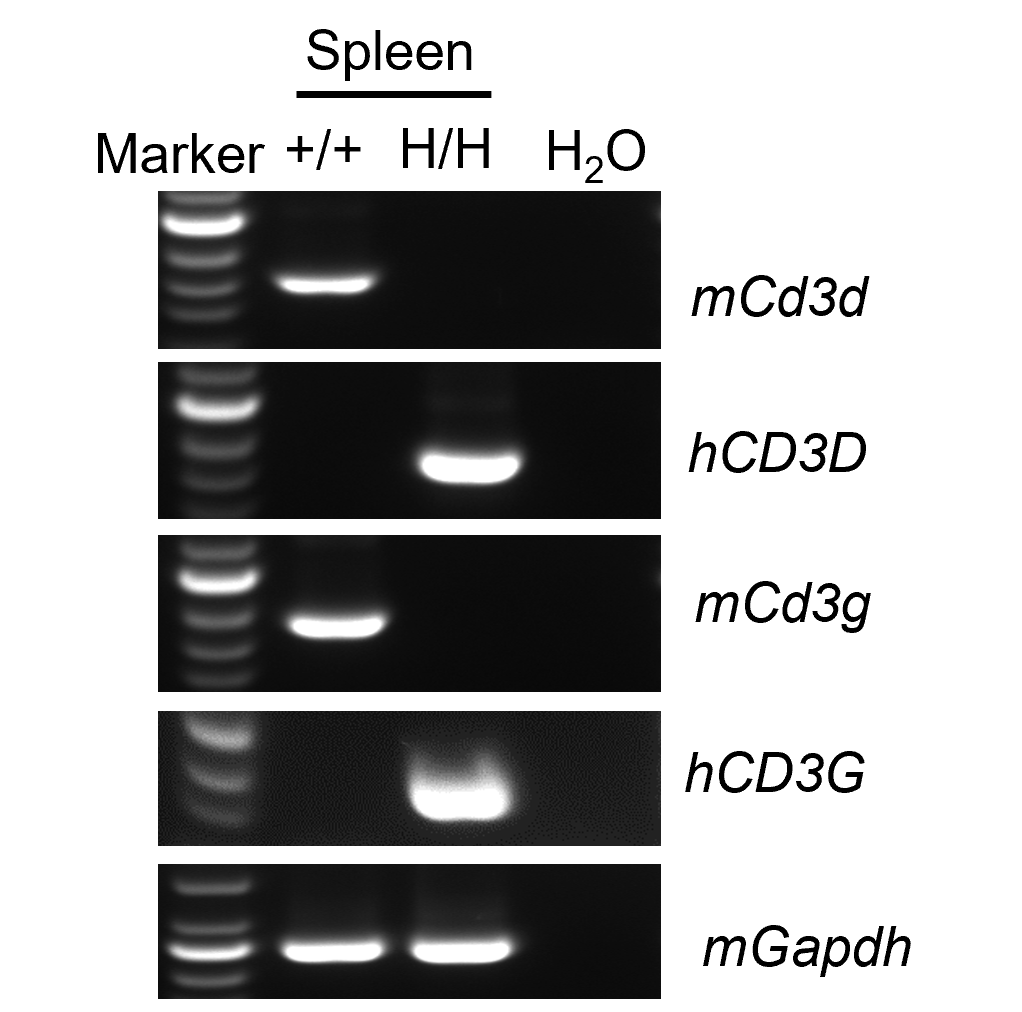
Human CD3D and CD3G mRNA Expression by RT-PCR in Spleen
- Human CD3D and CD3G mRNA were specifically and correctly expressed in B-hCD3EDG/hCXCL16/hCXCR6 mice.
Species specific analysis of CD3D and CD3G and gene expression in wild-type C57BL/6JNidfc mice and homozygous humanized B-hCD3EDG/hCXCL16/hCXCR6 mice by RT-PCR. Spleen was collected from wild-type C57BL/6JNidfc mice (+/+) and homozygous B-hCD3EDG/hCXCL16/hCXCR6 mice (H/H; H/H; H/H), then cDNA libraries were synthesized by reverse transcription, followed by PCR with mouse or human CD3D and CD3G primers. Human CD3D, CD3G mRNA were detectable only in homozygous B-hCD3EDG/hCXCL16/hCXCR6 mice, but not in wild-type C57BL/6JNidfc mice.
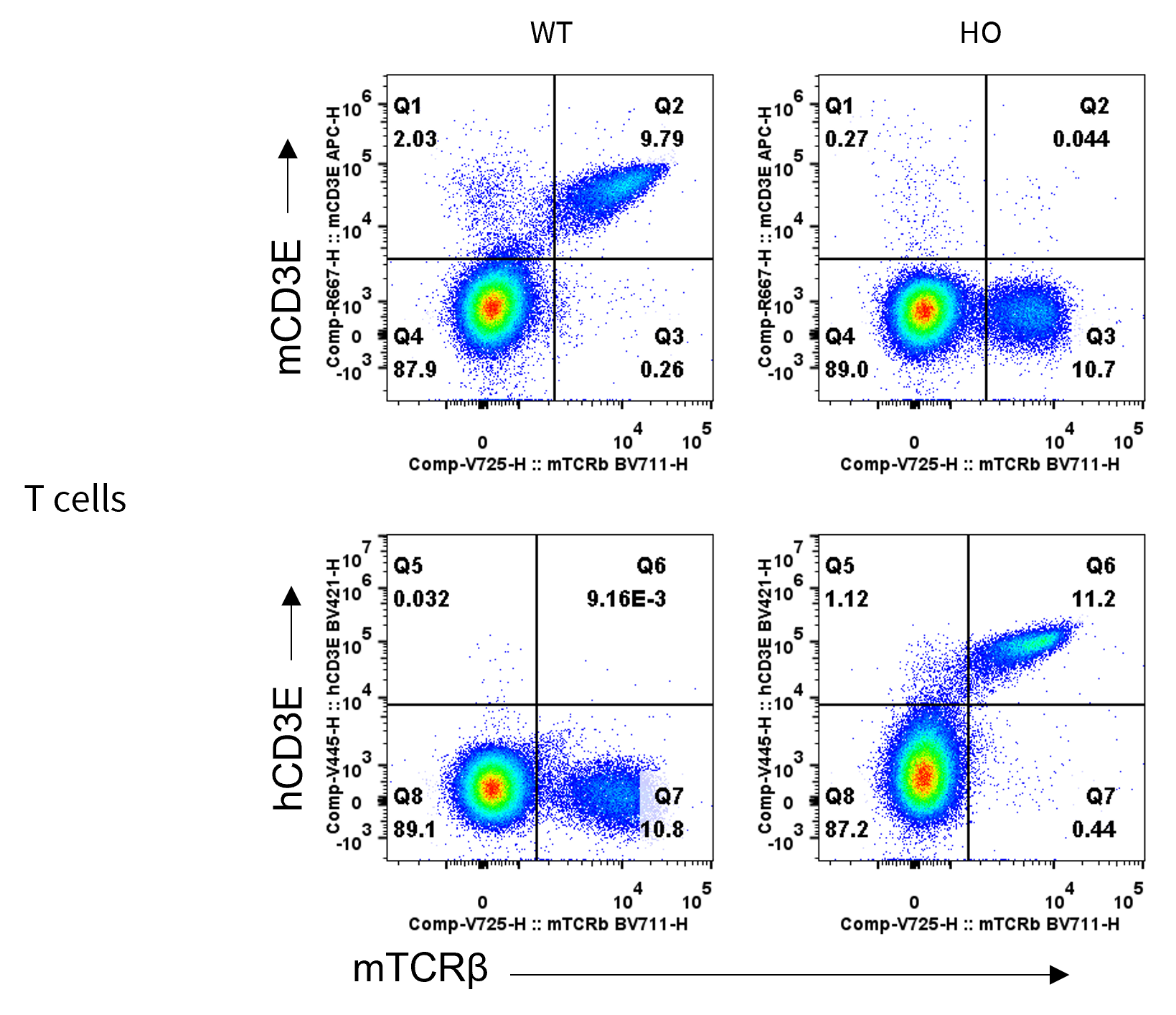
CD3E Protein Expression Analysis in Spleen
- Mouse CD3E was detected exclusively in wild-type C57BL/6JNifdc mice
- Human CD3E was detected in homozygous B-hCD3EDG/hCXCL16/hCXCR6 mice, but not in wild-type mice.
Strain specific CD3E expression analysis in homozygous B-hCD3EDG/hCXCL16/hCXCR6 mice by flow cytometry. Splenocytes were collected from wild-type C57BL/6JNifdc mice (+/+) and homozygous B-hCD3EDG/hCXCL16/hCXCR6 mice (H/H; H/H; H/H). Protein expression was analyzed with anti-mouse CD3E antibody (Biolegend, 100312) and anti-human CD3E antibody (BD Horizon™, 562426) by flow cytometry. Mouse CD3E was only detectable in wild-type C57BL/6JNifdc mice. Human CD3E was exclusively detectable in homozygous B-hCD3EDG/hCXCL16/hCXCR6 mice but not in wild-type C57BL/6JNifdc mice. WT: wild-type C57BL/6JNifdc mice; HO: homozygous B-hCD3EDG/hCXCL16/hCXCR6 mice.
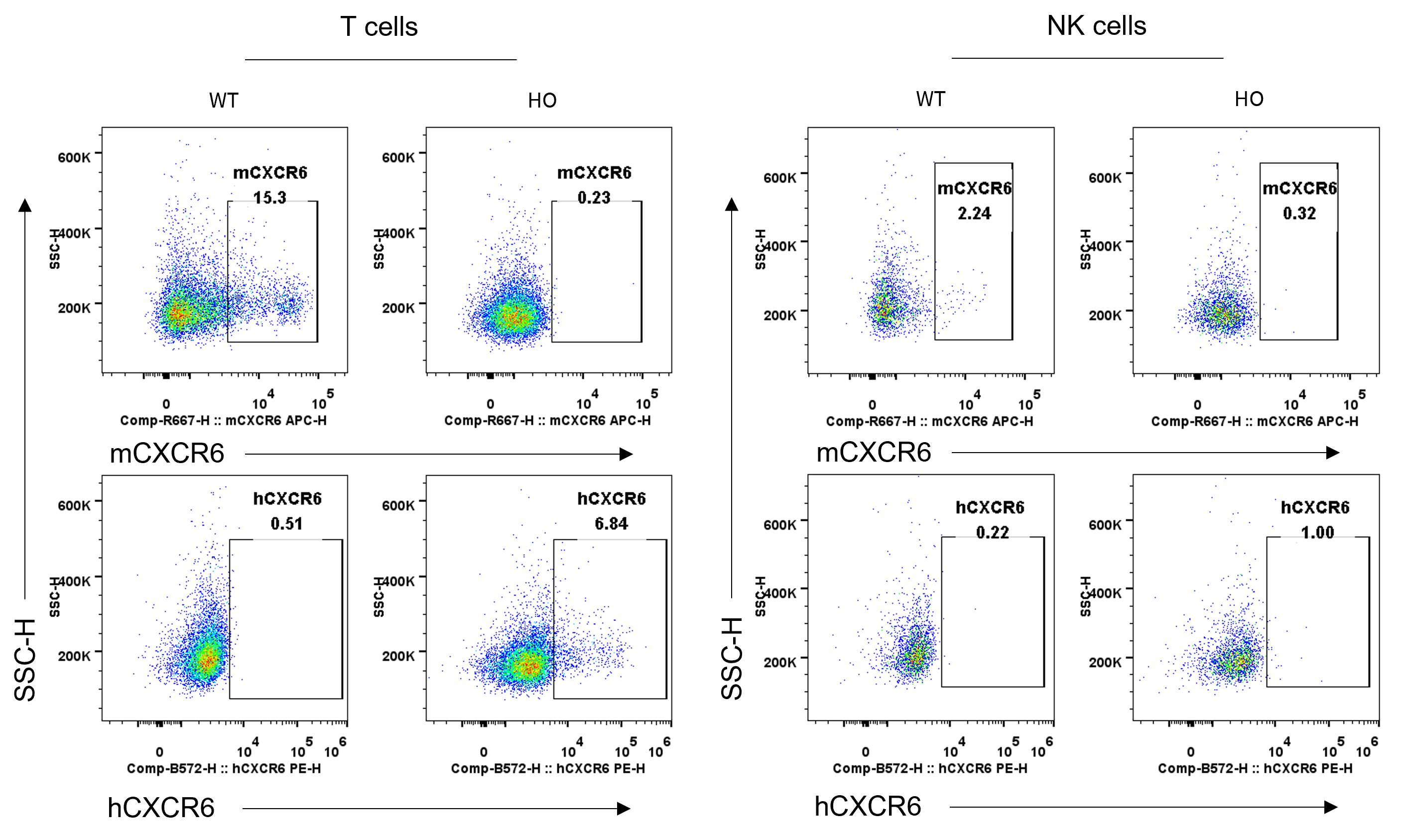
CXCR6 Protein Expression Analysis in Spleen
- Mouse CXCR6 was detected exclusively in wild-type C57BL/6JNifdc mice
- Human CXCR6 was detected in homozygous B-hCD3EDG/hCXCL16/hCXCR6 mice, but not in wild-type mice.
Strain specific CXCR6 expression analysis in homozygous B-hCD3EDG/hCXCL16/hCXCR6 mice by flow cytometry. Splenocytes were collected from wild-type C57BL/6JNifdc mice (+/+) and homozygous B-hCD3EDG/hCXCL16/hCXCR6 mice (H/H; H/H; H/H). Protein expression was analyzed with anti-mouse CXCR6 antibody (Biolegend, 151105) and anti-human CXCR6 antibody (Biolegend, 356003) by flow cytometry. mCXCR6 was detectable in T cells of splenocytes in wild-type mice, hCXCR6 was detectable in T cells of splenocytes in homozygous B-hCD3EDG/hCXCL16/hCXCR6 mice. WT: wild-type C57BL/6JNifdc mice; HO: homozygous B-hCD3EDG/hCXCL16/hCXCR6 mice.
CXCL16 Protein Expression Analysis in Serum
- Human CXCL16 was detectable in serum from B-hCD3EDG/hCXCL16/hCXCR6 mice but not in wild-type C57BL/6JNifdc mice.
Strain specific CXCL16 expression analysis in wild-type C57BL/6JNifdc mice and homozygous B-hCD3EDG/hCXCL16/hCXCR6 mice by ELISA. Serum was collected from wild-type C57BL/6JNifdc mice(+/+)(male, n=3, 6-week-old), homozygous B-hCD3EDG/hCXCL16/hCXCR6 mice(H/H; H/H; H/H)(male, n=3, 6-week-old) and homozygous B-hCXCL16/hCXCR6 mice(H/H; H/H)(female, n=2, 6-week-old). Expression level of human CXCL16 was analyzed by ELISA (Human: abcam, ab187397;Mouse CXCL16: abcam, ab197744). Human CXCL16 was only detectable in homozygous B-hCD3EDG/hCXCL16/hCXCR6 mice and homozygous B-hCXCL16/hCXCR6 mice. Values are expressed as mean ± SEM.
* When publishing results obtained using this animal model, please acknowledge the source as follows: The animal model [B-hCD3EDG/hCXCL16/hCXCR6 mice] (Cat# 114648) was purchased from Biocytogen.