Description
CD6: CD6 Regulates T-Cell Activation and Immunological Synapse Stabilization.
- Gene Information: CD6 encodes cluster of differentiation 6, a type I transmembrane glycoprotein located on human chromosome 11q12.2 that acts as a key co-stimulatory and immunomodulatory lymphocyte surface receptor.
- Protein Expression: Expressed predominantly on mature T lymphocytes, thymocytes, NK cell subsets, and B1a cells, CD6 contains three extracellular SRCR domains that mediate binding to adhesion molecules ALCAM (CD166) and CD318.
- Signaling Pathway: Ligand engagement localizes CD6 to the immunological synapse, where its phosphorylated cytoplasmic tail interacts with intracellular adaptors (SLP-76, ZAP-70) and RasGAP to fine-tune TCR signaling cascades and Ras/MAPK activation.
- Therapeutic Inhibition: Targeting CD6 with neutralizing monoclonal antibodies disrupts T-cell co-stimulation and pathogenic lymphocyte trafficking, offering a novel immunotherapeutic strategy for autoimmune conditions like multiple sclerosis, rheumatoid arthritis, and psoriasis.
Human CD6 Protein Expression Analysis in Spleen of CD6 Humanized Mice (BALB/c)
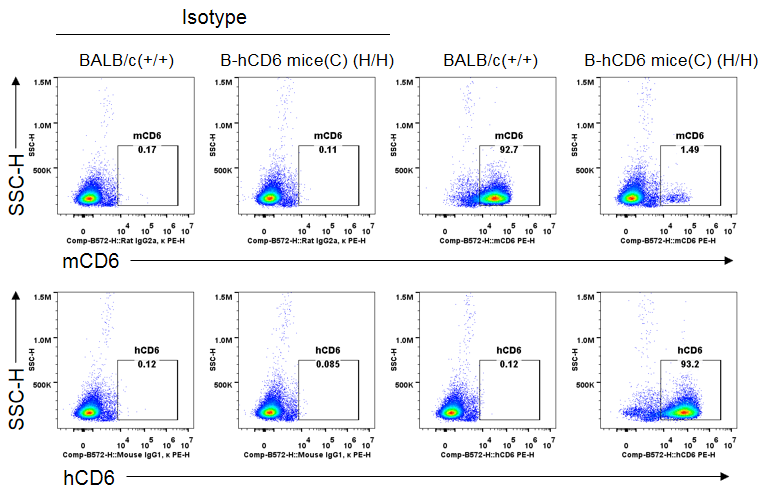
- Mouse CD6 was detectable in wild-type BALB/c mice.
- Human CD6 was detectable in homozygous CD6 humanized mice, but not in wild-type BALB/c mice.
Strain specific CD6 expression analysis in wild-type BALB/c mice and homozygous CD6 humanized mice by flow cytometry. Splenocytes were collected from wild-type BALB/c mice and homozygous B-hCD6 mice(C). Protein expression was analyzed with anti-mouse CD6 antibody (Biolegend, 146403) and anti-human CD6 antibody (Biolegend, 313906) by flow cytometry.
* When publishing results obtained using this animal model, please acknowledge the source as follows: The animal model [B-hCD6 mice(C)] (Cat# 113335) was purchased from Biocytogen.