B-hIL22RA1/hIL10RB mice

C57BL/6-Il22ra1tm1(IL22RA1)Bcgen Il10rbtm1(IL10RB)Bcgen/Bcgen • 112331

B-hIL22RA1/hIL10RB mice

Catalog Number: 112331
Strain Name: C57BL/6-Il22ra1tm1(IL22RA1)Bcgen Il10rbtm1(IL10RB)Bcgen/Bcgen
Strain Background: C57BL/6
NCBI gene ID: 58985,3588 (Human)
Aliases: IL22R; CRF2-9; IL22R1; CRFB4; IBD25; CRF2-4; D21S58; D21S66; CDW210B; IL-10R2; IL-10RB
---
ライセンスオプション提供可能
B-hIL22RA1/hIL10RB mice

このページで

  • Description
  • Targeting strategy
  • Phenotypic analysis

ポスター

すべて表示

    出版物

      Description

      IL-22: A crucial bridge between the immune system and epithelial barrier tissues, regulating both tissue defense and homeostasis.

      • Gene Information: The IL-22 receptor consists of IL10RB, which is ubiquitously expressed on nearly all cell types (including immune cells), and IL22RA1, which is strictly restricted to non-hematopoietic lineages, primarily epithelial cells (such as those in the gut, lung, and skin) and specific tissue cells like hepatocytes.
      • Protein Expression: IL-22 is primarily produced by specialized immune cells, most notably Th17 cells, Th22 cells, and group 3 innate lymphoid cells (ILC3s). Its expression is strongly induced by IL-23 and is typically a response triggered by the presence of extracellular pathogens or tissue injury at mucosal and skin barriers.
      • Signaling Pathway: IL-22 stimulation activates the JAK1 and TYK2 kinases, which subsequently leads to the phosphorylation and activation of STAT3 (and to a lesser extent, STAT1 and STAT5). This cascade induces the transcription of genes involved in producing antimicrobial peptides (AMPs), promoting cellular proliferation, and enhancing tissue repair.
      • Therapeutic Inhibition: Inhibiting IL-22 signaling helps suppress abnormal tissue proliferation and inflammation in skin diseases like psoriasis.
      Targeting strategy

      IL22RA1

      • The exons 2-5 of mouse Il22ra1 gene that encode extracellular domain are replaced by human counterparts in B-hIL22/hIL22RA1 mice. The genomic region of mouse Il22ra1 gene that encodes transmembrane domain and cytoplasmic portion is retained.
      • The promoter, 5’UTR and 3’UTR region of the mouse gene are also retained. The chimeric IL22RA1 expression is driven by endogenous mouse Il22ra1 promoter, while mouse Il22ra1 gene transcription and translation will be disrupted.

      IL10RB

      • The exons 2-6 of mouse Il10rb gene that encode extracellular domain and were replaced by human counterparts in B-hIL22RA1/hIL10RB mice. The genomic region of mouse Il10rb gene that encodes signal peptide, transmembrane domain and cytoplasmic portion was retained.
      • The promoter, 5’UTR and 3’UTR region of the mouse gene were also retained. The chimeric IL10RB expression was driven by endogenous mouse Il10rb promoter, while mouse Il10rb gene transcription and translation will be disrupted.
      Functional Validation
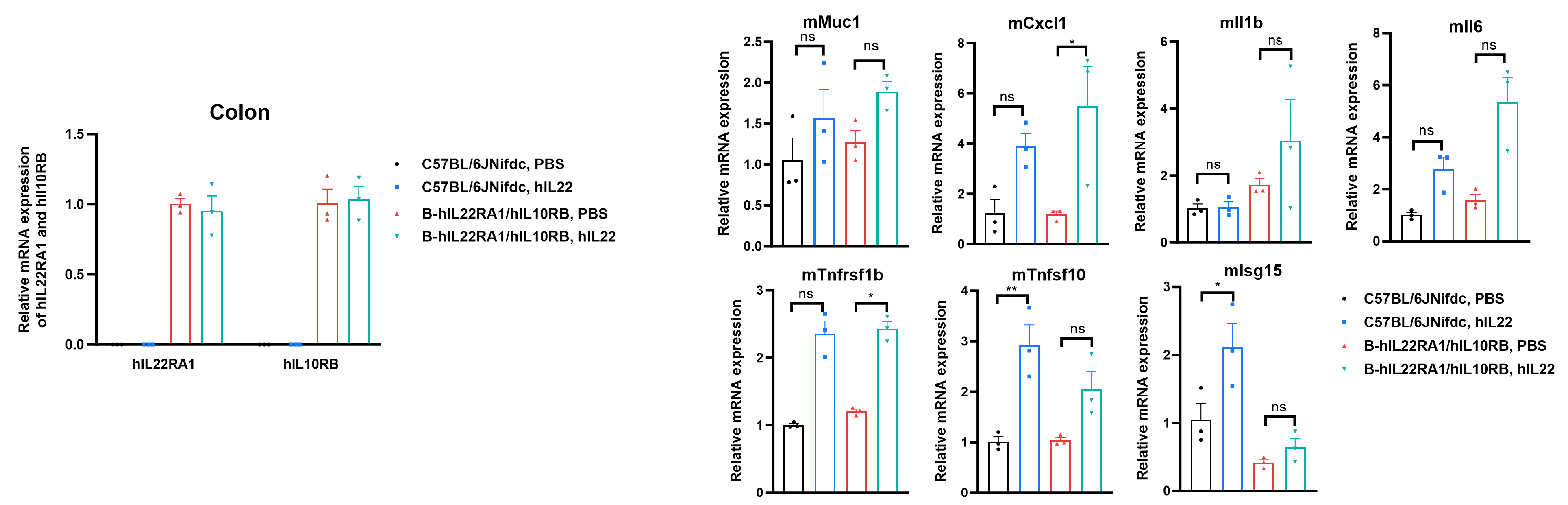
      • Human IL22RA1 and IL10RB mRNA were only detected in homozygous B-hIL22RA1/hIL10RB mice.
      • Human IL22 recombinant protein induces IL22 downstream related gene changes in B-hIL22RA1/hIL10RB mice through the receptor composed of hIL2RA1 and hIL0RB.

      Relative expression of IL-22 target genes from wild-type C57BL/6JNifdc mice and homozygous B-hIL22RA1/hIL10RB mice was analyzed by RT-qPCR. Colon was collected from wild-type C57BL/6JNifdc and homozygous B-hIL22RA1/hIL10RB mice (female, n=3, 7-week-old) stimulated with PBS or human IL22 (hIL22) recombinant protein (provided by the client, 200 μg/mice, i.p.) in vivo for 6 hours. Human IL22RA1 and IL10RB mRNA were only detected in homozygous B-hIL22RA1/hIL10RB mice (A). Relative expression of IL-22 target genes analyzed by RT-qPCR (B). The mRNA expression of Reg3b, Reg3g, Muc1, Il1b, Il6, Tnfsf10, and Isg15 in homozygous B-hIL22RA1/hIL10RB mice treated with hIL22 recombinant protein showed no significant changes. The mRNA expression of Cxcl1 and Tnfrsf1b were significantly increased in homozygous B-hIL22RA1/hIL10RB mice after the treatment of hIL22 recombinant protein. The expression of target genes in the skin did not change, and the data was not displayed. This indicates that hIL22 recombinant protein induces IL22 downstream related gene changes in B-hIL22RA1/hIL10RB mice through the receptor composed of hIL2RA1 and hIL0RB. Values are expressed as mean ± SEM. Significance was determined by two-way ANOVA. ns: non-significant, *P < 0.05, **P < 0.01, ***P < 0.001.
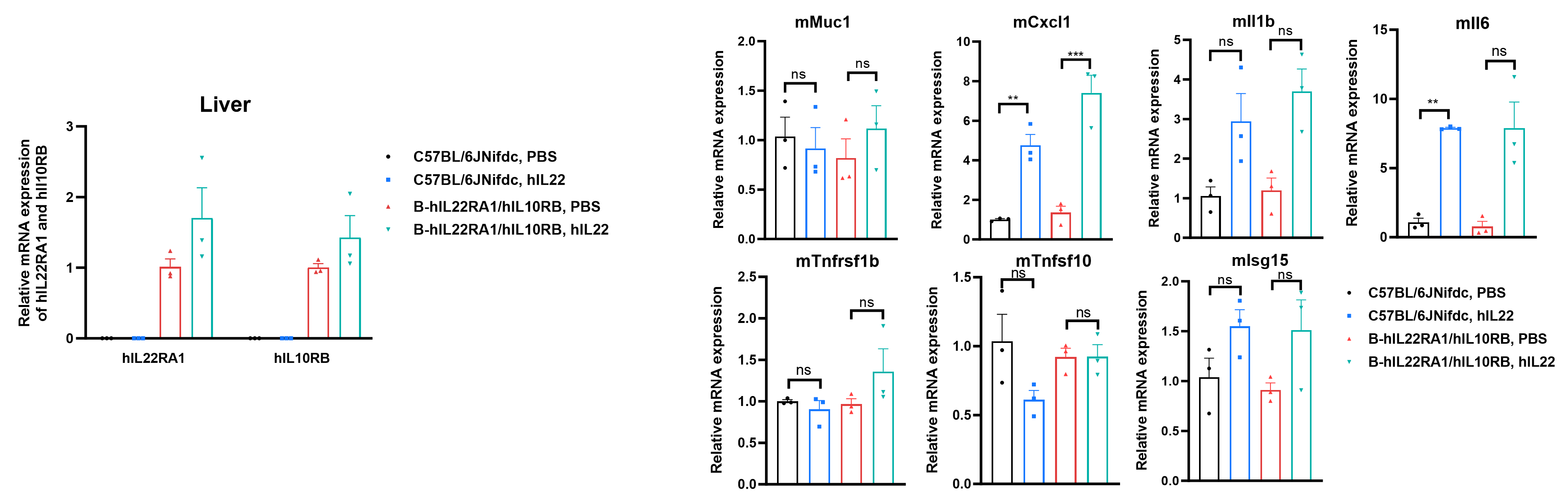
      • Human IL22RA1 and IL10RB mRNA were only detected in homozygous B-hIL22RA1/hIL10RB mice.
      • Human IL22 recombinant protein induces IL22 downstream related gene changes in B-hIL22RA1/hIL10RB mice through the receptor composed of hIL2RA1 and hIL0RB.

      Relative expression of IL-22 target genes from wild-type C57BL/6JNifdc mice and homozygous B-hIL22RA1/hIL10RB mice was analyzed by RT-qPCR. Liver was collected from wild-type C57BL/6JNifdc and homozygous B-hIL22RA1/hIL10RB mice (female, n=3, 7-week-old) stimulated with PBS or human IL22 (hIL22) recombinant protein (provided by the client, 200 μg/mice, i.p.) in vivo for 6 hours. Human IL22RA1 and IL10RB mRNA were only detected in homozygous B-hIL22RA1/hIL10RB mice (A). Relative expression of IL-22 target genes analyzed by RT-qPCR (B). The mRNA expression of Tnfrsf1b, Muc1, Il1b, Il6, Tnfsf10, and Isg15 in homozygous B-hIL22RA1/hIL10RB mice treated with hIL22 recombinant protein showed no significant changes. The mRNA expression of Cxcl1 was significantly increased in homozygous B-hIL22RA1/hIL10RB mice after the treatment of hIL22 recombinant protein. The expression of target genes in the skin did not change, and the data was not displayed. This indicates that hIL22 recombinant protein induces IL22 downstream related gene changes in B-hIL22RA1/hIL10RB mice through the receptor composed of hIL2RA1 and hIL0RB. Values are expressed as mean ± SEM. Significance was determined by two-way ANOVA. ns: non-significant, *P < 0.05, **P < 0.01, ***P < 0.001.

      * When publishing results obtained using this animal model, please acknowledge the source as follows: The animal model [B-hIL22RA1/hIL10RB mice] (Cat# 112331) was purchased from Biocytogen.