
B-hIL10RA/hIL10RB mice

C57BL/6-Il10ratm1(IL10RA)BcgenIl10rbtm1(IL10RB)Bcgen/Bcgen • 111871

B-hIL10RA/hIL10RB mice

Product nameB-hIL10RA/hIL10RB mice
Catalog number111871
Strain nameC57BL/6-Il10ratm1(IL10RA)BcgenIl10rbtm1(IL10RB)Bcgen/Bcgen
Strain backgroundC57BL/6
NCBI gene ID3587,3588 (Human)
AliasesCD210; IL10R; CD210a; CDW210A; HIL-10R; IL-10R1; CRFB4; IBD25; CRF2-4; D21S58; D21S66; CDW210B; IL-10R2; IL-10RB

このページで

  • Targeting strategy
  • Phenotypic analysis

ポスター

すべて表示

    出版物

      Targeting strategy

      Gene targeting strategy for B-hIL10RA/hIL10RB mice. The exons 1-6 of mouse Il10ra gene that encode the extracellular protein were replaced by human IL10RA exons 1-6 in B-hIL10RA/hIL10RB mice. The exons 2-6 of mouse Il10rb gene that encode the extracellular protein were replaced by human IL10RB exons 2-6 in B-hIL10RA/hIL10RB mice.

      mRNA expression analysis
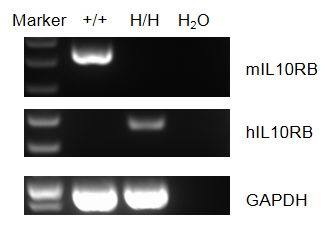
      Strain specific analysis of IL10RB mRNA expression in wild-type C57BL/6 mice and B-hIL10RA/hIL10RB mice by RT-PCR. Mouse Il10rb mRNA was detectable only in splenocytes of wild-type C57BL/6 mice (+/+). Human IL10RB mRNA was detectable only in homozygous B-hIL10RA/hIL10RB mice (H/H, H/H), but not in wild-type mice.
      Protein expression analysis
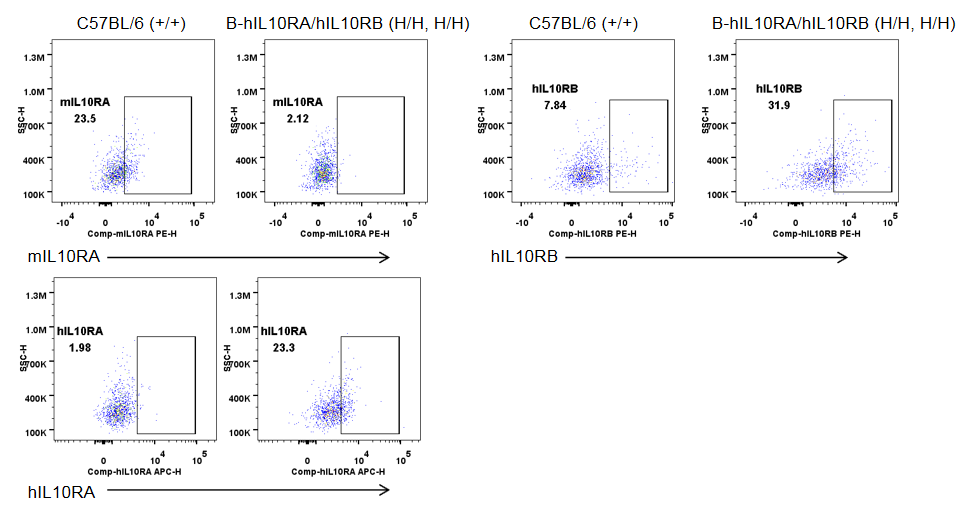
      Strain specific IL10RA and IL10RB expression analysis in homozygous B-hIL10RA/hIL10RB mice by flow cytometry. Dendritic cells from spleen were collected from wild-type C57BL/6 mice (+/+) and homozygous B-hIL10RA/hIL10RB mice (H/H, H/H), and analyzed by flow cytometry with species-specific anti-IL10RA and anti-IL10RB antibody. Mouse IL10RA was detectable in wild-type mice. Human IL10RA and human IL10RB were exclusively detectable in homozygous B-hIL10RA/hIL10RB mice but not in wild-type mice.
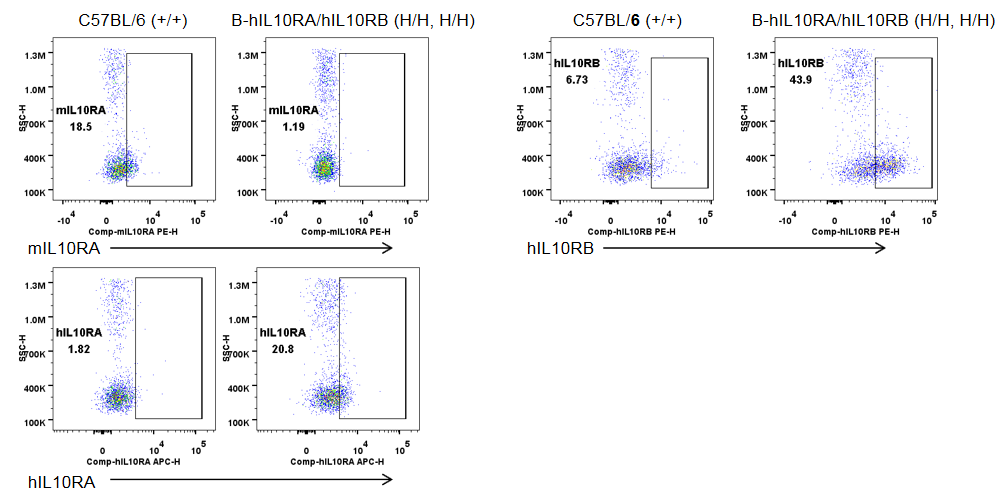
      Strain specific IL10RA and IL10RB expression analysis in homozygous B-hIL10RA/hIL10RB mice by flow cytometry. Macrophages from spleen were collected from wild-type C57BL/6 mice (+/+) and homozygous B-hIL10RA/hIL10RB mice (H/H, H/H), and analyzed by flow cytometry with species-specific anti-IL10RA and anti-IL10RB antibody. Mouse IL10RA was detectable in wild-type mice. Human IL10RA and human IL10RB were exclusively detectable in homozygous B-hIL10RA/hIL10RB mice but not in wild-type mice.
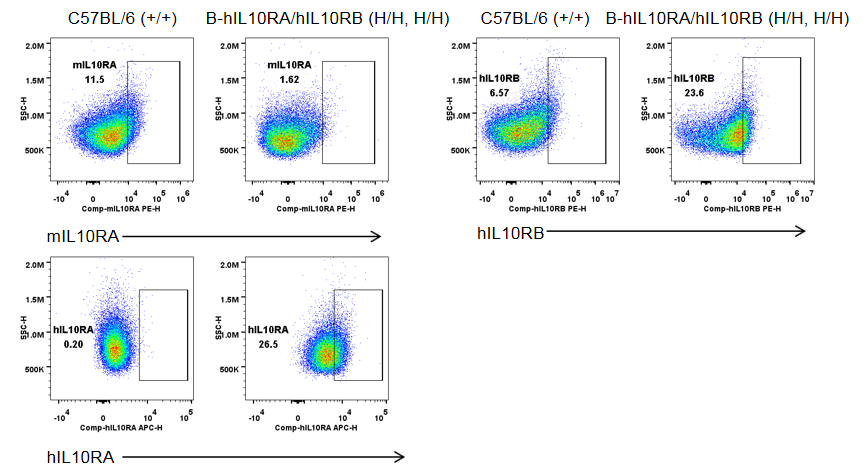
      Strain specific IL10RA and IL10RB expression analysis in homozygous B-hIL10RA/hIL10RB mice by flow cytometry. Peritoneal exudative macrophages were collected from wild-type C57BL/6 mice (+/+) and homozygous B-hIL10RA/hIL10RB mice (H/H, H/H), and analyzed by flow cytometry with species-specific anti-IL10RA and anti-IL10RB antibody. Mouse IL10RA was detectable in wild-type mice. Human IL10RA and human IL10RB were exclusively detectable in homozygous B-hIL10RA/hIL10RB mice but not in wild-type mice.
      Functional analysis

      Mouse TNF-α expression analysis in wild-type C57BL/6JNifdc and homozygous B-hIL10RA/hIL10RB mice by ELISA. Bone marrow-derived macrophages were isolated from the wild-type C57BL/6JNifdc mice (+/+) and homozygous B-hIL10RA/hIL10RB mice (H/H;H/H), and stimulated with 100 ng/mL LPS  in vitro for 6 h. The protein expression of mouse TNF-α in cell culture supernatant was measured using the mouse TNF-α ELISA kit (Biolegend, 430904). The mIL10 and hIL10 could reduce the production of mouse TNF-α in wild-type C57BL/6JNifdc mice. The hIL10 could reduce the production of mouse TNF-α in homozygous B-hIL10RA/hIL10RB mice. The results suggested that the mouse IL10 receptor could recognize both mouse IL10 and human IL10, while the human IL10 receptor only recognizes human IL10. Significance was determined by two-way ANOVA test.  *P < 0.05, **P < 0.01, ***P < 0.001, ****P < 0.0001.

      Mouse IL6 expression analysis in wild-type C57BL/6JNifdc and homozygous B-hIL10RA/hIL10RB mice by ELISA. Bone marrow-derived macrophages were isolated from the wild-type C57BL/6JNifdc mice (+/+) and homozygous B-hIL10RA/hIL10RB mice (H/H;H/H), and stimulated with 100 ng/mL LPS  in vitro for 6 h. The protein expression of mouse IL6 in cell culture supernatant was measured using the mouse IL6 ELISA kit (Biolegend, 431304). The mIL10 and hIL10 could reduce the production of mouse IL6 in wild-type C57BL/6JNifdc mice. The hIL10 could reduce the production of mouse IL6 in homozygous B-hIL10RA/hIL10RB mice. The results suggested that the mouse IL10 receptor could recognize both mouse IL10 and human IL10, while the human IL10 receptor only recognizes human IL10. Significance was determined by two-way ANOVA test.  *P < 0.05, **P < 0.01, ***P < 0.001, ****P < 0.0001.

      * When publishing results obtained using this animal model, please acknowledge the source as follows: The animal model [B-hIL10RA/hIL10RB mice] (Cat# 111871) was purchased from Biocytogen.