

C57BL/6-Tnftm1(TNF)Bcgen Tnfrsf1btm1(TNFRSF1B)Bcgen Tnfrsf1atm1(TNFRSF1A)Bcgen Il7rtm1(IL7R)Bcgen/Bcgen • 114150


Gene targeting strategy for B-hTNFA/hTNFR2/hTNFR1/hIL7R mice.
The exons 1-4 of mouse Tnfa gene that encode signal peptide, extracellular domain, transmembrane domain, cytoplasmic region and 3’UTR are replaced by human counterparts in B-hTNFA/hTNFR2/hTNFR1/hIL7R mice. The promoter and 5’UTR region of the mouse gene are replaced by human counterparts. The human TNFA expression is driven by human TNFA promoter, while mouse Tnfa gene transcription and translation will be disrupted.
The exons 2-6 of mouse Tnfr1 gene that encode extracellular domain are replaced by human counterparts in B-hTNFA/hTNFR2/hTNFR1/hIL7R mice. The genomic region of mouse Tnfr1 gene that encodes transmembrane domain and cytoplasmic portion is retained. The promoter, 5’UTR and 3’UTR region of the mouse gene are also retained. The chimeric TNFR1 expression is driven by endogenous mouse Tnfr1 promoter, while mouse Tnfr1 gene transcription and translation will be disrupted.
The exons 2-6 of mouse Tnfr2 gene that encode extracellular domain are replaced by human counterparts in B-hTNFA/hTNFR2/hTNFR1/hIL7R mice. The genomic region of mouse Tnfr2 gene that encodes transmembrane domain and cytoplasmic portion is retained. The promoter, 5’UTR and 3’UTR region of the mouse gene are also retained. The chimeric TNFR2 expression is driven by endogenous mouse Tnfr2 promoter, while mouse Tnfr2 gene transcription and translation will be disrupted.
The exons 1-6 of mouse Il7r gene that encode the extracellular region were replaced by human IL7R exons 1-6 in B-hTNFA/hTNFR2/hTNFR1/hIL7R mice.

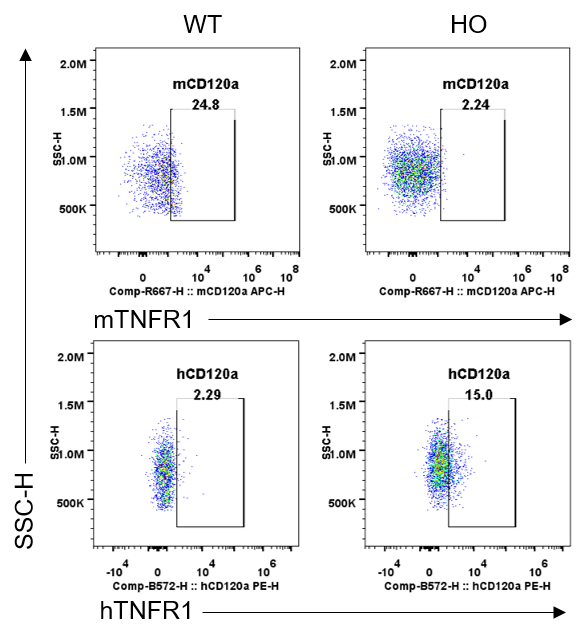
Strain specific TNFR1 expression analysis in wild-type C57BL/6JNifdc mice and homozygous B-hTNFA/hTNFR2/hTNFR1/hIL7R mice by flow cytometry. Splenocytes were collected from wild-type C57BL/6JNifdc mice (+/+) and homozygous B-hTNFA/hTNFR2/hTNFR1/hIL7R mice(H/H;H/H;H/H;H/H), protein expression was analyzed with anti-mouse TNFR1 antibody (Biolegend, 113005) and anti-human TNFR1 antibody (Biolegend, 369903) by flow cytometry. Mouse TNFR1 was detectable in wild-type C57BL/6JNifdc mice. Human TNFR1 was detectable in homozygous B-hTNFA/hTNFR2/hTNFR1/hIL7R mice. WT: wild-type C57BL/6JNifdc mice; HO: homozygous B-hTNFA/hTNFR2/hTNFR1/hIL7R mice.
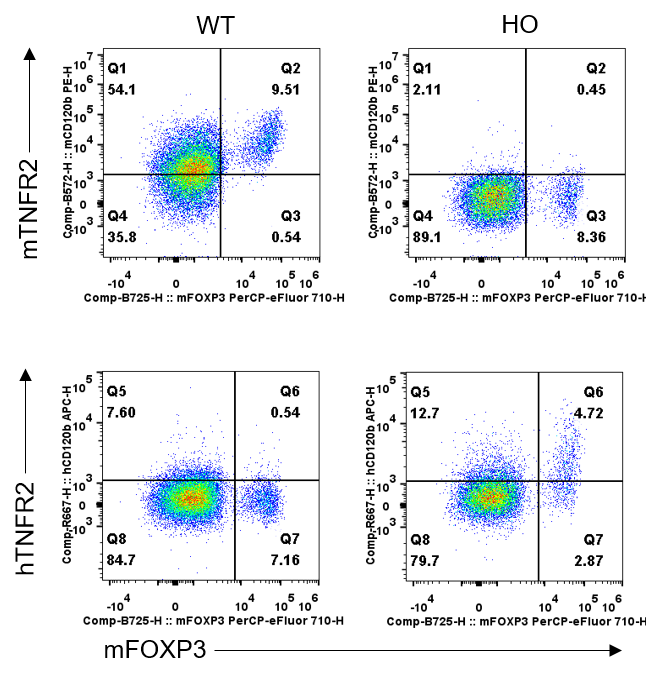
Strain specific TNFR2 expression analysis in wild-type C57BL/6JNifdc mice and homozygous B-hTNFA/hTNFR2/hTNFR1/hIL7R mice by flow cytometry. Splenocytes were collected from wild-type C57BL/6JNifdc mice (+/+) and homozygous B-hTNFA/hTNFR2/hTNFR1/hIL7R mice(H/H;H/H;H/H;H/H), stimulated with anti-CD3ε in vivo (7.5 μg/mice, stimulation for 24 h, i.p.). Protein expression was analyzed with anti-mouse TNFR2 antibody (Biolegend, 113405) and anti-human TNFR2 antibody (Biolegend, 358406) by flow cytometry. Mouse TNFR2 was detectable in wild-type C57BL/6JNifdc mice. Human TNFR2 was detectable in homozygous B-hTNFA/hTNFR2/hTNFR1/hIL7R mice. WT: wild-type C57BL/6JNifdc mice; HO: homozygous B-hTNFA/hTNFR2/hTNFR1/hIL7R mice.
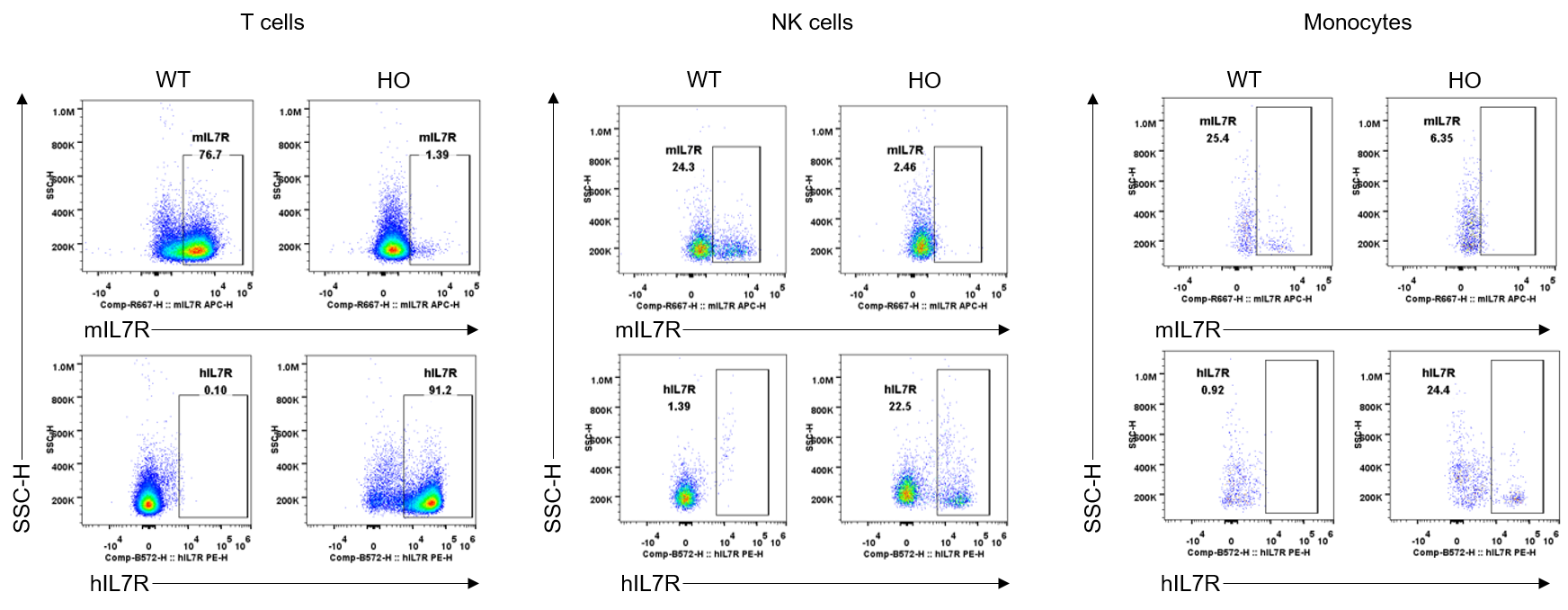
Strain specific IL7R expression analysis in wild-type C57BL/6JNifdc mice and homozygous B-hTNFA/hTNFR2/hTNFR1/hIL7R mice by flow cytometry. Splenocytes were collected from wild-type C57BL/6JNifdc mice (+/+) and homozygous B-hTNFA/hTNFR2/hTNFR1/hIL7R mice(H/H;H/H;H/H;H/H), protein expression was analyzed with anti-mouse IL7R antibody (Biolegend, 135011) and anti-human IL7R antibody (Biolegend, 351303) by flow cytometry. Mouse IL7R was detectable in wild-type C57BL/6JNifdc mice. Human IL7R was detectable in homozygous B-hTNFA/hTNFR2/hTNFR1/hIL7R mice. WT: wild-type C57BL/6JNifdc mice; HO: homozygous B-hTNFA/hTNFR2/hTNFR1/hIL7R mice.

Strain specific TNFA expression analysis in wild-type C57BL/6JNifdc mice and homozygous humanized B-hTNFA/hTNFR1/hTNFR2/hIL7R mice by ELISA. Serum were collected from wild-type C57BL/6JNifdc mice (+/+) and homozygous B-hTNFA/hTNFR1/hTNFR2/hIL7R mice (H/H;H/H;H/H;H/H), the production of TNFA in serum were assessed after 2 h of stimulation with LPS in vivo. Expression levels of mouse and human TNFA were analyzed by ELISA (Mouse TNFA ELISA Kit: Biolegend, 430904; Human TNFA ELISA Kit: Biolegend, 430204). Mouse TNFA was only detectable in wild-type C57BL/6JNifdc mice, and human TNFA was only detectable in homozygous B-hTNFA/hTNFR1/hTNFR2/hIL7R mice. Values are expressed as mean ± SEM.
