Description
LILRB2/3: Myeloid-associated inhibitory receptors and targets for cancer immunotherapy
- Gene Information: LILRB2 (ILT4) and LILRB3 (ILT5) are homologous inhibitory receptor genes located within the leukocyte receptor complex (LRC) on human chromosome 19q13.4.
- Protein Expression: These transmembrane glycoproteins are predominantly expressed on myeloid-lineage cells, including monocytes, macrophages, dendritic cells, and granulocytes.
- Signaling Pathway: Upon engagement with ligands such as MHC class I molecules and angiopoietin-like proteins (ANGPTLs), their cytoplasmic ITIM domains recruit SHP-1 and SHP-2 phosphatases to attenuate downstream activating cascades and sustain immunosuppressive states.
- Therapeutic Inhibition: Targeted blockade of LILRB2 and LILRB3 relieves myeloid-mediated suppression, reprogramming tumor-associated macrophages and MDSCs toward pro-inflammatory phenotypes to reactivate anti-tumor immunity.
Human LILRB2 Protein Expression Analysis in Blood of LILRB2/LILRB3 Humanized Transgenic Mice
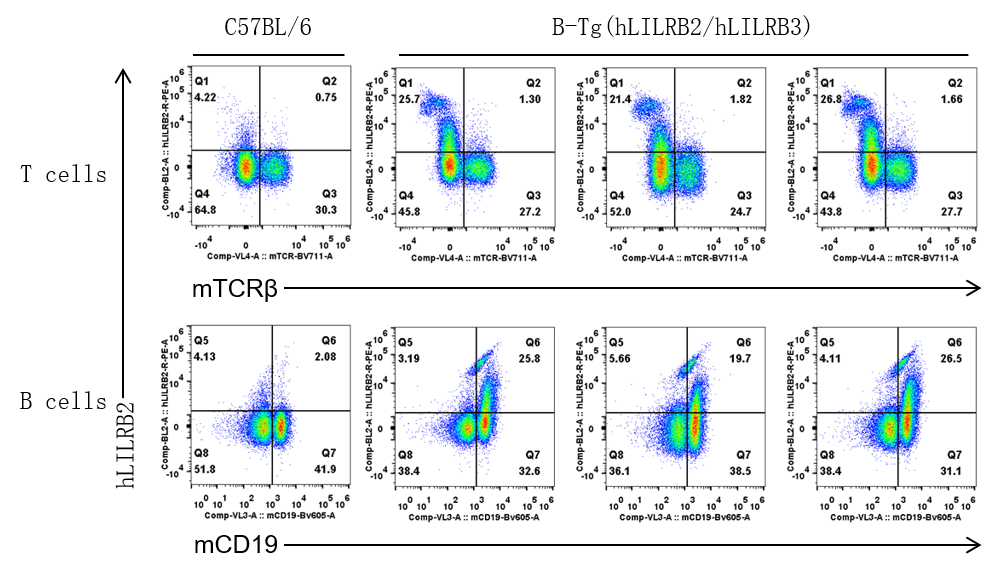
- Human LILRB2 was specifically detected on B cells, but not T cells, in LILRB2/LILRB3 humanized transgenic mice, and was undetectable in wild-type mice
Strain specific human LILRB2 expression analysis in LILRB2/LILRB3 humanized transgenic mice by flow cytometry. Blood cells were collected from wild-type C57BL/6 mice (+/+) and transgenic B-Tg(hLILRB2/hLILRB3) mice (Tg). Human LILRB2 expression was analyzed by flow cytometry using anti-human LILRB2 antibody (R&D, FAB2078P).
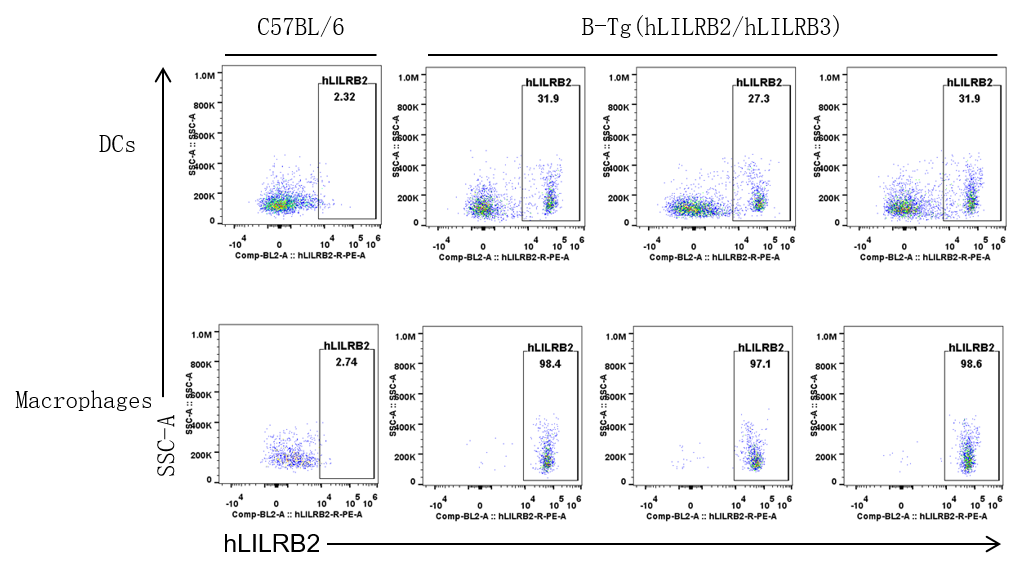
- Human LILRB2 was specifically detected on DCs and macrophages in LILRB2/LILRB3 humanized transgenic mice but not wild-type mice.
Strain specific human LILRB2 expression analysis in LILRB2/LILRB3 humanized transgenic mice by flow cytometry. Blood cells were collected from wild-type C57BL/6 mice (+/+) and transgenic B-Tg(hLILRB2/hLILRB3) mice (Tg). Human LILRB2 expression was analyzed by flow cytometry using anti-human LILRB2 antibody (R&D, FAB2078P).
Human LILRB3 Protein Expression Analysis in Blood of LILRB2/LILRB3 Humanized Transgenic Mice
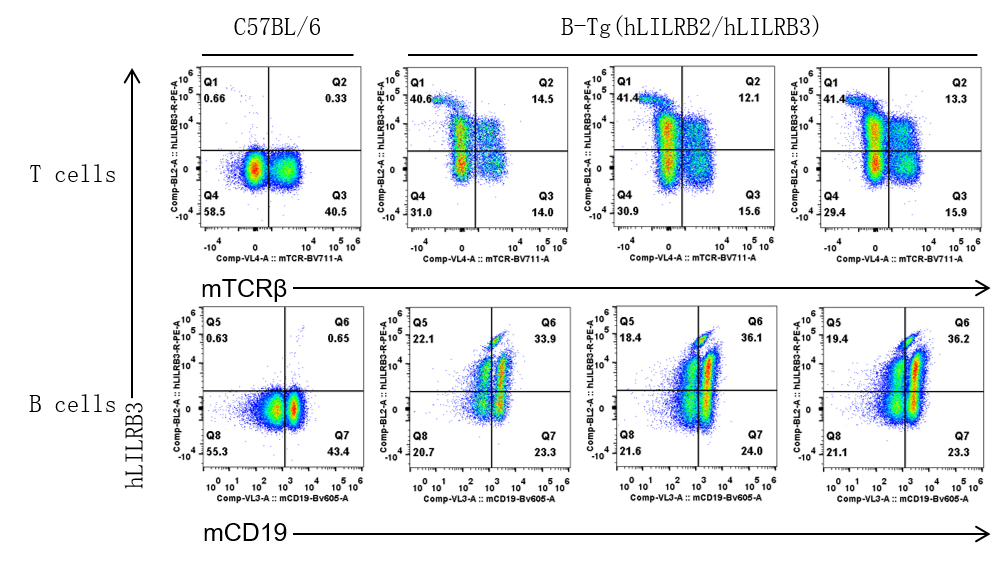
- Human LILRB3 was detected on B cells and T cells in LILRB2/LILRB3 humanized transgenic mice, but not in wild-type mice.
Strain specific human LILRB3 expression analysis in LILRB2/LILRB3 humanized transgenic mice by flow cytometry. Blood cells were collected from wild-type C57BL/6 mice (+/+) and transgenic B-Tg(hLILRB2/hLILRB3) mice (Tg). Human LILRB3 expression was analyzed by flow cytometry using anti-human LILRB3 antibody (R&D, FAB1806P-100).
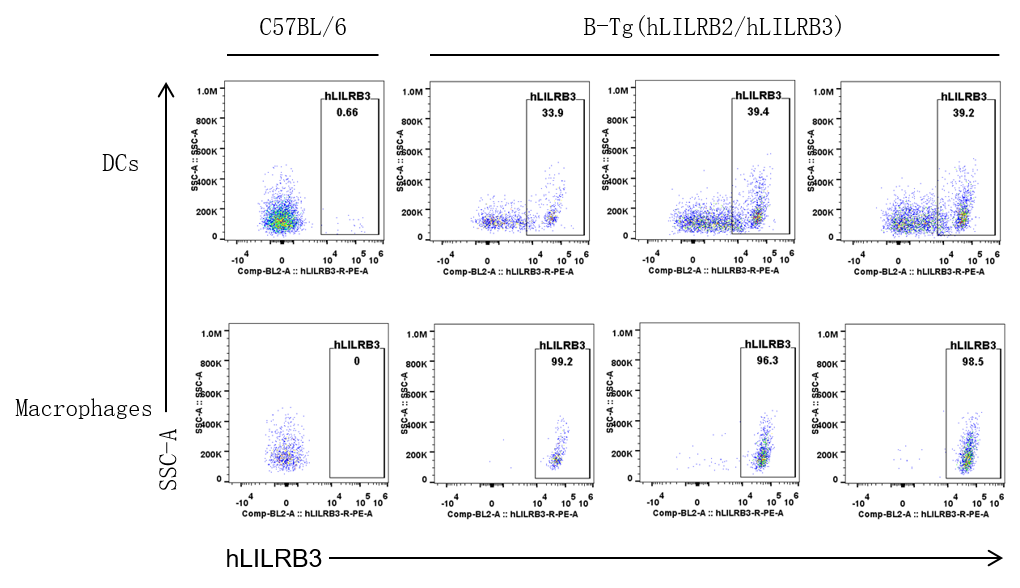
- Human LILRB3 was specifically detected on DCs and macrophages in LILRB2/LILRB3 humanized transgenic mice but not wild-type mice.
Strain specific human LILRB3 expression analysis in LILRB2/LILRB3 humanized transgenic mice by flow cytometry. Blood cells were collected from wild-type C57BL/6 mice (+/+) and transgenic B-Tg(hLILRB2/hLILRB3) mice (Tg). Human LILRB3 expression was analyzed by flow cytometry using anti-human LILRB3 antibody (R&D, FAB1806P-100).
In Vivo Efficacy of Anti-Human LILRB2 Antibody in LILRB2/LILRB3 Humanized Transgenic Mice
- The anti-human LILRB2 antibody J19.h7 (in-house) was efficacious in controlling tumor growth in LILRB2/LILRB3 humanized transgenic mice, demonstrating that these mice provide a robust preclinical model for the in vivo evaluation of anti-human LILRB2 antibodies.
Antitumor activity of anti-human LILRB2 antibody in LILRB2/LILRB3 humanized transgenic mice. (A) Anti-human LILRB2 antibody inhibited MC38 tumor growth in B-Tg(hLILRB2/hLILRB3) mice. Murine colon cancer MC38 cells were subcutaneously implanted into B-Tg(hLILRB2/hLILRB3) mice (female, 9 weeks old, n = 6). Mice were grouped when tumor volume reached approximately 100-150 mm3, and treated with anti-hLILRB2 antibody in panel A. (B) Body weight changes. Values are expressed as mean ± SEM.
* When publishing results obtained using this animal model, please acknowledge the source as follows: The animal model [B-Tg(hLILRB2/hLILRB3) mice] (Cat# 110858) was purchased from Biocytogen.