
C57BL/6-Muc13tm1(MUC13)Bcgen/Bcgen • 113205


Gene targeting strategy for B-hMUC13 mice. The exons 2-10 and part of exon 11 of mouse Muc13 gene that encode signal peptide, extracellular domain and part of transmembrane domain were replaced by human counterparts in B-hMUC13 mice. The genomic region of mouse Muc13 gene that encodes part of transmembrane domain and cytoplasmic portion was retained. The promoter, 5’UTR and 3’UTR region of the mouse gene were also retained. The MUC13 expression was driven by endogenous mouse Muc13 promoter, while mouse Muc13 gene transcription and translation will be disrupted.

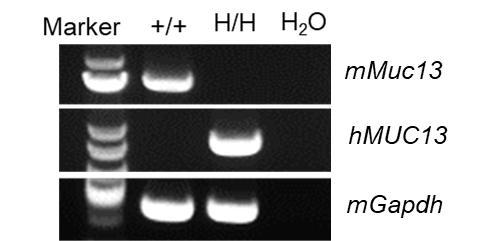
Strain specific analysis of MUC13 mRNA expression in wild-type C57BL/6 mice and B-hMUC13 mice by RT-PCR. Colon RNA were isolated from wild-type C57BL/6 mice (+/+) and homozygous B-hMUC13 mice (H/H), then cDNA libraries were synthesized by reverse transcription, followed by PCR with mouse or human MUC13 primers. Mouse Muc13 mRNA was only detectable in wild-type mice. Human MUC13 mRNA was exclusively detectable in homozygous B-hMUC13 mice but not in wild-type mice.
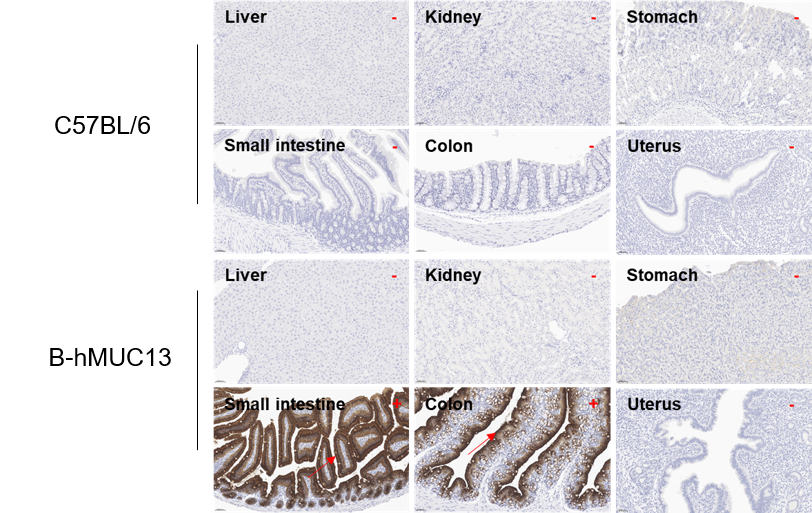
Immunohistochemical (IHC) analysis was performed to evaluate MUC13 protein expression in wild-type (WT) and B-hMUC13 mice. Tissues from six major organs were collected from WT and homozygous B-hMUC13 mice (1 female, 7 weeks old) and analyzed by IHC using anti-human MUC13 antibody (Cellsignal, 44454S). Human MUC13 expression was detected in the small intestine and colon of homozygous B-hMUC13 mice. The antibody was species-specific and did not bind to mouse MUC13 in WT mice. The results demonstrated that the MUC13 expression profile in B-hMUC13 mice closely resembles that in normal human tissues (Table 1).