Description
STC2 MOA: A Crucial Role in Cell Growth and Metabolic Homeostasis
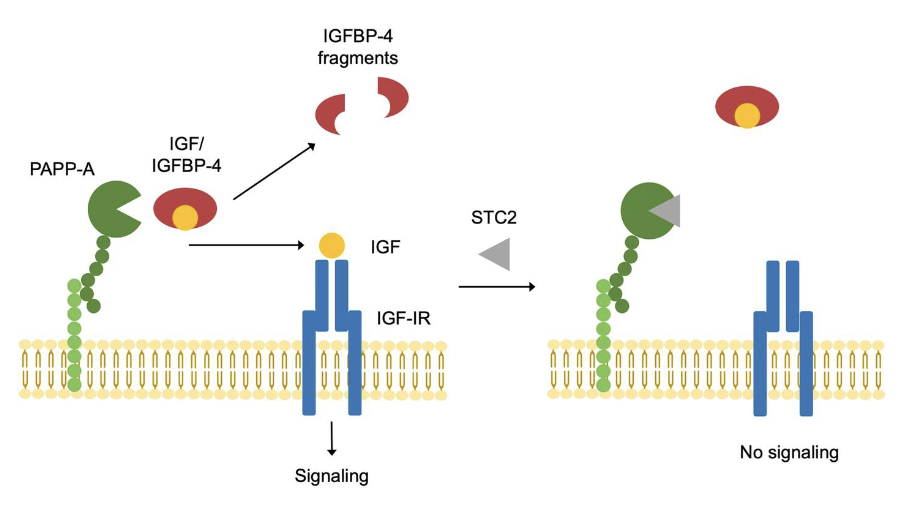
STC2: A Key Regulator of IGF Signaling, Cell Growth, and Metabolic Homeostasis
- Gene Information: Stanniocalcin-2 (STC2) is a protein-coding gene encoding a secreted glycoprotein belonging to the stanniocalcin family.
- Protein Expression: STC2 is widely expressed in various tissues, including the adipose tissue, skeletal muscle, kidney, and brain.
- Signaling Pathway: STC2 primarily regulates the IGF signaling pathway by inhibiting PAPP-A activity. STC2 forms a stable disulfide-linked complex with PAPP-A, preventing PAPP-A-mediated cleavage of insulin-like growth factor-binding protein 4 (IGFBP-4). This maintains IGF in its bound state, reduces IGF availability, and suppresses IGF1R activation and downstream PI3K/AKT and MAPK signaling. Consequently, STC2 modulates cell proliferation, survival, differentiation, and tissue growth.
- Therapeutic Agonists: STC2 and the PAPP-A/IGF signaling axis represent potential therapeutic targets in growth disorders, metabolic diseases, and cancer. Modulating STC2 activity may influence local IGF signaling, tissue growth, and metabolic homeostasis. In particular, targeting the STC2–PAPP-A interaction may provide new opportunities for regulating IGF-dependent biological processes. However, the therapeutic potential of STC2 modulation remains under investigation.
Humanized B-hSTC2 Mice: Gene Targeting Strategy
STC2
- The exons 1-4 of mouse Stc2 gene that encode the whole molecule, including promoter, 5’UTR, and 3’UTR, were replaced by human counterparts in B-hSTC2 mice.
- The human STC2 expression is driven by the human STC2 promoter.
- The mouse Stc2 gene transcription and translation will be disrupted.
Humanized B-hSTC2 Mice: mRNA Expression Analysis
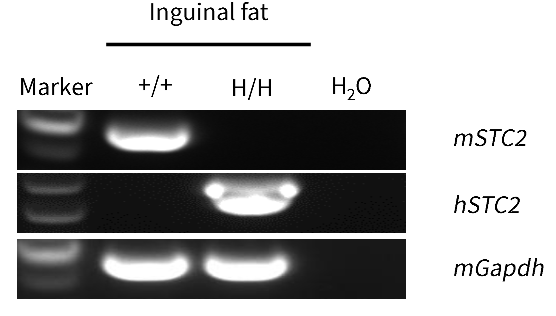
- Mouse Stc2 mRNA was only detectable in wild-type mice.
- Human STC2 mRNA was exclusively detectable in homozygous B-hSTC2 mice but not in wild-type mice.
Strain specific analysis of STC2 mRNA expression in wild-type C57BL/6JNifdc mice and B-hSTC2 mice by RT-PCR. Inguinal fat RNA were isolated from wild-type C57BL/6JNifdc mice (+/+) and B-STC2 mice (H/H), then cDNA libraries were synthesized by reverse transcription, followed by PCR with mouse Stc2 primers and human STC2 primers. Mouse Stc2 mRNA was only detected in wild-type mice. Human STC2 mRNA was only detected in humanized B-hSTC2 mice but not in wild-type mice.
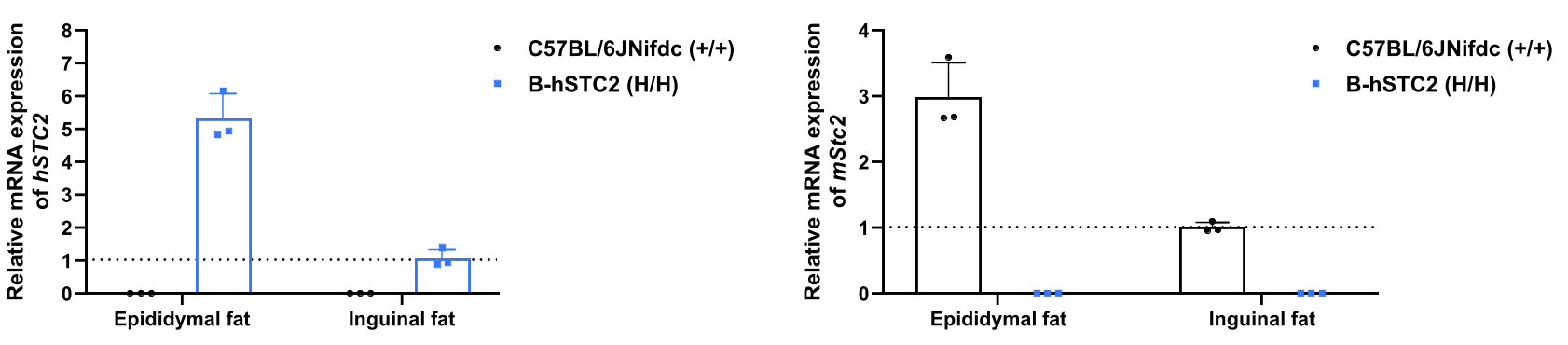
- Mouse Stc2 mRNA was only detectable in wild-type mice.
- Human STC2 mRNA was exclusively detectable in homozygous humanized B-hSTC2 mice but not in wild-type mice.
Species specific analysis of STC2 gene expression in wild-type C57BL/6JNifdc mice and homozygous B-hSTC2 mice by RT-qPCR. Various tissue were collected from wild-type C57BL/6JNifdc mice (+/+) (male, n=3, 8-week-old) and homozygous B-hSTC2 mice (H/H) (male, n=3, 8-week-old), then cDNA libraries were synthesized by reverse transcription, followed by RT-qPCR with mouse or human STC2 primers. Human STC2 mRNA was detectable only in homozygous humanized B-hSTC2 mice but not in wild-type mice. Mouse Stc2 mRNA was only detectable in wild-type mice. All results were normalized to the inguinal fat. Values are expressed as mean ± SEM.
Humanized B-hSTC2 Mice: Protein Expression by Western Blot
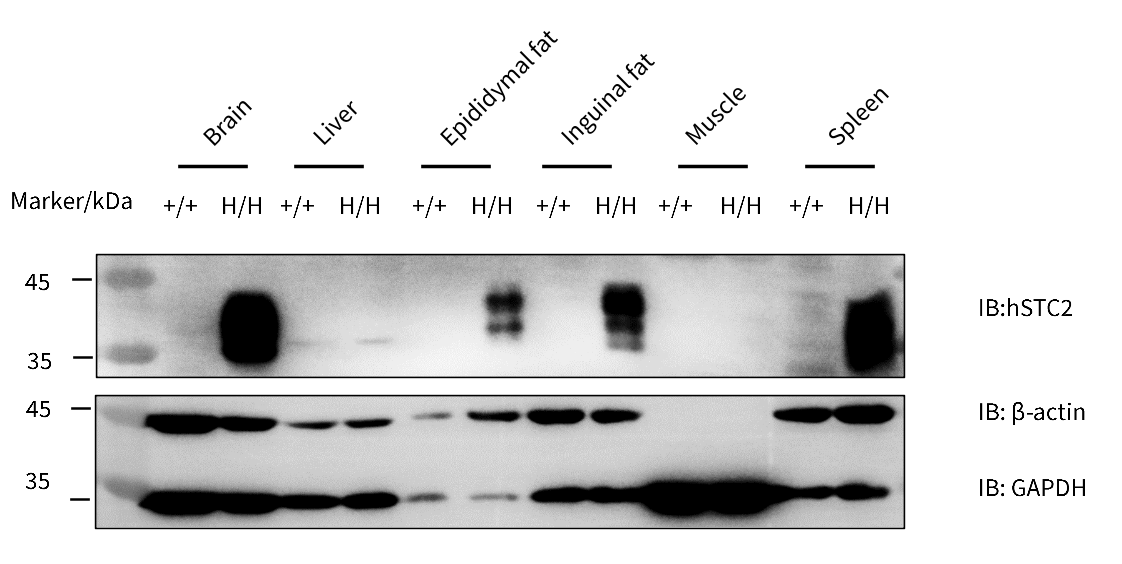
- Human STC2 was detected in brain, epididymal fat, inguinal fat and spleen of B-hSTC2 mice.
Western blot analysis of STC2 protein expression in homozygous B-hSTC2 mice. Various tissue lysates were collected from C57BL/6JNifdc (+/+) and homozygous B-hSTC2 mice (H/H), and then analyzed by western blot with human-specific anti-STC2 antibody (Abcam, ab255610). 40 μg total proteins were loaded for western blotting analysis. Human STC2 was detected in brain, epididymal fat, inguinal fat and spleen of B-hSTC2 mice.
Humanized B-hSTC2 Mice: Related Product List
* When publishing results obtained using this animal model, please acknowledge the source as follows: The animal model [B-hSTC2 mice] (Cat# 114339) was purchased from Biocytogen.