
B-hSTK25 mice

C57BL/6-Stk25tm1(STK25)Bcgen/Bcgen

• 113049

B-hSTK25 mice

Product nameB-hSTK25 mice
Catalog number113049
Strain name

C57BL/6-Stk25tm1(STK25)Bcgen/Bcgen

Strain backgroundC57BL/6
NCBI gene ID10494 (Human)
AliasesSOK1; YSK1

このページで

  • Description
  • Targeting strategy
  • Phenotypic analysis

ポスター

すべて表示

    出版物

      Description
      • STK25 (serine/threonine-protein kinase 25) is a member of the GCK-III (germinal center kinase III) family. It plays a key role in regulating lipid metabolism in the liver and adipose tissue. Overexpression of STK25 promotes hepatic lipid accumulation, exacerbating non-alcoholic fatty liver disease (NAFLD) and even progressing to non-alcoholic steatohepatitis (NASH).
      • Gene targeting strategy for B-hSTK25 mice. The exons 1-10 of mouse Stk25 gene that encode the whole molecule, including 5’UTR and 3’UTR, were replaced by the exons 1-12 of the human counterparts in B-hSTK25 mice. The human STK25 expression is driven by the human STK25 promoter, while mouse Stk25 gene transcription and translation will be disrupted.
      • STK25 was detectable in liver, kidney, brain, small intestine and large intestine of wild-type mice and homozygous B-hSTK25 mice, as the antibody cross-recognizes both human and mouse STK25.
      • Mouse Stk25 mRNA was exclusively detectable in C57BL/6JNifdc. Human STK25 mRNA was exclusively detectable in homozygous B-hSTK25 mice but not in wild-type mice.
      • Application: Efficacy validation of NASH-related metabolic diseases.
      Targeting Strategy

      Gene targeting strategy for B-hSTK25 mice. The exons 1-10 of mouse Stk25 gene that encode the whole molecule, including 5’UTR and 3’UTR were replaced by the exons 1-12 of human counterparts in B-hSTK25 mice. The human STK25 expression is driven by human STK25 promoter, while mouse Stk25 gene transcription and translation will be disrupted.

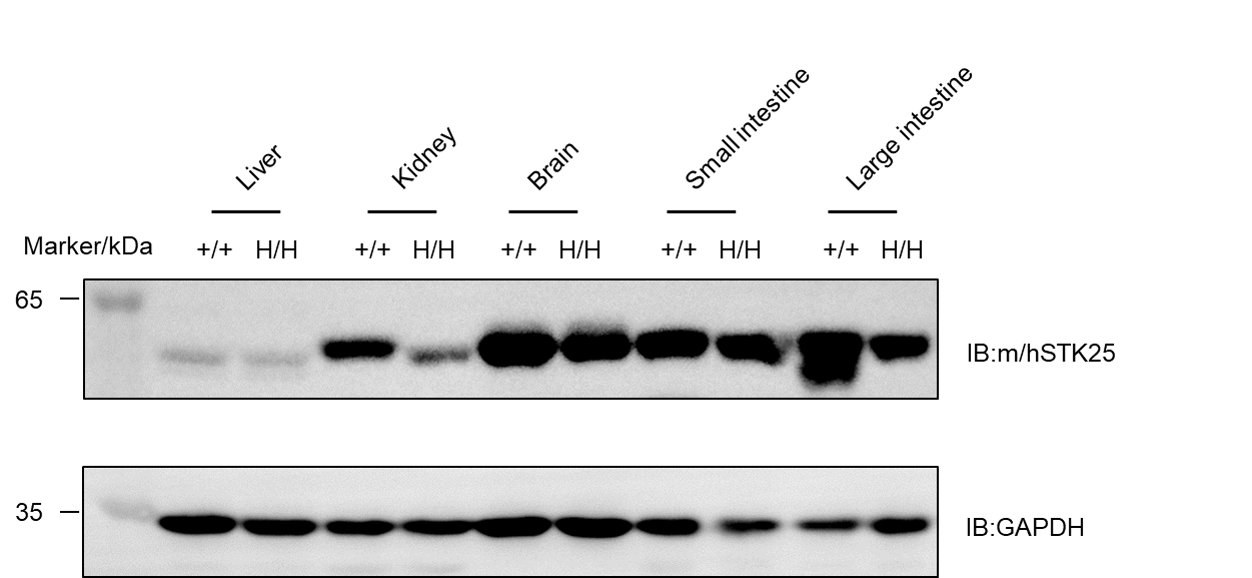
      Protein Expression Analysis

      Western blot analysis of STK25 protein expression in homozygous B-hSTK25 mice. Various tissue lysates were collected from wild-type C57BL/6JNifdc mice (+/+) and homozygous B-hSTK25 mice (H/H) (male, 6-week-old), and then analyzed by western blot with anti-STK25 antibody (Proteintech, 25821-1). 40 μg total proteins were loaded for western blotting analysis. STK25 was detectable in liver, kidney, brain, small intestine and large intestine of wild-type mice and homozygous B-hSTK25 mice, as the antibody cross-recognize both human and mouse STK25.
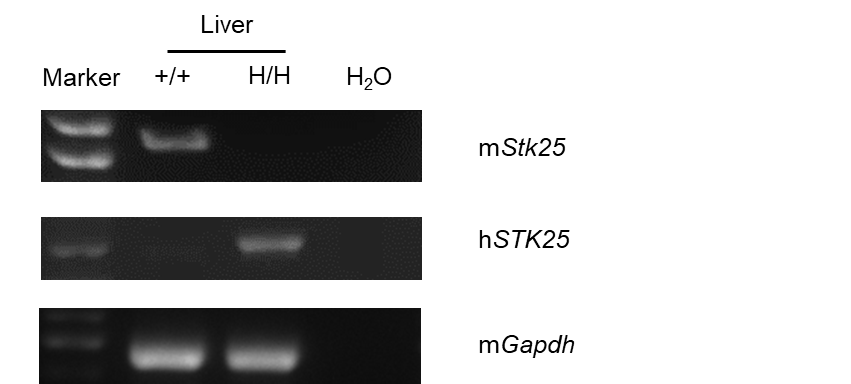
      mRNA Expression Analysis

      Strain specific analysis of STK25 mRNA expression in wild-type C57BL/6JNifdc mice and B-hSTK25 mice by RT-PCR. Liver RNA was isolated from wild-type C57BL/6JNifdc mice (+/+) and homozygous B-hSTK25 mice (H/H), then cDNA libraries were synthesized by reverse transcription, followed by PCR with mouse and human STK25 primers. Mouse Stk25 mRNA was exclusively detectable in C57BL/6JNifdc mice. Human STK25 mRNA was exclusively detectable in homozygous B-hSTK25 mice but not in wild-type mice. And the human STK25 mRNA was confirmed via Sanger Sequencing.

      * When publishing results obtained using this animal model, please acknowledge the source as follows: The animal model [B-hSTK25 mice] (Cat# 113049) was purchased from Biocytogen.