


➢ Inoculated cell lines can be suspended with DMEM/F12 stock solution.
➢ Before implementing the project, it is recommended to perform tumor growth experiments. The recommended cell inoculation amount is between 5E5-2E6.
➢ In the experiment, it is necessary to ensure that the number of animals inoculated subcutaneously is at least 1.2-1.4 times the actual grouping number.

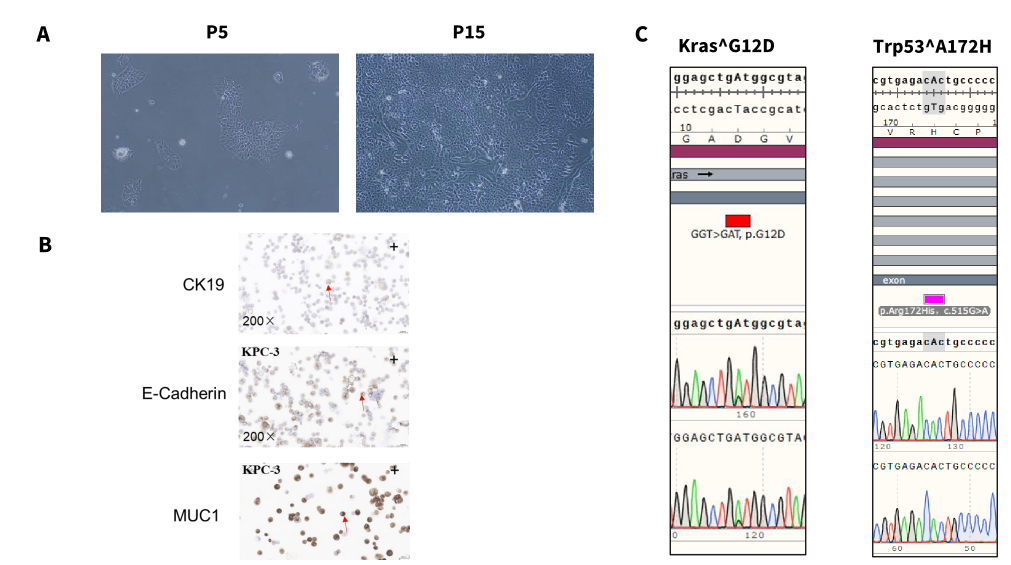
Characterization of B-KPC cells. (A) Cell Morphology. B-KPC cells exhibited a tightly arranged, epithelial-like (cobblestone) morphology, consistent with the characteristics of the parental pancreatic tumor cells. (B) MUC1, E-cadherin and CK19 expression analyzed by IHC with anti-mouse MUC1 (abcam, ab52625), E-cadherin(abcam, ab324191) and CK19 antibody (abcam, ab109185) (C) Sanger sequencing confirmed the presence of the Kras^G12D and Trp53^A172H mutations in B-KPC cells.
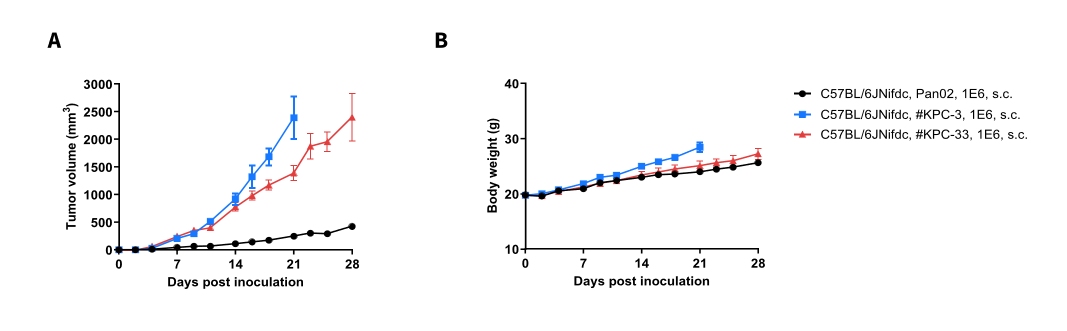
Subcutaneous tumor growth of B-KPC cells. Pan02 (1×10⁶), B-KPC cells #KPC-3 (1×10⁶) and #KPC-33 (1×10⁶) were subcutaneously implanted into C57BL/6JNifdc (Male, 6-week-old, n=6). Tumor volume and body weight were measured thrice a week. (A) Average tumor volume. (B) Body weight. B-KPC cells can be used to establish syngeneic pancreatic cancer models. Volume was expressed in mm3 using the formula: V=0.5 × long diameter × short diameter2. Values are expressed as mean ± SEM.
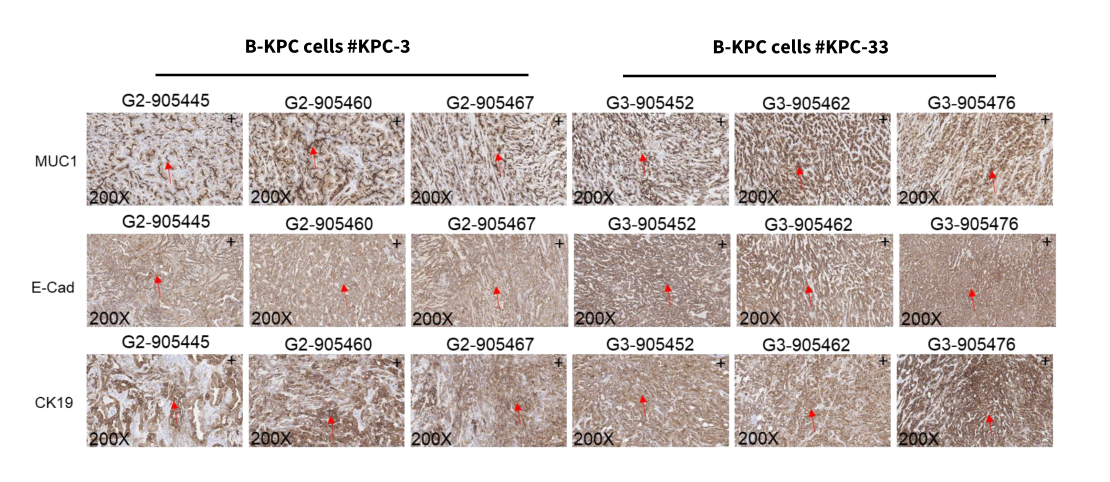
MUC1, E-cadherin and CK19 expression were evaluated on B-KPC cells by Immunohistochemical analysis (IHC). B-KPC cells were subcutaneously transplanted into C57BL/6JNifdc (n=3). Upon conclusion of the experiment, tumor cells were harvested and analyzed with anti-mouse MUC1 (abcam, ab52625), E-cadherin(abcam, ab324191) and CK19 antibody (abcam, ab109185) by IHC. The arrow indicates tissuecells with positive MUC1, E-cadherin and CK19 staining (brown).