

NA • 322475

In the experiment, it is necessary to ensure that the number of animals inoculated subcutaneously is 1.6~2 times the actual grouping number.

Gene targeting strategy for B-hPD-L1 B16-F10 cells. The exogenous promoter and human PD-L1 coding sequence were inserted to replace part of murine exon 3. The insertion disrupts the endogenous murine Pdl1 gene, resulting in a non-functional transcript. The human VEGFA coding sequence was inserted to replace part of murine exon 1 and all of exons 2-5. The insertion disrupts the endogenous murine Vegfa gene, resulting in a non-functional transcript.

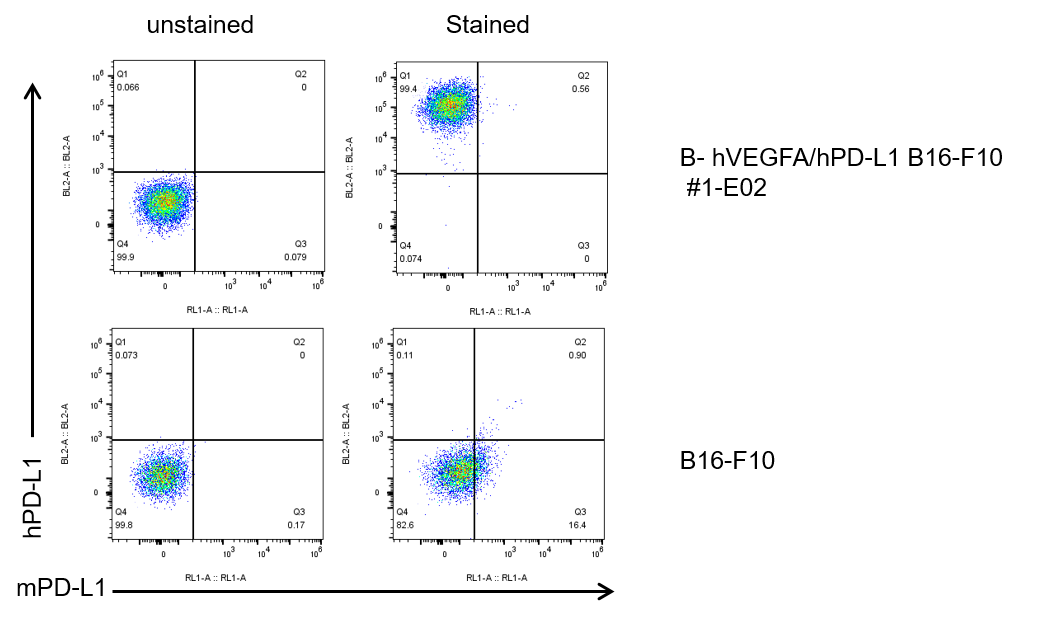
PD-L1 expression analysis in B-hVEGFA/hPD-L1 B16-F10 cells by flow cytometry. Single cell suspensions from wild-type B16-F10 and B-hVEGFA/hPD-L1 B16-F10 were stained with species-specific anti-human PD-L1 antibody (Biolgend, 329706) and anti-mouse PD-L1 antibody (Biolgend, 124312). Human PD-L1 was detected on the surface of B-hVEGFA/hPD-L1 B16-F10 cells but not wild-type B16-F10 cells. The 1-E02 clone of B-hVEGFA/hPD-L1 B16-F10 was used for in vivo experiments.

VEGFA expression analysis in B-hVEGFA/hPD-L1 B16-F10 by ELISA. Cell culture supernatant collected from B16-F10 and clone 1-E02 of B-hVEGFA/hPD-L1 B16-F10, and analyzed by ELISA with species-specific VEGFA kit (anti-mouse VEGFA antibody: R&D, MMV00; anti-human VEGFA antibody: R&D, DVE00). Mouse VEGFA was only detectable in B16-F10. Human VEGFA was detectable in B-hVEGFA/hPD-L1 B16-F10. Values are expressed as mean. ND: Not detected.

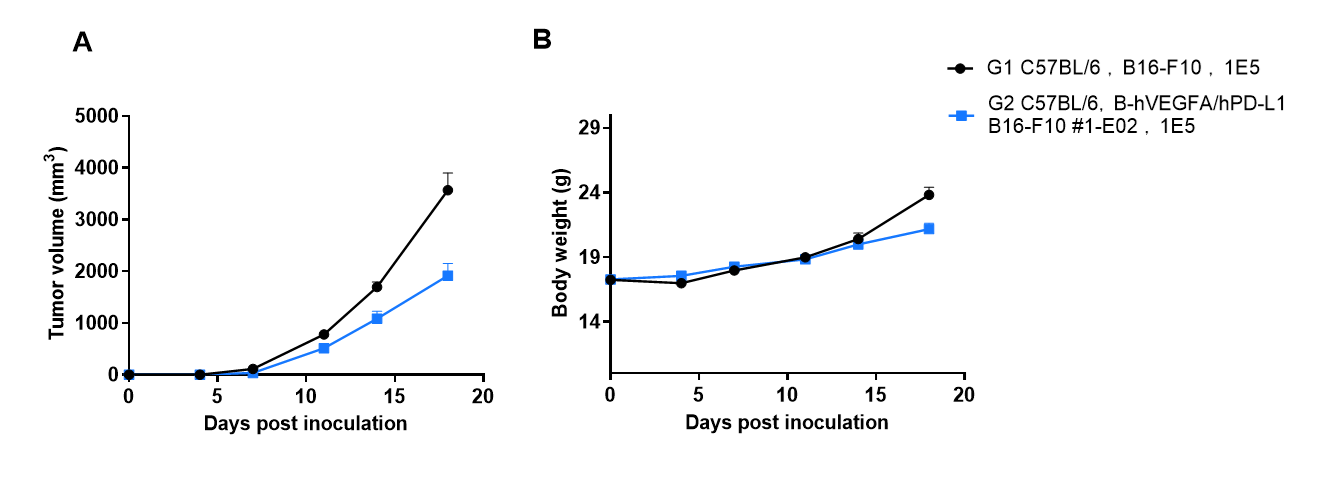
Subcutaneous tumor growth of B-hVEGFA/hPD-L1 B16-F10 cells. B-hVEGFA/hPD-L1 B16-F10 (1×10⁵) and wild-type B16-F10 cells (1×10⁵) were subcutaneously implanted into C57BL/6 mice (female, 6-week-old, n=8). Tumor volume and body weight were measured twice a week. (A) Average tumor volume. (B) Body weight. Volume was expressed in mm3 using the formula: V=0.5 × long diameter × short diameter2. Results indicate that B-hVEGFA/hPD-L1 B16-F10 were able to establish tumors in vivo and can be used for efficacy studies. Values are expressed as mean ± SEM.
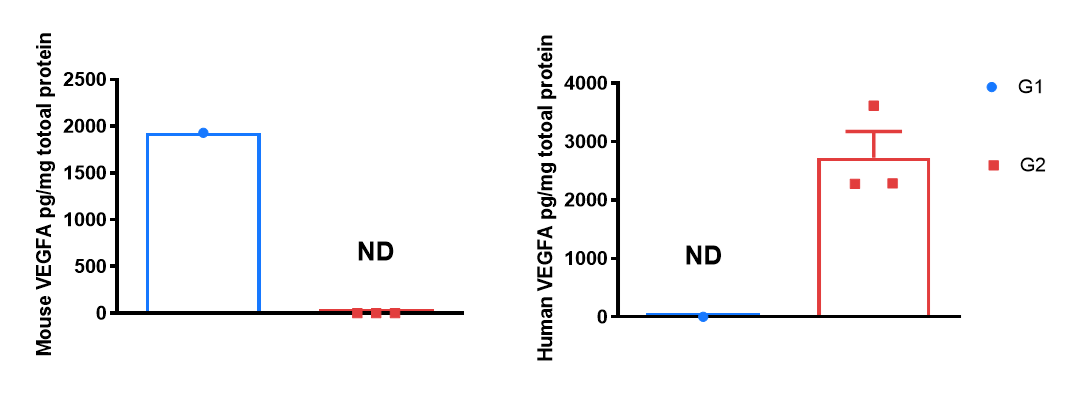
Tumor cells were harvested at the end of the experiment and assayed for mouse and human VEGFA expression by ELISA. As shown, human VEGFA was consistently highly expressed in the B-hVEGFA/hPD-L1 B16-F10 tumor homogenate, with an expression level of over 2000 pg per gram of total protein. Data are presented as mean ± SEM.

Subcutaneous tumor growth of B-hVEGFA/hPD-L1 B16-F10. B-hVEGFA/hPD-L1 B16-F10 (1×10⁵) and wild-type B16-F10 cells (1×10⁵) were subcutaneously implanted into B-hPD-1/hPD-L1/hVEGFA mice (male, 7-9 weeks old, n=8). Tumor volume and body weight were measured twice a week. (A) Average tumor volume. (B) Body weight. Volume was expressed in mm3 using the formula: V=0.5 × long diameter × short diameter2. Results indicate that B-hVEGFA/hPD-L1 B16-F10 were able to establish tumors in vivo and can be used for efficacy studies. Values are expressed as mean ± SEM.