
このページで

High-affinity fully human TCR-mimic (TCRm) antibodies specific to the gp100/HLA-A*02 complex were generated using Biocytogen’s RenMab®/HLA genetically modified mouse platform, followed by Beacon® high-throughput screening.
These fully human gp100/HLA-A02 TCR-mimic antibodies provide the core tumor-targeting moieties for construction of the trispecific T-cell engager. The molecule integrates gp100/HLA-A02 recognition, CD3 engagement, and an albumin-binding VHH in a spatially optimized trispecific format designed to preserve target and T-cell engagement in the presence of albumin.
The gp100/HLA-A02 × CD3 × Albumin trispecific antibody is being evaluated as a preclinical TCE asset for HLA-A*02:01-positive metastatic uveal melanoma (mUM), with potential indications including gp100-expressing melanoma and other biologically appropriate gp100/HLA-A02+ tumors.

The preclinical data package for the gp100/HLA-A02 × CD3 × Albumin trispecific TCR-mimic antibody includes specific target and T-cell binding, potent in vitro cytotoxicity with controlled cytokine release, albumin-mediated pharmacokinetic (PK) extension, and durable in vivo tumor regression accompanied by peripheral T-cell persistence. Together, these data support development of this long-acting trispecific TCE for gp100-expressing, HLA-A*02:01-positive tumors.
(Representative data shown; full data package available upon request.)
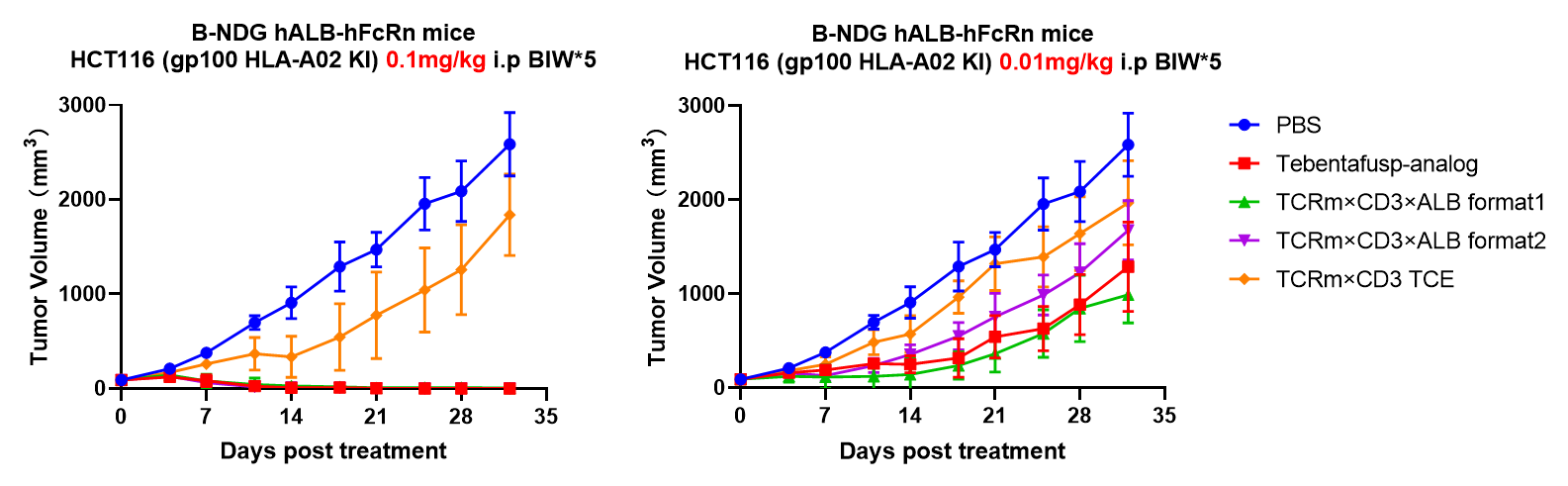
Figure 1. Dose-dependent antitumor activity of gp100/HLA-A02 × CD3 × Albumin trispecific TCR-mimic antibody. In dose-escalation studies, both TCRm × CD3 × ALB format 1 and format 2 induced near-complete tumor regression at 0.1 mg/kg. At 0.01 mg/kg, format 1 showed numerically greater tumor-growth inhibition than the benchmark and the other tested formats, supporting its prioritization for further development.
In addition, the gp100/HLA-A02 × CD3 × Albumin trispecific antibody showed specific target binding and retained T-cell binding in the presence of human serum albumin.
(Binding data, including gp100/HLA-A02 recognition, comparison with a Tebentafusp analog, and retained T-cell binding in the presence of human serum albumin, are available upon request.)
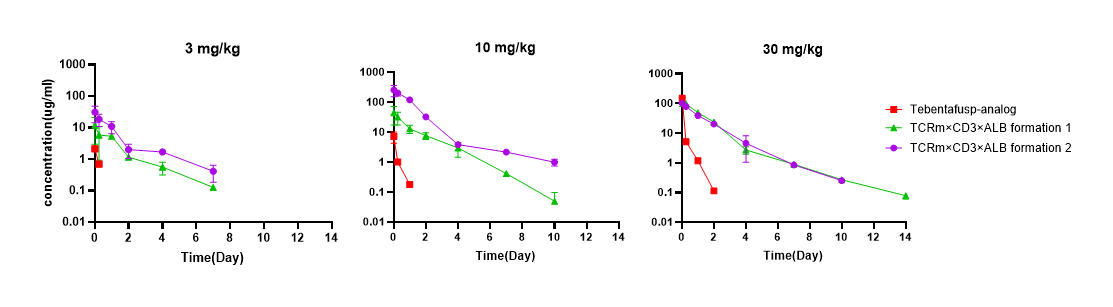
Figure 2. Albumin-mediated half-life extension of TCRm × CD3 × ALB. Pharmacokinetic studies at 3, 10, and 30 mg/kg showed that the albumin-binding VHH module prolonged the half-life of TCRm × CD3 × ALB to approximately 2.0–2.5 days in B-NDG ALB-FcRn humanized mice, compared with approximately 0.2–0.3 days for the Tebentafusp analog. This substantial half-life extension supported prolonged systemic exposure, with pharmacologically relevant exposure maintained for approximately two weeks, and may enable reduced dosing frequency.
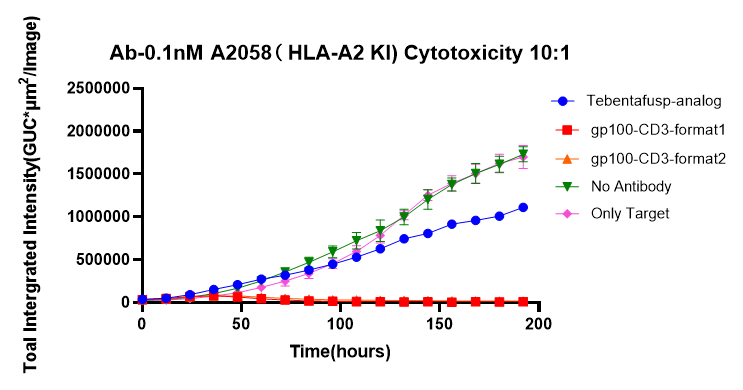
Figure 3. gp100/HLA-A02 × CD3 × Albumin TCR-mimic antibody induces potent cytotoxicity against A2058 (HLA-A2 KI) cells. In vitro cytotoxicity was evaluated at 0.1 nM and an effector-to-target ratio of 10:1 by monitoring total integrated intensity. Both gp100-CD3-format1 and format2 markedly reduced tumor-cell viability, with greater cytotoxic activity than the tebentafusp analog under the tested conditions. This result supports effective T-cell-mediated killing within the albumin-binding trispecific format.

Biocytogen welcomes partnership discussions to further evaluate this trispecific TCE asset. Contact us to request data package or discuss licensing, co-development, and partnership opportunities.

The trispecific TCE integrates three functional components within a single molecule. The gp100/HLA-A*02:01 TCR-mimic arm provides HLA-restricted tumor recognition, the engineered CD3-binding arm redirects T cells toward tumor cells while supporting controlled activation, and the albumin-binding arm extends systemic exposure. Together, these functions create a long-acting TCE designed to combine precise tumor targeting, sustained T-cell activity, and durable antitumor efficacy.
Tebentafusp has clinically validated gp100/HLA-A*02:01-directed T-cell engagement and established an important treatment option for HLA-A*02:01-positive metastatic uveal melanoma. However, treatment requires weekly intravenous administration, and cytokine release syndrome (CRS) is a common treatment-related adverse event. These limitations warrant continued development of gp100-directed TCEs to extend systemic exposure and balance T-cell activation with cytokine release, with the goal of reducing dosing frequency while maintaining antitumor efficacy.
RenMab® mice generate fully human antibodies with high diversity, high affinity, and reduced immunogenicity risk. For this program, Biocytogen combined its RenMab®/HLA genetically modified mouse system with proprietary immunization and high-throughput Beacon® screening to identify antibodies recognizing the gp100/HLA-A*02:01 complex. Selected TCR-mimic antibodies then serve as the tumor-recognition arm for trispecific TCE engineering.
Albumin binding extends systemic exposure, with preclinical PK showing an approximately 5- to 6-fold half-life extension relative to a Tebentafusp analog. The compact albumin-binding VHH supports trispecific assembly while preserving target and T-cell binding. Engineered CD3 engagement is designed to control T-cell activation, potentially mitigating activation-induced cell death (AICD) and T-cell exhaustion. Consistent with this design, controlled IFN-γ release in vitro and maintained peripheral CD3+ T-cell levels in vivo support sustained T-cell fitness and durable antitumor activity.
This preclinical asset is available for licensing and co-development. The data package includes gp100/HLA-A*02:01 target binding, T-cell binding in the presence of human serum albumin, benchmark comparisons with a Tebentafusp analog, in vitro T-cell-engaging activity and IFN-γ release, dose-dependent in vivo antitumor efficacy with peripheral CD3+ T-cell assessments, and pharmacokinetic characterization. Contact Biocytogen to request the full data package or discuss licensing and co-development opportunities.