Description
AREG: Biological Roles and Therapeutic Strategies
- Gene Information: AREG (Amphiregulin) encodes an epidermal growth factor (EGF) family ligand that regulates cell growth, differentiation, and tissue repair.
- Protein Expression: AREG is synthesized as a transmembrane precursor that undergoes proteolytic cleavage to release a soluble ligand capable of activating EGFR.
- Signaling Pathway: AREG binding to EGFR activates downstream RAS–RAF–MEK–ERK and PI3K–AKT signaling pathways, promoting cell proliferation, survival, and tissue remodeling.
- Therapeutic Inhibition: Targeting AREG may suppress aberrant EGFR signaling and tumor progression, offering a potential therapeutic strategy for AREG-driven malignancies and other pathological conditions.
Human AREG mRNA Expression Analysis in AREG Humanized Mice
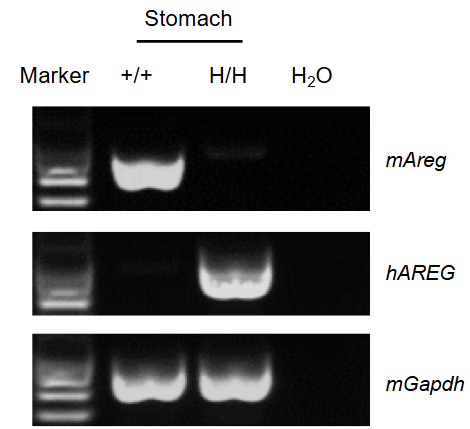
- Mouse Areg mRNA was detectable only in wild-type C57BL/6 mice.
- Human AREG mRNA was detectable in homozygous AREG humanized mice but not in wild-type mice.
Strain specific analysis of AREG mRNA expression in wild-type C57BL/6 mice and AREG humanized mice by RT-PCR. Stomach RNA was isolated from wild-type C57BL/6 mice (+/+) and homozygous B-hAREG mice (H/H), then cDNA libraries were synthesized by reverse transcription, followed by PCR with mouse or human AREG primers.
Human AREG Protein Expression Analysis in AREG Humanized Mice
- AREG protein was detected in the testis, lung and stomach of wild-type C57BL/6 mice and homozygous AREG humanized mice.
- The anti-AREG antibody was cross-reactive between human and mouse.
Western blot analysis of AREG protein expression in homozygous AREG humanized mice. Various tissue lysates were collected from wild-type C57BL/6 mice (+/+) and homozygous B-hAREG mice (H/H), and then analyzed by western blot with anti-AREG antibody. 30μg total proteins were loaded for western blotting analysis.
* When publishing results obtained using this animal model, please acknowledge the source as follows: The animal model [B-hAREG mice] (Cat# 111615) was purchased from Biocytogen.