Description
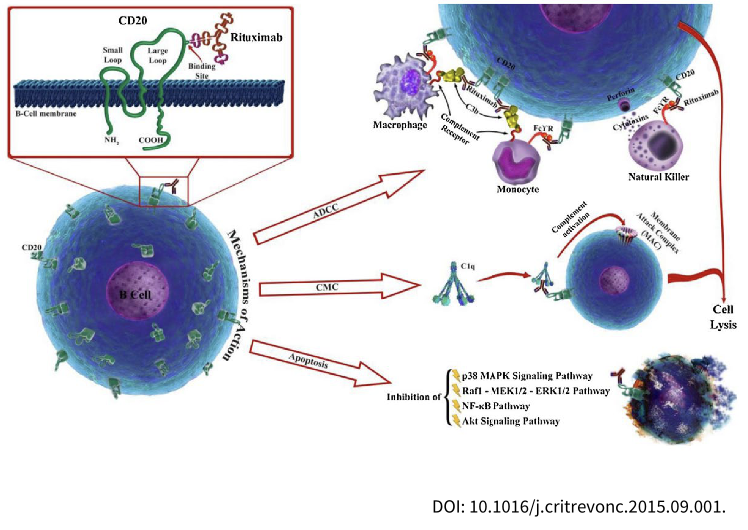
CD20 MOA: Regulates B-cell Store-operated Calcium Entry
CD20: A B-cell surface marker modulating calcium influx and activation.
- Gene Information: Located on chromosome 11q12, the MS4A1 gene encodes CD20, a highly conserved hydrophobic transmembrane protein belonging to the membrane-spanning 4-domain family A member 1.
- Protein Expression: D20 is expressed exclusively on the surface of B cells, spanning from the late pro-B stage through mature cells, but is notably absent on pluripotential stem cells and mature plasma cells.
- Signaling Pathway: Upon activation, CD20 functions as or regulates a store-operated calcium channel, altering intracellular calcium concentrations to modulate B-cell activation, differentiation, and cell-cycle progression.
- Therapeutic Inhibition: Monoclonal antibodies like rituximab target CD20 to deplete pathogenic B cells via antibody-dependent cellular cytotoxicity (ADCC), complement-dependent cytotoxicity (CDC), and direct induction of apoptosis.
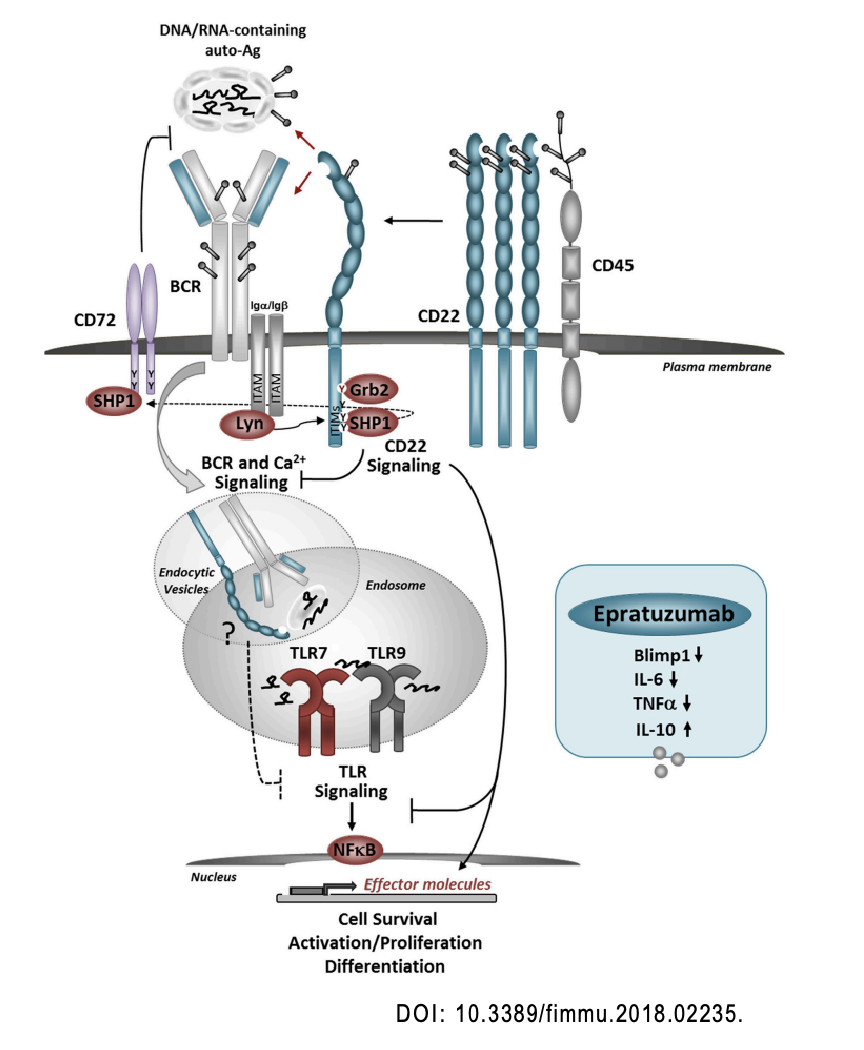
CD22 MOA: Inhibiting B Cell Receptor Signaling Cascade
CD22: CD22 negatively regulates B cell receptor activation via inhibitory signaling.
- Gene Information: Located on human chromosome 19q13.12, the CD22 gene encodes a transmembrane glycoprotein belonging to the Siglec family that recognizes sialic acid-containing glycans on immune cells.
- Protein Expression: CD22 is specifically expressed on mature B lymphocytes, appearing during late pre-B cell development and lost upon differentiation into antibody-secreting plasma cells or lymphoblasts.
- Signaling Pathway: Upon ligand engagement, CD22 undergoes ITIM phosphorylation by Lyn kinase, recruiting SHP-1 phosphatase to dephosphorylate downstream signaling molecules, thereby dampening calcium influx and BCR activation.
- Therapeutic Inhibition: Targeting CD22 with antibody-drug conjugates or CAR-T cell therapies selectively eliminates malignant B cells in acute lymphoblastic leukemia and non-Hodgkin lymphoma treatments.
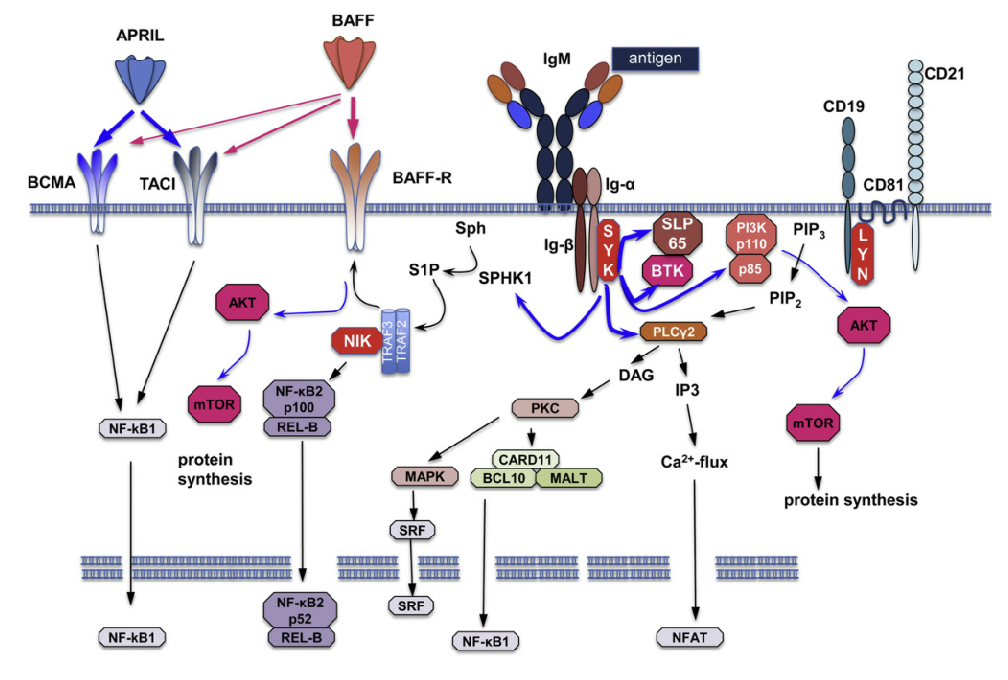
BCMA MOA: Promoting Long-Term Plasma Cell Survival
BCMA: BCMA drives plasma cell survival through NF-$\kappa$B pathway activation.
- Gene Information: Located on human chromosome 16p13.13, the TNFRSF17 gene encodes B-cell maturation antigen (BCMA), a type I transmembrane glycoprotein belonging to the tumor necrosis factor receptor superfamily.
- Protein Expression: BCMA is selectively expressed on mature B lymphocytes, preferentially upregulated in plasmablasts and terminally differentiated plasma cells, while absent on naive B cells and non-hematopoietic tissues.
- Signaling Pathway: Binding of APRIL or BAFF triggers BCMA trimerization, recruiting TRAF complexes to activate NF-kappa B, AKT, and MAPK cascades, upregulated anti-apoptotic proteins to promote plasma cell survival.
- Therapeutic Inhibition: Targeting BCMA via CAR-T cells, bispecific antibodies, or antibody-drug conjugates induces selective clearance of malignant plasma cells in relapsed or refractory multiple myeloma.
B-hCD20/hCD22/hBCMA Mice: Gene Targeting Strategy
CD20
- The exons 2-7 of mouse Cd20 gene that encode the whole molecule (ATG to STOP codon) were replaced by human counterparts in B-hCD20/hCD22/hBCMA mice.
- The promoter, 5’UTR and 3’UTR region of the mouse gene were retained. The human CD20 expression was driven by endogenous mouse Cd20 promoter, while mouse Cd20 gene transcription and translation will be disrupted.
CD22
- The exons 4-11 of mouse Cd22 gene that encode extracellular domain were replaced by human counterparts in B-hCD20/hCD22/hBCMA mice.
- The genomic region of mouse Cd22 gene that encodes transmembrane domain and cytoplasmic portion was retained. The promoter, 5’UTR and 3’UTR region of the mouse gene were retained. The chimeric CD22 expression was driven by endogenous mouse Cd22 promoter, while mouse Cd22 gene transcription and translation will be disrupted.
BCMA
- The exon 1 and part of exon 2 that encode the extracellular region of mouse Bcma gene were replaced with the corresponding human sequences in B-hCD20/hCD22/hBCMA mice.
- The endogenous mouse promoter, 5′ UTR, and 3′ UTR regions were retained, allowing chimeric BCMA expression to be driven by the native mouse Bcma promoter, while endogenous mouse Bcma transcription and translation are abolished.
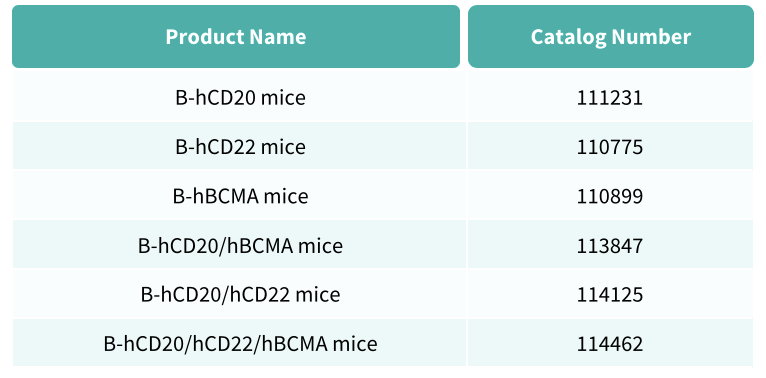
B-hCD20/hCD22/hBCMA mice (114462) were obtained by mating B-hCD20/hCD22 mice (114125) and B-hCD20/hBCMA mice (113847).
B-hCD20/hCD22/hBCMA Mice: CD20 Protein Expression in Spleen
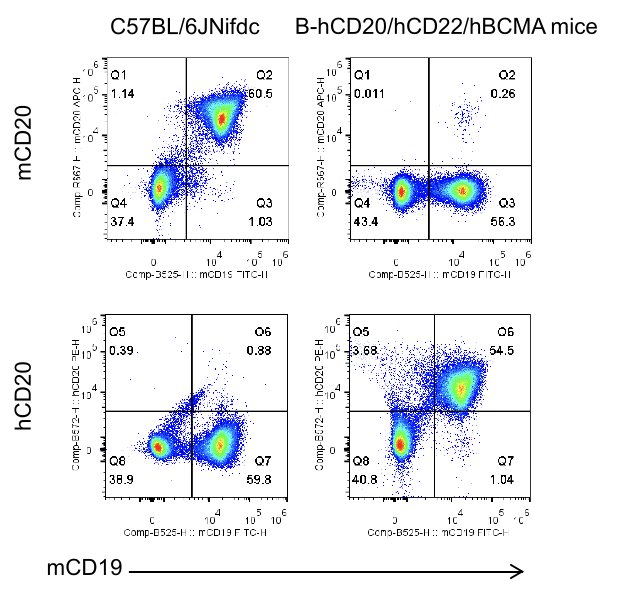
- Mouse CD20 was detectable in wild-type C57BL/6JNifdc mice.
- Human CD20 was detectable in homozygous B-hCD20/hCD22/hBCMA mice, but not in wild-type C57BL/6JNifdc mice.
Strain specific CD20 expression analysis in wild-type C57BL/6JNifdc mice and homozygous humanized B-hCD20/hCD22/hBCMA mice by flow cytometry.
Splenocytes were collected from wild-type C57BL/6JNifdc mice and homozygous B-hCD20/hCD22/hBCMA mice. Protein expression was analyzed with anti-mouse CD20 antibody (Biolegend, 152108) and anti-human CD20 antibody (Biolegend, 302305) by flow cytometry.
B-hCD20/hCD22/hBCMA Mice: CD22 Protein Expression in Spleen
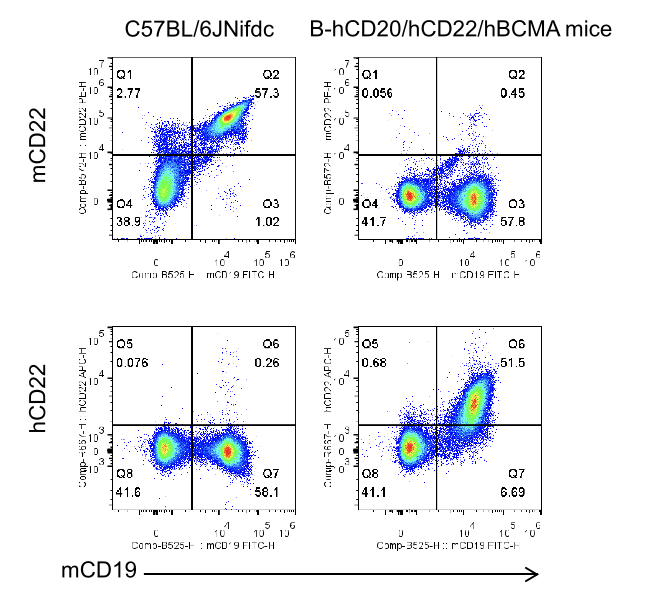
- Mouse CD22 was detectable in wild-type C57BL/6JNifdc mice.
- Human CD22 was detectable in homozygous B-hCD20/hCD22/hBCMA mice, but not in wild-type C57BL/6JNifdc mice.
Strain specific CD22 expression analysis in wild-type C57BL/6JNifdc mice and homozygous humanized B-hCD20/hCD22/hBCMA mice by flow cytometry. Splenocytes were collected from wild-type C57BL/6JNifdc mice and homozygous B-hCD20/hCD22/hBCMA mice. Protein expression was analyzed with anti-mouse CD22 antibody (Biolegend, 126111) and anti-human CD22 antibody (Biolegend, 363505) by flow cytometry.
B-hCD20/hCD22/hBCMA Mice: BCMA Protein Expression in Spleen
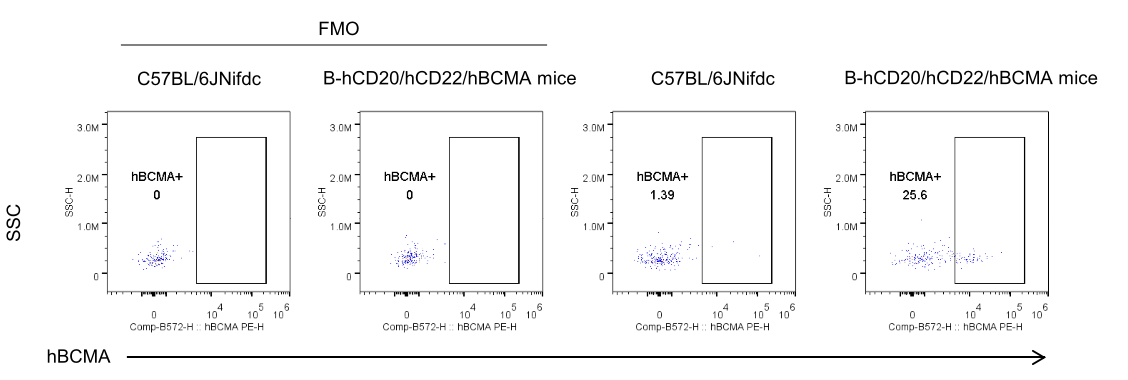
- Human BCMA was detectable in homozygous B-hCD20/hCD22/hBCMA mice, but not in wild-type C57BL/6JNifdc mice.
Strain specific BCMA expression analysis in wild-type C57BL/6JNifdc mice and homozygous humanized B-hCD20/hCD22/hBCMA mice by flow cytometry.
Splenocytes were collected from wild-type C57BL/6JNifdc mice and homozygous B-hCD20/hCD22/hBCMA mice. BCMA expression on plasma cells was analyzed with anti-human BCMA antibody (Biolegend, 357504) by flow cytometry.
B-hCD20/hCD22/hBCMA Mice: Related Product List
* When publishing results obtained using this animal model, please acknowledge the source as follows: The animal model [B-hCD20/hCD22/hBCMA mice] (Cat# 114462) was purchased from Biocytogen.