Description
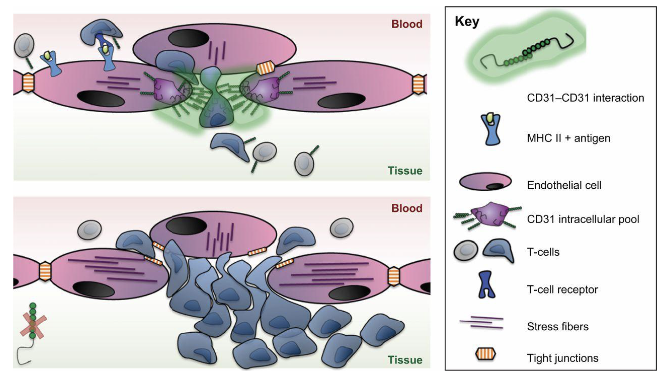
CD31: Regulates leukocyte transmigration, cell adhesion, and maintains vascular integrity.
- Gene Information: Encoded by the human PECAM1 gene located on chromosome 17q23.3, which spans 16 exons and undergoes alternative splicing to generate functionally distinct isoforms across endothelial and hematopoietic lineages.
- Protein Expression: Constitutively expressed as a ~130 kDa type I transmembrane glycoprotein concentrated at endothelial cell intercellular junctions, while also present at lower densities on circulating platelets, monocytes, neutrophils, and selected T-cell subsets.
- Signaling Pathway: Signals via cytoplasmic ITIM tyrosine phosphorylation to recruit SHP-1/2 phosphatases.
- Therapeutic Inhibition: Blockade disrupts transendothelial migration, stabilizes or inhibits angiogenesis, and suppresses tumor vascularization.
Targeting strategy
CD31
- The exons 3-9 of mouse Cd31 gene that encode extracellular domain and part of transmembrane domain are replaced by human counterparts in humanized B-hCD31 mice. The genomic region of mouse Cd31 gene that encodes cytoplasmic portion and signal peptide are retained. The promoter, 5’UTR and 3’UTR region of the mouse gene are retained. The chimeric CD31 expression is driven by endogenous mouse Cd31 promoter, while mouse Cd31 gene transcription and translation will be disrupted.
Humanized B-hCD31 mice: Protein Expression Analysis
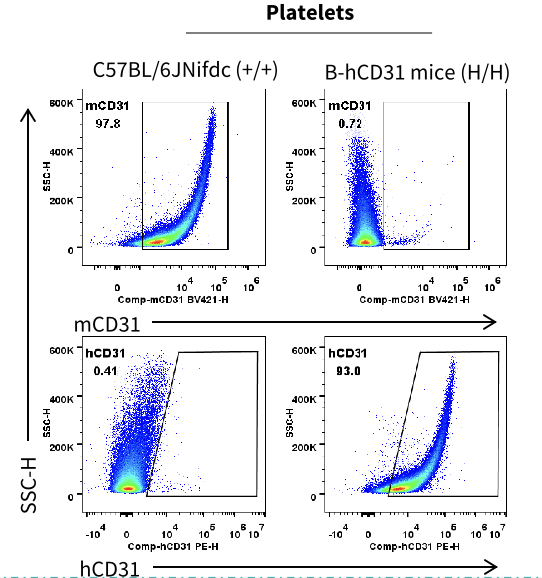
- Mouse CD31 was only detectable in platelets of wild-type C57BL/6JNifdc mice. hCD31 was only detectable in platelets of homozygous humanized B-hCD31 mice, but not in wild-type C57BL/6JNifdc mice.
Strain specific CD31 expression analysis in homozygous humanized B-hCD31 mice by flow cytometry. Platelets were collected from wild-type C57BL/6JNifdc mice (+/+) and homozygous humanized B-hCD31 mice (H/H), and protein expression was analyzed with anti-mouse CD31 antibody (Biolegend, 102423) and anti-human CD31 antibody (Biolegend, 303106) by flow cytometry.
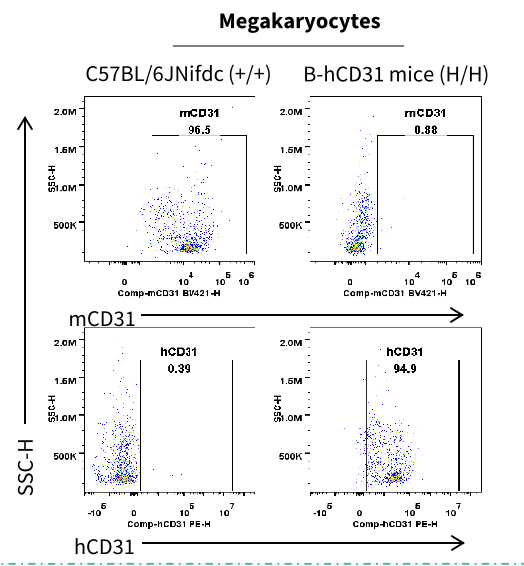
- Mouse CD31 was only detectable in megakaryocytes of wild-type C57BL/6JNifdc mice. hCD31 was only detectable in megakaryocytes of homozygous humanized B-hCD31 mice, but not in wild-type C57BL/6JNifdc mice.
Strain specific CD31 expression analysis in homozygous B-hCD31 mice by flow cytometry. Megakaryocytes were collected from wild-type C57BL/6JNifdc mice (+/+) and homozygous B-hCD31 mice (H/H), and protein expression was analyzed with anti-mouse CD31 antibody (Biolegend, 102423) and anti-human CD31 antibody (Biolegend, 303106) by flow cytometry.
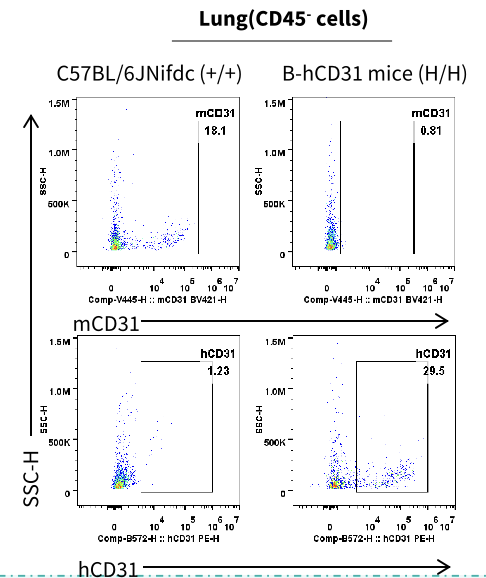
- Mouse CD31 was only detectable in CD45- cells from lung of wild-type C57BL/6JNifdc mice. hCD31 was only detectable in CD45- cells from lung of homozygous humanized B-hCD31 mice, but not in wild-type C57BL/6JNifdc mice.
Strain specific CD31 expression analysis in homozygous B-hCD31 mice by flow cytometry. Lung was collected from wild-type C57BL/6JNifdc mice (+/+) and homozygous humanized B-hCD31 mice (H/H), and protein expression was analyzed with anti-mouse CD31 antibody (Biolegend, 102423) and anti-human CD31 antibody (Biolegend, 303106) by flow cytometry.
Humanized B-hCD31 mice: Related Product List
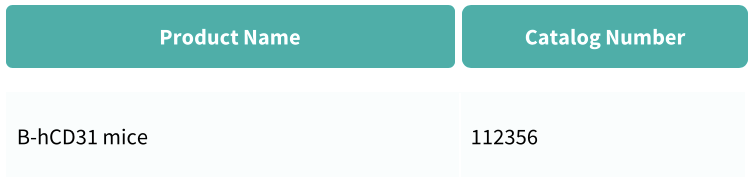
* When publishing results obtained using this animal model, please acknowledge the source as follows: The animal model [B-hCD31 mice] (Cat# 112356) was purchased from Biocytogen.