Description
- Gene Information: CD3: Encoded by CD3E, D, G; part of the Ig superfamily. It forms the essential signaling backbone of the T-cell receptor (TCR) complex. EGFR: encodes a transmembrane receptor tyrosine kinase belonging to the ErbB receptor family. EGFR plays a central role in regulating cell proliferation, survival, differentiation, and tissue repair and is frequently dysregulated in cancer.
- Protein Expression: CD3: Constitutive and universal marker for all mature T cells (CD4+, CD8+). Always present on the cell surface. EGFR: EGFR is widely expressed in epithelial tissues, including the skin, lung, gastrointestinal tract, liver, and kidney. It is also detected in various epithelial-derived tumors, where overexpression, amplification, or activating mutations can drive tumor growth and disease progression.
- Signaling Pathway: CD3: Operates via ITAM phosphorylation and ZAP-70. It triggers the initial "on" switch, Ca2+ flux, and immediate cytotoxicity. EGFR: EGFR is activated by ligands such as EGF and TGF-α, inducing receptor dimerization and activation of downstream pathways including RAS/RAF/MEK/ERK, PI3K/Akt/mTOR, JAK/STAT, and PLCγ/PKC. These signaling cascades promote cell proliferation, survival, migration, angiogenesis, and tumor progression.
- Therapeutic Inhibition: CD3×EGFR bispecific antibodies recruit and activate T cells by simultaneously binding CD3 on T cells and EGFR on tumor cells, resulting in targeted killing of EGFR-positive cancer cells. Additional therapeutic strategies include monoclonal antibodies, CAR-T cells, antibody–drug conjugates, and cancer vaccines targeting EGFR.
Targeting strategy
Gene targeting strategy for B-hCD3EDG/hEGFR mice.
- The exons 2-17 of mouse Egfr gene that encode extracellular domain were replaced by human counterparts in B-hCD3EDG/hEGFR mice.
- The genomic region of mouse Egfr gene that encodes transmembrane domain and cytoplasmic portion was retained. The promoter, 5’UTR, signal peptide and 3’UTR region of the mouse gene were also retained.
EGFR mRNA Expression by RT-PCR
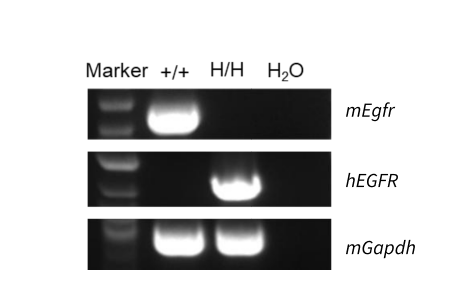
Mouse and human EGFR analysis in liver by RT-PCR and sequencing. Liver RNA was isolated from wild-type C57BL/6 mice (+/+) and homozygous B-hCD3EDG/hEGFR mice (H/H), and then cDNA libraries were synthesized by reverse transcription, followed by PCR with mouse or human EGFR primers.
CD3E Protein Expression in Spleen and Blood
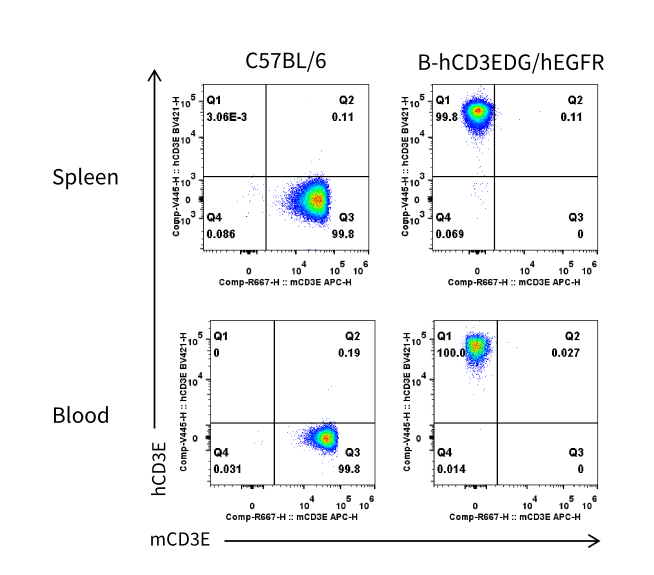
Mouse and human CD3E expression analysis in splenocytes and blood. Splenocytes and blood cells were collected from wild-type C57BL/6 mice and homozygous B-hCD3EDG/hEGFR mice (female, 6-week-old, n = 1). CD3E expression on T cells was analyzed by flow cytometry using species-specific anti-CD3E antibodies (anti-human CD3E antibody, BD Horizon, 562426; anti-mouse CD3E antibody, Biolegend, 100312 ).
Immunohistochemical Analysis
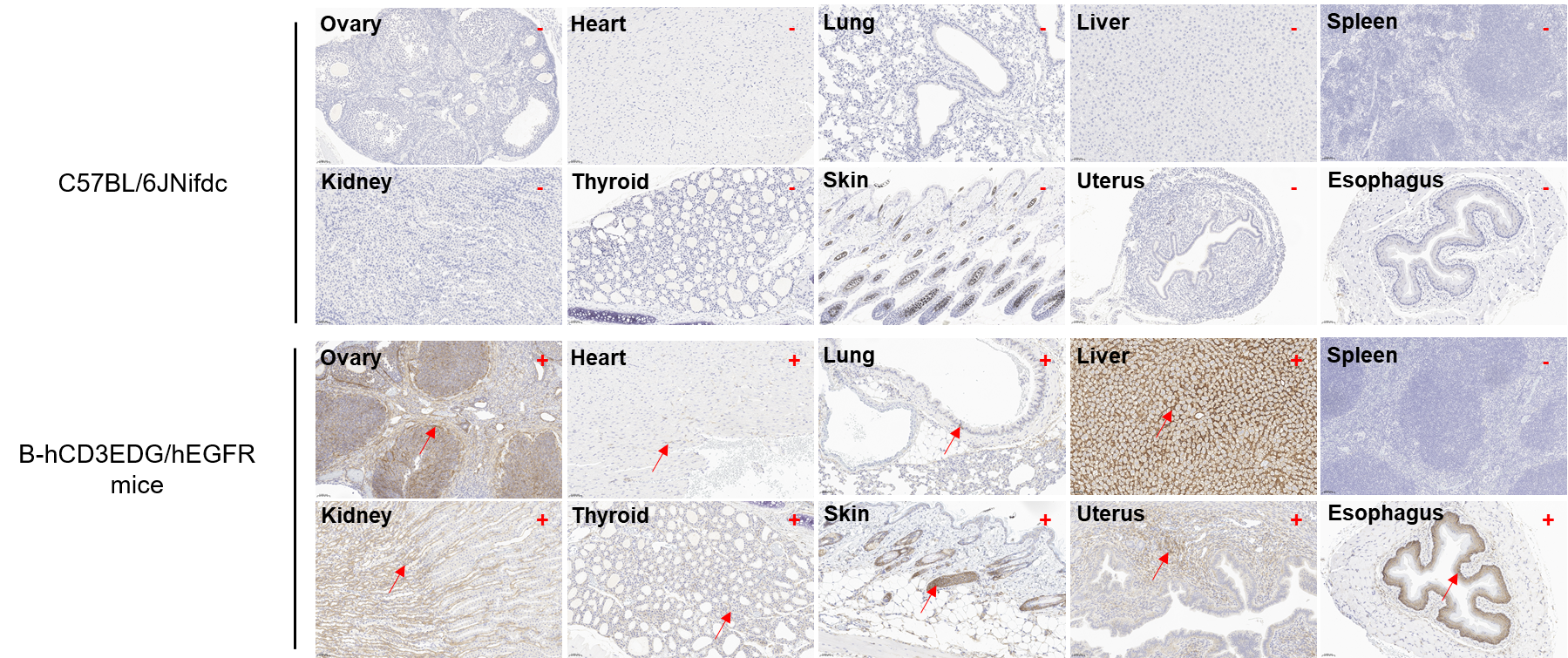
Immunohistochemical (IHC) analysis of EGFR expression in B-hCD3EDG/hEGFR mice. The ovary, heart, lung, liver, spleen, kidney, thyroid gland, skin, uterus, and esophagus were collected from wild-type C57BL/6JNifdc mice and B-hCD3EDG/hEGFR mice (female, 6-week-old), analyzed by IHC with anti-EGFR (Invitrogen, MA5-49312). Human EGFR was detectable in B-hCD3EDG/hEGFR mice but not in C57BL/6JNifdc mice. The arrow indicates tissue cells with positive EGFR staining (brown). “+” indicates that the tissue is positive, and “-” indicates that the tissue is negative.
* When publishing results obtained using this animal model, please acknowledge the source as follows: The animal model [B-hCD3EDG/hEGFR mice] (Cat# 113562) was purchased from Biocytogen.