
Key Advantages
Validation
Application

In B-hCTLA4/hCCR8 mice, exon 2 of the mouse Ctla4 gene encoding the extracellular domain was replaced by human CTLA4 exon 2. In the same B-hCTLA4/hCCR8 mice model, exon 2 of the mouse Ccr8 gene encoding the full coding sequence was replaced by exon 2 of the human CCR8 gene. This targeting strategy supports human CTLA4 and human CCR8 expression in an immunocompetent C57BL/6 background for antibody efficacy and tumor immune microenvironment studies.

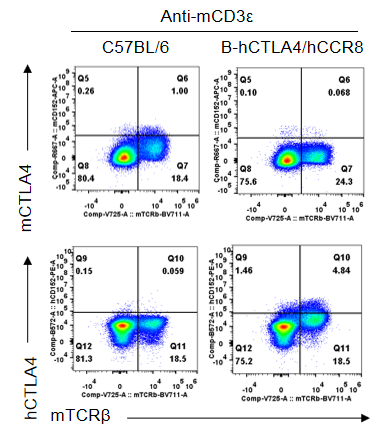
CTLA4 (CD152) protein expression analysis in B-hCTLA4/hCCR8 mice by FACS. Spleen was collected from wild-type mice and homozygous B-hCTLA4/hCCR8 mice stimulated with anti-mouse CD3ε antibody (7.5 μg, i.p.) in vivo for 24 hrs. Protein expression was analyzed with anti-mouse CTLA4 antibody (BioLegend, 106310) and anti-human CTLA4 antibody (BioLegend, 349906) by flow cytometry. Human CTLA4 was detectable in homozygous B-hCTLA4/hCCR8 mice but not in wild-type mice.
Human CTLA4 (CD152) protein expression analysis in B-hCTLA4/hCCR8 mice by FACS. Spleen was collected from wild-type mice and homozygous B-hCTLA4/hCCR8 mice stimulated with anti-mouse CD3ε antibody (7.5 μg, i.p.) in vivo for 24 hrs. Protein expression was analyzed with anti-mouse CTLA4 antibody (BioLegend, 106310) and anti-human CTLA4 antibody (BioLegend, 349906) by flow cytometry. Human CTLA4 was detectable in homozygous B-hCTLA4/hCCR8 mice.
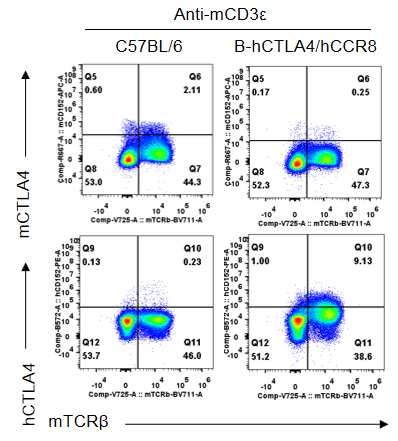
Human CTLA4 (CD152) protein expression analysis in B-hCTLA4/hCCR8 mice by FACS. Lymph node was collected from wild-type mice and homozygous B-hCTLA4/hCCR8 mice stimulated with anti-mouse CD3ε antibody (7.5 μg, i.p.) in vivo for 24 hrs. Protein expression was analyzed with anti-mouse CTLA4 antibody (BioLegend, 106310) and anti-human CTLA4 antibody (BioLegend, 349906) by flow cytometry. Human CTLA4 was detectable in homozygous B-hCTLA4/hCCR8 mice but not in wild-type mice.
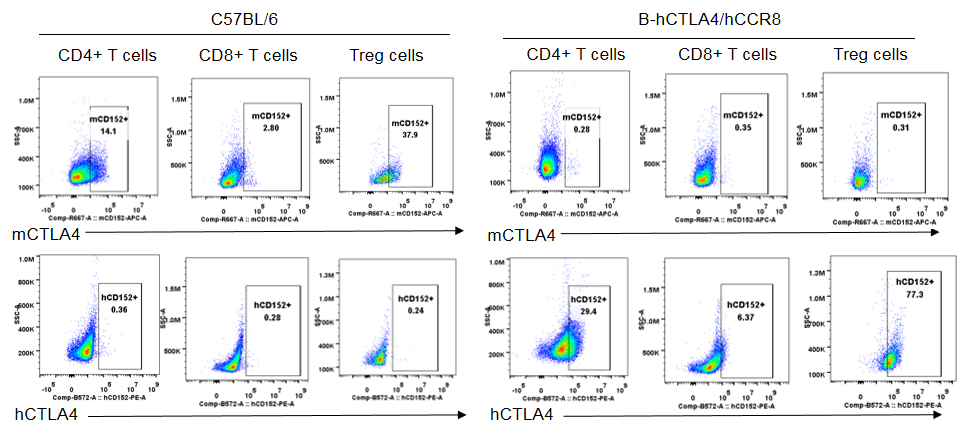
Human CTLA4 (CD152) protein expression analysis in B-hCTLA4/hCCR8 mice by FACS. Lymph node was collected from wild-type mice and homozygous B-hCTLA4/hCCR8 mice stimulated with anti-mouse CD3ε antibody (7.5 μg, i.p.) in vivo for 24 hrs. Protein expression was analyzed with anti-mouse CTLA4 antibody (BioLegend, 106310) and anti-human CTLA4 antibody (BioLegend, 349906) by flow cytometry. Human CTLA4 was detectable in homozygous B-hCTLA4/hCCR8 mice.
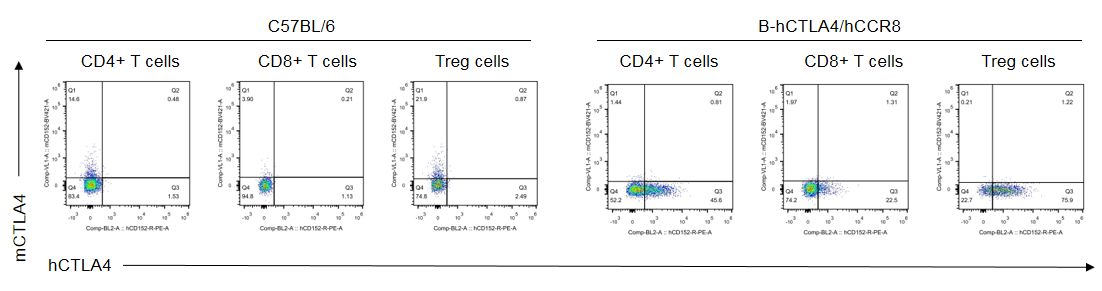
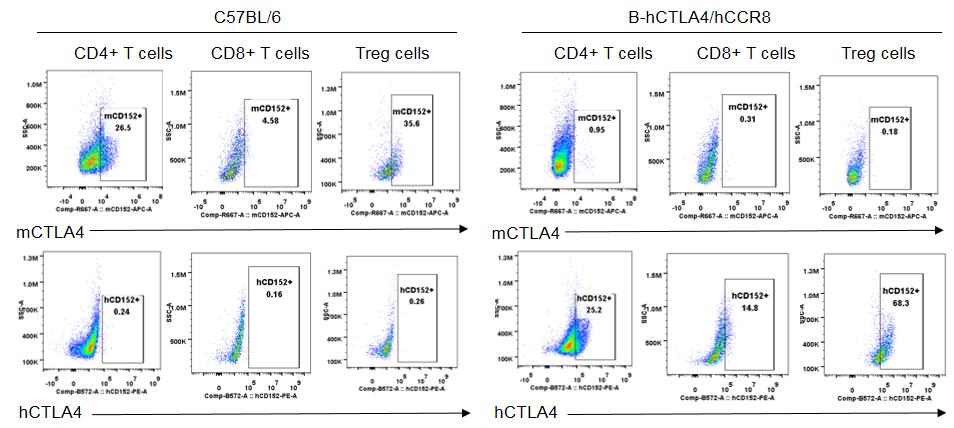
Human CTLA4 (CD152) protein expression analysis in B-hCTLA4/hCCR8 mice by FACS. Murine colon cancer MC38 cells were subcutaneously implanted into homozygous B-hCTLA4/hCCR8 mice. Tumors were harvested at approximately 400-700 mm^3 and analyzed with anti-mouse CTLA4 antibody (BioLegend, 106312) and anti-human CTLA4 antibody (BioLegend, 349906) by flow cytometry. Human CTLA4 was detectable in T cells in tumors of homozygous B-hCTLA4/hCCR8 mice.
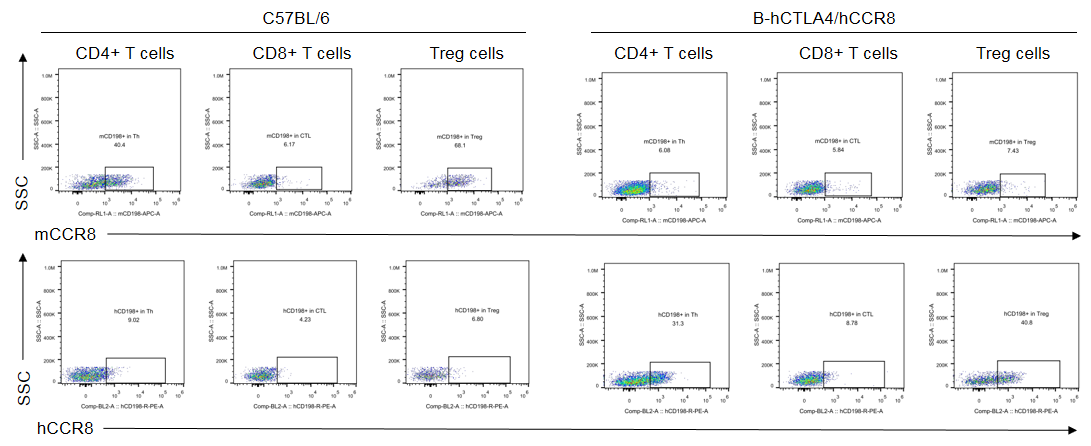
Human CCR8 (CD198) protein expression analysis in B-hCTLA4/hCCR8 mice by FACS. Murine colon cancer MC38 cells were subcutaneously implanted into homozygous B-hCTLA4/hCCR8 mice. Tumors were harvested at approximately 400-700 mm^3 and analyzed by flow cytometry. Human CCR8 was detectable in CD4+ T cells and Treg cells in tumors of homozygous B-hCTLA4/hCCR8 mice.

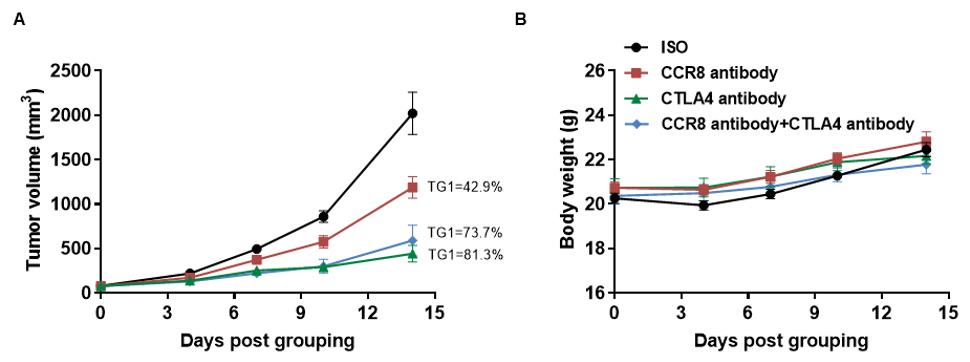
Antitumor activity of anti-human CCR8 antibody or anti-human CTLA4 antibody in B-hCTLA4/hCCR8 mice.
Anti-human CCR8 antibody, anti-human CTLA4 antibody, or the combination inhibited MC38 tumor growth in B-hCTLA4/hCCR8 mice. MC38 cells were subcutaneously implanted into homozygous B-hCTLA4/hCCR8 mice. Mice were grouped when tumor volume reached approximately 80 mm^3 and treated as indicated. Body weight changes were monitored. All data was provided by the client.

Q1: What are B-hCTLA4/hCCR8 mice?
B-hCTLA4/hCCR8 mice are gene-humanized mice developed by Biocytogen for human target expression, pharmacology studies, and preclinical efficacy evaluation.
Q2: Why are B-hCTLA4/hCCR8 mice useful?
B-hCTLA4/hCCR8 mice combine humanized CTLA4 and CCR8 targets, supporting studies of checkpoint blockade, CCR8-positive Treg cells, and combination immuno-oncology therapies.
Q3: How was human CTLA4 expression validated?
Human CTLA4 expression was validated in spleen, lymph node, and tumor-infiltrating T cells, while human CCR8 expression was validated in tumor-infiltrating CD4+ T cells and Treg cells.