Description
CXCL13: CXCL13 Recruits B-Lymphocytes to Lymphoid Follicles via CXCR5.
- Gene Information: CXCL13 encodes chemokine (C-X-C motif) ligand 13, a homeostatic small cytokine located on human chromosome 4q21.21 that functions as the primary chemoattractant regulating B-cell spatial organization.
- Protein Expression: Expressed constitutively by follicular dendritic cells and stromal cells in secondary lymphoid tissues, CXCL13 expression is pathologically upregulated by endothelial cells and macrophages at tertiary lymphoid structures during chronic inflammation.
- Signaling Pathway: Binding specifically to G protein-coupled receptor CXCR5 activates intracellular Gαi signaling cascades, triggering actin polymerization, intracellular calcium mobilization, and directional cell migration toward lymphoid follicles.
- Therapeutic Inhibition: Targeting CXCL13 with neutralizing monoclonal antibodies or small-molecule antagonists disrupts abnormal germinal center formation and autoreactive B-cell trafficking, offering a therapeutic approach for autoimmune diseases and lymphoid malignancies.
Human CXCL13 mRNA Expression Analysis in CXCL13 Humanized Mice
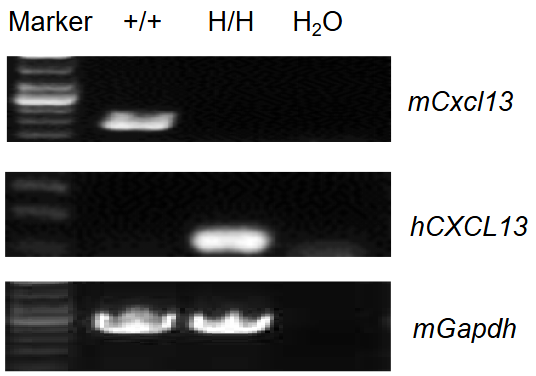
- Mouse Cxcl13 mRNA were detected in spleen of wild-type C57BL/6 mice.
- Human CXCL13 mRNA were detected in spleen of homozygous CXCL13 humanized mice, but not in wild-type C57BL/6 mice.
Species specific analysis of CXCL13 gene expression in wild-type C57BL/6 mice and homozygous CXCL13 humanized mice by RT-PCR. Spleen RNA was isolated from wild-type C57BL/6 mice (+/+) and homozygous B-hCXCL13 mice (H/H), and then cDNA libraries were synthesized by reverse transcription, followed by PCR with mouse Cxcl13 primers and human CXCL13 primers.
Human CXCL13 Protein Expression Analysis in Serum of CXCL13 Humanized Mice
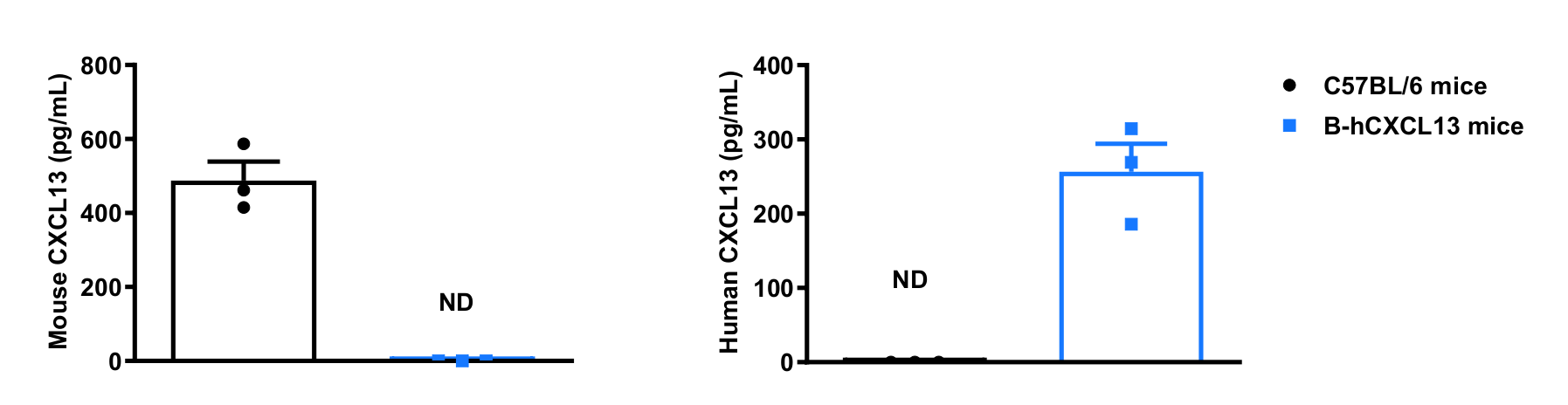
- Mouse CXCL13 was detected in wild-type C57BL/6 mice.
- Human CXCL13 was detected in homozygous CXCL13 humanized mice, but not in wild-type C57BL/6 mice.
Strain specific CXCL13 expression analysis in wild-type C57BL/6 mice and homozygous CXCL13 humanized mice by ELISA. Serum was collected from wild-type C57BL/6 mice and homozygous B-hCXCL13 mice (female, 6-8-week-old, n = 3). Expression level of mouse and human CXCL13 were analyzed by ELISA (anti-mouse CXCL13: R&D, MCX130; anti-human CXCL13: R&D, DCX130). Values are expressed as mean ± SEM. ND: not detectable.
* When publishing results obtained using this animal model, please acknowledge the source as follows: The animal model [B-hCXCL13 mice] (Cat# 111136) was purchased from Biocytogen.