
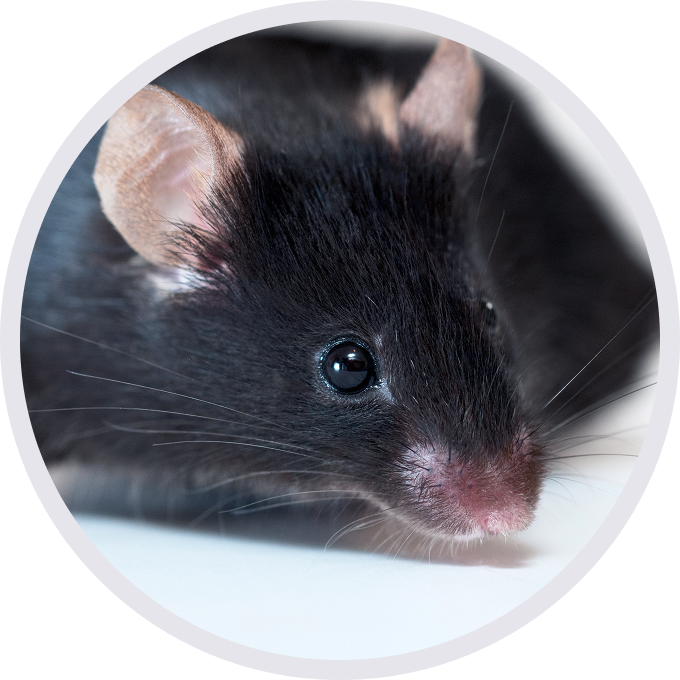

B-hIL31/hIL31RA/hOSMR/hOX40/hOX40L mice
C57BL/6-Il31tm1(IL31)Bcgen Il31ratm1(IL31RA)Bcgen Osmrtm1(OSMR)BcgenTnfrsf4tm1(TNFRSF4)Bcgen Tnfsf4tm1(TNFSF4)Bcgen/Bcgen • 113671

B-hIL31/hIL31RA/hOSMR/hOX40/hOX40L mice

Catalog Number
113671
Strain Name
C57BL/6-Il31tm1(IL31)Bcgen Il31ratm1(IL31RA)Bcgen Osmrtm1(OSMR)BcgenTnfrsf4tm1(TNFRSF4)Bcgen Tnfsf4tm1(TNFSF4)Bcgen/Bcgen
Strain Background
C57BL/6
NCBI gene ID
Aliases
IL-31; CRL, CRL3, GLM-R, GLMR, GPL, IL-31RA, PLCA2, PRO21384, hGLM-R, zcytoR17; IL-31R-beta, IL-31RB, OSMRB, OSMRbeta, PLCA1; ACT35, CD134, IMD16, OX40, TXGP1L; CD134L, CD252, GP34, OX-40L, OX4OL, TNLG2B, TXGP1

このページで

  • Description
  • Targeting strategy
  • Phenotypic analysis

ポスター

すべて表示

    出版物

      Description

      IL31: A key cytokine in inflammation and its therapeutic intervention

      •  Gene Information: Interleukin 31 (IL31) is a protein-coding gene located on chromosome 12q24.31. IL-31 belongs to the family of IL-6-derived cytokines. IL31 encodes a cytokine that is primarily secreted by activated T cells and functions in pro-inflammatory signaling through the IL31RA/OSMR receptor complex.
      •  Protein Expression: IL31 is a pro-inflammatory cytokine linked to various disorders, such as AD, asthma, and inflammatory bowel disease. Produced chiefly by TH2 cells and immature dendritic cells (iDCs). 
      • Signaling Pathway: IL31 binds to the IL31RA/OSMR receptor complex on keratinocytes and dorsal root ganglia (DRG) neurons. Through this pathway, IL-31 acts as a pivotal mediator linking immune cells to both the epithelium and the neuronal network. 
      • Therapeutic Inhibition: IL-31 is a neuroimmune cytokine that induces itch, inflammation, keratinocyte differentiation and fibroblast activation in chronic pruritic skin diseases. Nemolizumab (Mitchga Syringes) was approved in Japan on 28 March 2022 for use in adults and children over the age of 13 years for the treatment of itch associated with AD (only when existing treatment is insufficiently effective).

      OX40L: Enhances effector T cell function, sustains their survival and suppresses apoptosis

      • Gene Information: Tumor Necrosis Factor Ligand Superfamily Member 4 (TNFSF4, also known as OX40L) is a protein-coding gene located on chromosome 1q25.1. OX40L is a 35 kD member of the TNF superfamily and is also known as OX40 ligand, CD252, and CD134L. 
      • Protein Expression: OX40L functions as a type II transmembrane glycoprotein. Beyond abundant expression in activated B cells and antigen presenting cells, OX40L can be detected in the heart, bone and lung, while activated T cells express this molecule at a low level. 
      • Signaling Pathway: The OX40L–OX40 signaling axis drives persistent activation and proliferation of effector T cells and effector memory T cells, while remaining quiescent in naive T cells and resting memory T cells. Engagement of OX40 with its ligand OX40L promotes the differentiation of both Th1 and Th2 effector cells. 
      • Therapeutic Inhibition: Recent therapeutic success in clinical trials highlights the importance of the OX40L–OX40 axis as a promising target for the treatment of atopic dermatitis.
      Targeting strategy

      IL31

      •  The mouse Il31 gene that encode the full length protein was replaced by human IL31 counterpart gene sequences in B hIL31/hIL31RA/hOSMR/hOX40/hOX40L mice.

      IL31RA

      • The coding sequences including human IL31RA extracellularregion and mouse Il31ra intracellularregion were inserted into mouse IL31RA gene in B hIL31/hIL31RA/hOSMR/hOX40/hOX40L mice.

      OSMR

      •  The coding sequences including human IL31RA extracellularregion and mouse Il31ra intracellularregion were inserted into mouse IL31RA gene in B hIL31/hIL31RA/hOSMR/hOX40/hOX40L mice.

      OX40

      •  The exons 1-5 of mouse OX40  gene that encode the extracellular domain were replaced by human OX40 exons 1- 5 in B hIL31/hIL31RA/hOSMR/hOX40/hOX40L mice.
      •  The endogenous mouse promoter, 5′ UTR, and 3′ UTR regions are retained, allowing human OX40 expression to be driven by the native mouse Ox40 promoter, while endogenous mouse Ox40 transcription and translation are abolished.

      OX40L

      •  The exons 2-3 of mouse Ox40l gene that encode the extracellularregion were replaced by human OX40L exons 2 3 in B hIL31/hIL31RA/hOSMR/hOX40/hOX40L mice.
      •  The endogenous mouse promoter, 5′ UTR, and 3′ UTR regions are retained, allowing human OX40L expression to be driven by the native mouse Ox40l promoter, while endogenous mouse Ox40l transcription and translation are abolished.

      The mice was obtained by B hIL31/hIL31RA/hOSMR mice cross breeding with B hOX40/hOX40L mice.

      Human IL31,IL31RA,OSMR,OX40 and OX40L mRNA Expression by RT-PCR

      Strain specific analysis of IL31, IL31RA, OSMR, OX40 and OX40L mRNA expression in wild-type C57BL/6JNifdc mice and homozygous B-hIL31/hIL31RA/hOSMR/hOX40/hOX40L mice by RT-PCR. Testis, kidney and spleen RNA were isolated from wild-type C57BL/6JNifdc mice(+/+) and homozygous B-hIL31/hIL31RA/hOSMR/hOX40/hOX40L mice(H/H;H/H;H/H;H/H;H/H), then cDNA libraries were synthesized by reverse transcription, followed by PCR with mouse or human IL31, IL31RA, OSMR, OX40 and OX40L primers. Mouse Il31, Il31ra, Osmr, Ox40 and Ox40l mRNA were only detectable in wild-type C57BL/6JNifdc mice. Human IL31, IL31RA, OSMR, OX40 and OX40L mRNA were exclusively detectable in homozygous B-hIL31/hIL31RA/hOSMR/hOX40/hOX40L mice but not in wild-type C57BL/6JNifdc  mice.

      OX40 Protein Expression in Spleen

      Strain specific OX40 expression analysis in homozygous B-hIL31/hIL31RA/hOSMR/hOX40/hOX40L mice by flow cytometry. Splenocytes were collected from wild-type C57BL/6JNifdc(+/+) and homozygous B-hIL31/hIL31RA/hOSMR/hOX40/hOX40L mice(H/H;H/H;H/H;H/H;H/H) stimulated with anti-CD3ε in vivo, and protein expression was analyzed with anti-mouse OX40 antibody (Biolegend, 119414) and anti-human OX40 antibody (Biolegend, 350004) by flow cytometry. mOX40 was only detectable in T cells of wild-type C57BL/6JNifdc mice. hOX40 was only detectable in T cells of homozygous B-hIL31/hIL31RA/hOSMR/hOX40/hOX40L mice, but not in wild-type C57BL/6JNifdc mice.

      OX40L Protein Expression in BMDC

      Strain specific OX40L expression analysis in homozygous B-hIL31/hIL31RA/hOSMR/hOX40/hOX40L mice by flow cytometry. Bone marrow cells were collected from wild-type C57BL/6JNifdc(+/+) and homozygous B-hIL31/hIL31RA/hOSMR/hOX40/hOX40L mice(H/H;H/H;H/H;H/H;H/H). BMDCs were induced from bone marrow cells and stimulated with LPS. Then BMDCs were analyzed with anti-mouse OX40L antibody (Biolegend, 108814) and anti-human OX40L antibody (BD Horizon™, 563766) by flow cytometry. mOX40L was only detectable in BMDCs of wild-type C57BL/6JNifdc mice. hOX40L was only detectable in BMDCs of homozygous B-hIL31/hIL31RA/hOSMR/hOX40/hOX40L mice, but not in wild-type C57BL/6JNifdc mice.

      OSMR Protein Expression in Brain, Lung, Kidney, Liver, Bladder, and Ovary

      Strain specific OSMR expression analysis in homozygous humanized B-hIL31/hIL31RA/hOSMR/hOX40/hOX40L mice by western blot. Brain, lung, kidney, liver, bladder, and ovary were collected from wild-type C57BL/6JNifdc(+/+) and homozygous B-hIL31/hIL31RA/hOSMR/hOX40/hOX40L mice(H/H;H/H;H/H;H/H;H/H) and analyzed by western blot with anti-OSMR antibody(Proteintech, 10982-1-AP). m/hOSMR was detectable in brain, lung, kidney, liver, bladder, and ovary of wild-type C57BL/6JNifdc mice and homozygous B-hIL31/hIL31RA/hOSMR/hOX40/hOX40L mice.
      Functional Validation

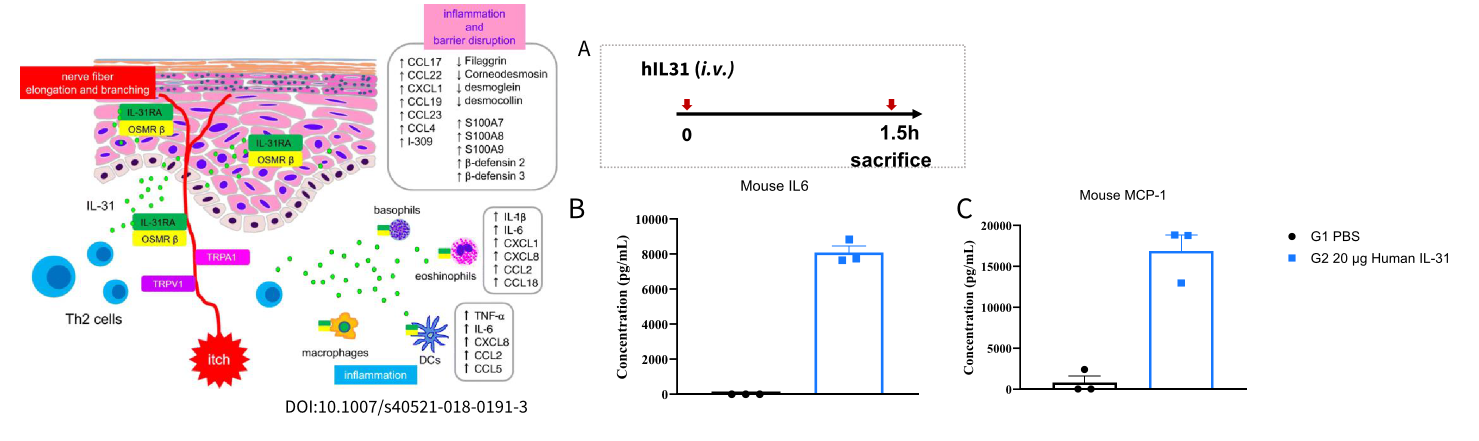
      Function analysis of hIL31 signaling pathway in homozygous B-hIL31/hIL31RA/hOSMR/hOX40/hOX40L mice. Mice in G2 were treated with human IL31 protein (hIL31) (in house). (A) Functional experiment scheme diagram. (B) Mouse IL-6 levels in serum. (C) Mouse CCL2 levels in serum. After 1.5 hours of intravenous injection of hIL31, the serum was collected and the levels of IL6 and CCL2 in the serum were measured by ELISA (n = 3). Mouse IL-6 and CCL2 levels in serum were increased after hIL31 stimulation, demonstrating that the IL-31 signaling pathway in B-hIL31/hIL31RA/hOSMR/hOX40/hOX40L mice is intact.

      * When publishing results obtained using this animal model, please acknowledge the source as follows: The animal model [B-hIL31/hIL31RA/hOSMR/hOX40/hOX40L mice] (Cat# 113671) was purchased from Biocytogen.